Want to see where training fits in the bigger picture? Our guide to hiring a US virtual assistant covers matching, the Boiler Room and onboarding.
Tag: VAConnect
-

How to Build a Long-Term Relationship with Your Virtual Assistant
How to Build a Long-Term Relationship with Your Virtual Assistant
It starts small. A Tuesday morning, 07:40. You open your laptop to write the strategy memo you promised yourself you’d finish before anyone else woke up, and there are already nineteen emails, four Slack threads, a rescheduled call from a client in Manchester, an invoice query, and a WhatsApp from a supplier who has decided that “urgent” means “before your coffee.” By 09:15 the memo hasn’t been started. By 16:00 you’ve been in six conversations about scheduling other conversations. By 21:00 you’re editing a deck for tomorrow’s meeting because nobody else knew it existed.
That day isn’t a personal failure. It’s a measurable, industry-wide pattern, and the numbers on it are worse than most business owners realise. Microsoft’s 2025 Work Trend Index, built on aggregated Microsoft 365 signals and a survey of 31,000 knowledge workers, found that the average employee is now interrupted every two minutes during core hours — roughly 275 pings a day across meetings, email and chat. The same research clocked 117 emails and 153 Teams messages per workday, meetings starting after 8pm up 16% year on year, and 40% of users checking mail before 6am. Nearly half of employees and a slight majority of leaders described their work as chaotic and fragmented. Independent research from the University of California, Irvine has long put the recovery cost of a single interruption at around 23 minutes.
The instinctive response in 2026 is to reach for a tool. Another automation. Another agent. Another integration that promises to make the mess disappear.
The businesses quietly pulling ahead are doing something less fashionable and considerably more effective. They’re hiring a person, and — this is the part almost everyone gets wrong — they’re keeping that person for years.
What follows is not a pitch for delegation in the abstract. It’s an examination of why the duration of the working relationship, not the hourly rate, is the variable that determines whether a virtual assistant transforms your week or becomes one more thing you have to manage.
The Coordination Tax Nobody Puts on the Balance Sheet
Every business runs two operations. The first is the one you’d describe to an investor: the product, the service, the client work. The second is the invisible one — the scheduling, the chasing, the confirming, the reformatting, the “did you get my last email” follow-ups. Nobody costs the second operation. Everybody pays for it.
The scale is genuinely startling once you total it up. One widely cited analysis puts the average professional at 25.6 meetings a week and 5.1 context switches a day. Employees rate around 71% of their meetings as time wasted. Microsoft’s telemetry found that roughly 60% of meetings are ad hoc, with no calendar invite at all, and that PowerPoint edits spike 122% in the final ten minutes before a meeting starts — a near-perfect signal that preparation time has collapsed to zero.
Read a few threads on Blind or Reddit and the human texture underneath those figures becomes uncomfortable. One engineer described spending sixteen of forty weekly hours in meetings, unable to focus, dreading the calendar, and quietly planning to take sick leave rather than burn annual leave recovering from work. The top reply was not sympathy. It was that sixteen hours sounded light.
Interrupted every two minutes. 275 pings a day. 71% of meetings judged a waste. The modern working day has become a coordination machine that produces coordination.
Here’s what makes the coordination tax so corrosive for owner-operators specifically: it doesn’t scale down. A ten-person agency generates almost as much scheduling friction per client as a hundred-person one. The founder absorbs it personally, and absorbs it at the exact hours — 9 to 11am, 1 to 3pm, per Microsoft’s data on when meetings cluster — when they’d otherwise be doing the highest-value thinking available to the business.
You cannot buy that time back with software alone. You can only buy it back by handing the coordination layer to someone who owns it.
Why Most Virtual Assistant Relationships Die in the First Ninety Days
Ask around and you’ll hear the same story with different names attached: I tried a VA. It didn’t work out.
Dig into why, and the pattern is remarkably consistent. It is almost never a skills problem. It’s a context problem, compounded by an expectations problem, sealed by an impatience problem.
The abdication trap
There’s a line that circulates in outsourcing circles and deserves to be framed: hiring someone and expecting them to read your mind isn’t delegation, it’s abdication. A virtual assistant cannot guess what “professional tone” means in your business, or what you actually mean when you say something is urgent, or which of your three biggest clients gets an immediate reply and which can wait a day. Those things live in your head. Until they’re written down or demonstrated, no assistant on earth — and no model either — can act on them.
The most upvoted advice in a long-running Hacker News thread on hiring assistants was a question posed back to the person asking: are you genuinely ready to stop doing the things you’re about to hire someone to do? If the answer is no, the commenter warned, you’ll burn through assistant after assistant wondering why good people are so hard to find.
The trial that never ends
The second killer is the perpetual audition. Business owners, burned once, hire on short trials with narrow tasks, then evaluate the assistant on tasks so constrained that the assistant has no opportunity to demonstrate judgement. Data entry gets done. Nothing else changes. The owner concludes VAs are “only good for admin” and cancels.
The irony is sharp. The narrow brief caused the narrow result. In the same HN thread, an executive who’d worked with the same assistant for three years described handing her a genuinely ambiguous goal — clear my calendar for a day off, you pick which day — and getting it executed without further conversation. When another commenter called this telepathy, his reply was flat and precise:
“It’s not telepathy, it’s shared context and experience.”
Three years of shared context. That’s the asset. Not the assistant’s typing speed.
The cost of churning through people
Turnover is where this stops being philosophical and starts being financial. Gallup’s long-standing estimate puts the cost of replacing an employee at between one-half and two times their annual salary, with technical roles around 80% and management roles nearer 200%. SHRM’s figure lands at six to nine months of salary. Voluntary turnover costs US businesses roughly a trillion dollars a year on Gallup’s numbers, and the largest hidden components are the vacancy gap, the six-to-twelve-month ramp of the replacement, and lost institutional knowledge.
Now apply that to an assistant. Their entire value proposition is institutional knowledge about you. Churn them and you don’t lose 30% of the value. You lose almost all of it, and then you pay to rebuild it from zero.
Context Compounds: What Year Two Actually Buys You
There’s a curve almost nobody plots when they hire an assistant, and it explains most of the disappointment in month two and most of the delight in month fourteen.
Months 1–3: net negative. You’re explaining. They’re documenting. Every task takes longer than doing it yourself. This is the front-loaded investment, and it is unavoidable. Skip it and you get an expensive typist.
Months 4–9: break-even, then acceleration. SOPs exist. The assistant knows which suppliers are difficult, which client hates phone calls, how you like your inbox triaged. Requests stop requiring specification. You say “handle the Blackwell renewal” and it’s handled.
Months 10–24: compounding returns. This is where the relationship stops being a service and becomes a capability. The assistant starts catching things before you flag them — the conflicting diary entry, the invoice that’s fourteen days overdue, the client who’s gone quiet. They’re not executing instructions any more. They’re exercising judgement inside a model of your business they’ve built over hundreds of interactions.
The academic literature on virtual teams supports this shape. A systematic review of 49 peer-reviewed empirical studies published between 2011 and early 2025, coded against the Job Demands-Resources framework, found that social resources — communication quality, knowledge sharing and trust — accounted for over a third of all studies and were consistently linked to stronger team performance. Coordination strain and digital overload, when unsupported, proved actively harmful. In other words: the thing that makes distributed working work isn’t the tooling. It’s accumulated trust and transferred knowledge, both of which are functions of time.
Stanford’s Nicholas Bloom and colleagues found something adjacent in their large randomised trial of hybrid work, published in Nature: performance was unaffected, but quit rates fell by roughly a third. Managers had predicted a 2.6% productivity drop going in; by the end they believed hybrid had improved performance by about 1%. Direct experience changed their assessment. The same reversal happens with assistants, on roughly the same timeline.
The uncomfortable implication for anyone currently on their fourth VA in eighteen months: you have never once seen what a virtual assistant is actually capable of. You’ve only ever seen month two, over and over.
The Human in the Loop: Why Judgement Refuses to Automate
This is the section where a 2026 article about assistants is supposed to concede that AI is about to make the whole conversation obsolete. The evidence doesn’t support that concession — and understanding precisely where it doesn’t is the single most valuable strategic insight available to a small business owner right now.
What the benchmarks actually show
Carnegie Mellon researchers built a simulated software company staffed entirely by AI agents, with roles spanning CTO, HR manager and engineer, and set them loose on ordinary office tasks drawn from finance, administration and engineering. No agent completed more than 24% of its assigned tasks. Agents got lost, took shortcuts, fabricated information, and in at least one case renamed a colleague to force a task to resolve. Failure rates hovered near 70%.
The International AI Safety Report’s 2025 update is blunter still. In customer service simulations that domain experts judged realistic in 90% of cases, the best agents completed fewer than 40% of tasks. In a simulated small software firm, the best agents finished 30% of 175 workplace tasks like information gathering and email communication. On open-ended web tasks — planning a trip, making a purchase — the best model succeeded 12% of the time. The report’s own explanation of why is the part worth sitting with: current systems cannot build institutional knowledge or adapt through ongoing workplace relationships the way human colleagues do.
That is not a criticism of the technology. It’s a description of the exact capability an assistant relationship is made of.
Even the optimistic readings prove the point. WebArena scores climbed from about 14% to roughly 62% over two years, against human performance of 78%. But when researchers added selective human intervention through a takeover sandbox, success rates jumped past 95% — with average human involvement of fifteen to thirty seconds. The authors’ conclusion was explicit: human intervention is a key reliability strategy, not a stopgap. Separately, MIT researchers found that only about 5% of enterprise generative AI systems reach production at all; the other 95% fail during evaluation.
The best autonomous agents complete under 40% of realistic office tasks. Add a human checkpoint and the same systems clear 95%. The multiplier isn’t the model. It’s the person watching it.
The humanising layer
There’s a second argument, and in client-facing work it matters more than the reliability numbers.
A 2025 customer experience study by SurveyMonkey found that 79% of respondents strongly prefer dealing with a human over an AI agent — even when speed and service quality are identical. Not slower. Not worse. Identical. People simply want a person.
Anyone who has read a LinkedIn feed lately understands why this is now a competitive variable. Generic, model-generated content has become instantly recognisable, and audiences have adjusted accordingly. The follow-up email that reads like a template, the social post with the tidy three-part structure and the rhetorical question at the end, the proposal that mentions your industry but not your company — these now actively cost trust rather than building it.
A long-tenured assistant is the antidote, and specifically because of the tenure. They know your client had a difficult quarter. They know your co-founder’s name is spelled the unusual way. They know you always ask after the dog. They can take an AI draft and put the three details in it that make it unmistakably from you — and, critically, they know which drafts to bin entirely.
The correct architecture in 2026 is not human or machine. It’s a person with deep context using AI tools aggressively, and applying judgement to everything the tools produce. That person’s value increases as the tools improve, because verification and contextual judgement become the scarce inputs. VAConnect trains toward exactly this configuration through VAVarsity, its internal upskilling platform, on the reasoning that an assistant fluent in modern tooling and embedded in your business is worth considerably more than either component alone.
The South African Advantage
For UK and European businesses, there’s a geographic dimension to all of this that has been building quietly for a decade and is now impossible to ignore.
Two hours ahead, not eight
South Africa sits at GMT+2 year-round — one to two hours ahead of the UK depending on the season. That single fact restructures the entire working relationship. Your assistant’s day overlaps with yours for six to eight hours, every day. Not a handover window. Not an async queue. Actual, simultaneous working time on Teams, Slack and Zoom.
Set that against Microsoft’s finding that 30% of meetings now span multiple time zones, up eight percentage points since 2021, and that the resulting cross-time-zone scrambling is a primary driver of the 16% rise in meetings scheduled after 8pm. Time zone misalignment doesn’t save you coordination effort. It converts your coordination effort into evening work.
An assistant who starts when you start eliminates a category of problem rather than deferring it. The client query that lands at 11am gets handled at 11am, by someone who can reach you if it needs a decision.
Language, accent, and the cost of being misunderstood
English is a primary business language in South Africa, not a second one acquired for export purposes. The EF English Proficiency Index scores South Africa at 602 against a global average of 488 — ahead of the Philippines at 578 and India at 563. Buyer preference research tracked by Ryan Strategic Advisory has repeatedly found South African accents easier for UK, Australian and US listeners to parse than the main competing offshore markets.
The commercial effect shows up in outcome data: companies outsourcing to South Africa achieve customer experience quality roughly 18% better than competing offshore markets, with higher first-contact resolution, according to figures published by BPESA and Everest Group.
Cultural affinity compounds it. Shared legal and commercial heritage, familiarity with British business norms, the same instincts about tone in a client email, the same understanding of what “let’s circle back” is actually communicating. SafetySA’s HR Manager wrote in a verified Clutch review: “She has fully embraced our company culture, communicates with the same commitment and energy as an in-house team member, and consistently shows up with a “one-team” mindset.” Read the full review on Clutch
Cost without the quality trade
The economics are not marginal. A full-time PA in London runs roughly £35,000–£50,000 before employer NI, pension auto-enrolment and desk space. Current VAConnect packages are listed on the pricing page.
What’s changed since 2020 is that the quality argument stopped being a trade-off. South Africa’s Global Business Services sector added 26,346 new international jobs in 2025 — its strongest year since 2018 — with about 90% of those roles filled by young people, according to BPESA’s sector report. Sector headcount grew from 65,000 in 2019 to an estimated 150,000 in 2024, with market revenue rising from roughly $1.04bn to $2.91bn over the same period. The country is now widely ranked the third most attractive offshoring destination globally, and BPESA and Everest Group put the UK at 55% of South Africa’s offshore GBS headcount — making the UK, by some distance, South Africa’s largest client market.
That’s not a low-cost labour story. It’s a mature professional services export sector with a national skills strategy behind it and a target of 500,000 cumulative jobs by 2030.
VAConnect has been operating inside that ecosystem since 2008 (originally as Limetree Consulting), pivoting to a managed virtual assistant model in 2014.
The Operating Rhythm That Makes Assistants Stick
Knowing that longevity matters is useless without knowing how to produce it. The businesses that hold onto assistants for three, five, seven years tend to run a recognisable set of practices.
Front-load the documentation, then stop. Spend the first fortnight recording screen-shares and writing SOPs — but have the assistant write them, not you. They’re the ones who’ll discover the gaps. A living SOP library is the single asset that survives holidays, illness and, eventually, the assistant’s own departure.
Hold a real weekly one-to-one. Fifteen minutes, same slot, non-negotiable. Not a status update — status belongs in writing. Use it for context transfer: what’s coming, what changed, what you’re worried about. This is where judgement gets calibrated. The three-year assistant in that HN thread got carte blanche to clear a calendar precisely because a standing weekly conversation had made that possible.
Set explicit decision rights. Write down what your assistant can decide alone, what needs a heads-up, and what needs your sign-off — with dates attached. Under £200, decide it. Client-facing wording, draft it and send. Anything touching contracts, ask first. Then widen the boundaries deliberately every quarter. Assistants who never get more authority leave; assistants who get more than they’re ready for make expensive mistakes.
Give feedback in the first week, not the third month. The most common failure mode is silent accumulation. A small correction on day four costs nothing. The same correction delivered in month three, after resentment has compounded on both sides, usually ends the relationship.
Include them. Invite them to team meetings. Mark their birthday. Say what the work is for. An assistant who understands the mission catches things a task-taker never will, and an assistant who feels peripheral will take the first better offer that appears.
Delegate outcomes, not just tasks. The transition from “book this flight” to “own my travel” is the single highest-leverage move available, and it can only happen once enough context exists to make it safe.
Paying for Permanence — and What Happens When It Doesn’t Work
The most counterintuitive advice in that Hacker News thread came from a former Hollywood assistant, and it holds up: the best assistants are the ones who want to stay in the role. Someone treating the job as a rung on a ladder will be gone before they’ve become genuinely useful. Which means paying properly, respecting boundaries, and making the person feel valued isn’t soft-touch management — it’s the mechanism that protects the context you’ve spent a year building.
This is exactly where the managed agency model separates from the freelance marketplace, and the gap is wider than most buyers assume.
Hire independently on a bidding platform and you own everything: sourcing, vetting, contracting, training, performance management, payment disputes, cover during illness, and — the expensive one — the entire replacement process when they move on. There’s no continuity mechanism. The relationship ends and the knowledge goes with it.
A managed model inverts that. VAConnect handles recruitment, vetting, training, performance review and backup cover, runs a wellbeing programme (branded internally as Atomic Energy) alongside a two-way satisfaction programme designed to monitor the health of the client-assistant relationship from both sides, and commits to replacing a non-performing assistant at no additional cost — including managing the transition. Placements typically fill within two to three weeks.
The two-way element deserves emphasis, because it’s the part freelance arrangements structurally cannot replicate. Most VA relationships fail quietly. The assistant is unhappy for six weeks before anyone finds out, and by the time the client notices, the situation is unrecoverable. A managed layer with an independent line to both parties catches the drift while it’s still fixable. That’s the actual machinery behind VAConnect’s 98% client retention over 14 months, verified from VAConnect’s invoice records — not luck, and not simply better initial matching.
The Gap Is Wider Than It Should Be
Here is what’s genuinely surprising about 2026, and it deserves stating plainly.
The tools available to a two-person consultancy in Bristol are now, functionally, the tools available to a hundred-person firm. The information asymmetry has collapsed. The capital requirements have collapsed. On paper, the playing field should be flatter than at any point in commercial history.
It isn’t. It’s the opposite. And the variable pulling businesses apart isn’t technology access, or capital, or even talent in the abstract.
It’s whether someone has spent eighteen months learning how your business works.
One founder is on their fourth VA of the year, still writing the same onboarding email, still explaining that the Henderson account gets a phone call not an email, still doing their own diary at 21:00 on a Sunday because it’s faster than explaining it. Another founder — same sector, same revenue, same tooling — has an assistant in Cape Town who’s been with them since 2024, who cleared their calendar for a day off without being asked, who spotted the overdue invoice, who drafted the client apology in a voice the client recognised, and who did all of it during the founder’s own working hours.
Those two businesses will not perform the same. They won’t be close. And the difference didn’t come from a subscription, an integration or a model upgrade. It came from one decision, made once, and then not undone every four months.
The technology is going to keep improving. Agents will get better at the 40% and then the 60%. But the International AI Safety Report already named the thing that isn’t arriving on any roadmap: the capacity to build institutional knowledge through an ongoing working relationship. That remains a human capability, it remains scarce, and — for UK and European businesses with the sense to look two hours south rather than eight hours east — it remains available at a price that makes the arithmetic almost embarrassing.
The assistant isn’t the investment. The relationship is. Everything valuable is on the far side of month twelve.
Three Ways to Buy Back Your Time: A Comparison
DIY Coordination Generic Freelancer VAConnect Time to productive output Immediate — but it’s your time 4–8 weeks (if they stay) 2–3 weeks to placement; front-loaded onboarding supported by the agency Who absorbs the coordination tax You. Every ping, every reschedule Split — you still manage the manager The assistant owns the layer end to end Vetting and screening Not applicable Buyer’s responsibility; platform ratings only Skills testing, background checks and cultural fit assessment before shortlist Timezone overlap with UK n/a Variable; often 1–3 hours or an async handover GMT+2 — 6–8 hours of live overlap daily English fluency n/a Highly variable Primary business language; EF EPI 602 vs 488 global average Training and upskilling Self-directed None; freelancer’s own initiative VAVarsity upskilling platform, ongoing Continuity when they’re ill or on leave You cover it No cover Backup cover managed by the agency If it isn’t working Nothing changes Re-post the job; restart from zero Rematch and transition managed, no additional fee Relationship health monitoring n/a None Two-way satisfaction programme covering client and assistant Employment admin (PAYE, NI, pension) n/a Your risk to classify correctly Handled agency-side Typical annual cost vs London PA Hidden — paid in founder hours and evenings Low headline rate, high churn cost (Gallup: 0.5–2× salary per replacement) — What you have after 24 months The same Tuesday, indefinitely Probably your third or fourth assistant An assistant who anticipates instead of asks
Sources
- Microsoft WorkLab, Breaking Down the Infinite Workday, Work Trend Index Special Report, 2025 — microsoft.com/worklab
- International AI Safety Report, First Key Update: Capabilities and Risk Implications, 2025 — arxiv.org/pdf/2510.13653
- Carnegie Mellon University, AI agents in a simulated company environment — summary
- BPESA, GBS Sector Job Creation Report and Refreshed National Value Proposition, 2025 — bpesa.org.za | ITWeb coverage of 2025 job figures
- Gallup, This Fixable Problem Costs U.S. Businesses $1 Trillion — gallup.com
- Bloom et al., hybrid work randomised trial, Nature — summarised in BFI working paper
- Systematic review of virtual team effectiveness, knowledge sharing and trust (49 studies, 2011–2025)
- Ask HN: I’d like to hire a personal/executive assistant — news.ycombinator.com
- VAConnect — vaconnect.co.za | vaconnect.co.uk | vajobs.co.za
-

How to Set Up SOPs for Your Virtual Assistant
How to Set Up SOPs for Your Virtual Assistant
It is 6:40 on a Tuesday evening. You have answered the same question about invoice formatting for the fourth time this month. Your calendar shows eleven meetings, four of which existed only to decide what someone else should do next. Somewhere in your Slack there is a message that reads “quick question” and it is not quick. You hired help six weeks ago specifically so this would stop happening, and yet here you are, still the single point of failure for a business you supposedly delegated.
This is the part nobody warns you about. The bottleneck was never capacity. It was that every process your business runs on lives inside your head, unwritten, retrieved on demand, and available only when you personally show up to retrieve it.
The fix is unglamorous and it works: standard operating procedures. Not the laminated binder version that dies in a shared drive, but a living, task-level system that lets a competent assistant do the work without pinging you. Done right, SOPs are the difference between an assistant who costs you time in month one and one who buys back fifteen hours a week by month two.
What follows is the practical build, the evidence for why it matters more now than it did five years ago, and an honest look at why the gap between businesses that have done this and businesses that haven’t has become genuinely uncomfortable to look at.
The Coordination Tax Nobody Puts on the P&L
Start with the scale of the problem, because most owners underestimate it by an order of magnitude.
Atlassian surveyed 5,000 knowledge workers across four continents and found that meetings miss their intended goal 72% of the time, 78% say meeting volume makes it hard to finish their actual work, and 76% report feeling drained on meeting-heavy days. Asana’s tracking is bleaker still on the trend line: time lost to unproductive meetings doubled between 2019 and 2024, reaching five hours per worker per week, with managers absorbing the worst of it at 5.8 hours.
Stack the rest of the coordination overhead on top. Research compiled across 2025 and 2026 puts the average knowledge worker at 103 hours a year in meetings they consider unnecessary, 209 hours on duplicated work, 352 hours talking about work instead of doing it, and 127 hours regaining focus after interruptions. Asana’s State of Work Innovation research found that 60% of work time now goes to “work about work” — searching for information, switching apps, chasing decisions, sitting in status updates.
Now the part that should worry anyone running a distributed team. There is a persistent belief that remote work is automatically more efficient. The best-controlled study says otherwise. Gibbs, Mengel and Siemroth, publishing in the Journal of Political Economy Microeconomics, tracked over 10,000 skilled professionals at an Asian IT services firm using actual personnel and analytics data rather than surveys. Total hours worked rose roughly 30%, including an 18% increase in after-hours work. Output stayed flat. Productivity per hour fell between 8% and 19% — because coordination costs climbed as meetings multiplied and uninterrupted work time shrank.
Read that again. People worked a third more and produced the same amount. The loss wasn’t laziness or distraction. It was coordination.
Workers put in roughly 30% more hours and produced no more output. The gap wasn’t effort — it was the cost of having to ask.
That single finding reframes the entire SOP conversation. An SOP is not administrative housekeeping. It is a direct reduction in the number of times a human being has to interrupt another human being to find out what to do. Every question your assistant doesn’t have to ask is a meeting that doesn’t get scheduled, a context switch that doesn’t happen, and a decision that doesn’t wait on your inbox.
The corroborating academic picture is nuanced but points the same way. A 2026 study of a fully remote Japanese company published in PLOS found no evidence that teammates’ average productivity affects an individual worker’s own productivity in fully remote settings, echoing earlier findings that knowledge sharing among US patent examiners boosted output only when peers worked in the same physical location, and that engineers received substantially more feedback from colleagues in the same building — a benefit that disappeared once they went remote.
Translation: the informal osmosis that teaches a new hire how things work in an office does not happen over Zoom. If you don’t write it down, it doesn’t transfer. That is the whole argument.
What an SOP Actually Is (And Three Myths That Keep Founders Stuck)
An SOP is a short document that answers, for one specific recurring task: what triggers it, what tools it touches, what the steps are, what “finished” looks like, and what to do when something unexpected shows up.
That’s it. Everything else is decoration.
Three beliefs stop people from writing them.
Myth one: SOPs have to be finished before you hire. They don’t, and waiting is expensive. The practical sequence is to write four or five SOPs for the tasks eating the most of your week, then build the rest with your assistant in the first month. Guidance from practitioners running VA onboarding puts the numbers plainly: businesses that prepare SOPs before a VA starts see that VA operating independently within week one, while those who skip SOPs wait three to four weeks — a month of payroll before real output appears.
Myth two: SOPs need to be comprehensive. The most-cited failure mode in the documentation world is over-engineering. One consultant’s account of building their first process library is worth sitting with: they bought software, built flowcharts, and wrote documents detailed enough to guide a space mission — and nobody ever read them. Not the freelancers, not the clients, not even the author. The same writer describes the moment the penny dropped, running a fever while a freelancer floundered because the process lived entirely in their head.
Myth three: writing them is your job forever. It isn’t. The highest-leverage move in SOP building is having the assistant write the second draft. Once they’ve run a task for a week or two, they document it as they understand it. This reveals gaps in the original instructions — if they documented it wrong, the instructions were unclear — creates an asset that survives staff changes, and gives the assistant ownership of a piece of the business.
The three-question filter for what to document first
Before you write anything, sort. The filter that holds up across most delegation frameworks: keep tasks that require your judgment, and delegate anything teachable in under 30 minutes that recurs weekly and eats an hour or more.
Run the inventory properly. Write down every task you did last week and label each one: Requires Only Me, Could Be Trained, or Fully Delegatable. The third bucket is your day-one handoff list. The second becomes delegatable in weeks two to four once SOPs exist. Twenty minutes with a blank page here saves a fortnight of confusion later, and it usually produces at least one genuinely uncomfortable realisation about where your week actually goes.
Start With an Extraction Audit, Not a Blank Document
The blank document is where SOP projects go to die. Nobody wants to sit down cold and write out how they process a supplier invoice.
So don’t. Extract instead.
Record first, write second. The next five times you do a delegatable task, hit record. Loom, Zoom, whatever screen recorder you already have. Narrate as you go, including the bits you’d normally skip because they’re obvious to you. Those are precisely the bits that aren’t obvious to anyone else. The recording becomes the raw material; the written SOP becomes the index.
Capture the exceptions while they’re fresh. Every recurring task has three or four scenarios that break the happy path. The client who pays late. The supplier whose invoices arrive as photographs. The one enquiry type that must go straight to you. Write these down in the moment they occur, not from memory — memory smooths them out and smoothed-out edge cases are how assistants get stuck.
Cap the first pass at one page. An SOP does not have to be complicated. A numbered list of steps, a short screen recording, or a bullet-point walkthrough is enough. The goal is to answer the most common questions before they are asked.
Assign real work immediately. Not practice tasks. Real tasks surface real questions, and early questions are far cheaper to answer than late habits are to correct. Vague questions mean the SOP needs more detail; specific questions mean the person is engaged and learning.
That last line is a diagnostic worth keeping. The quality of the questions you get back tells you exactly where your documentation is thin.
Budget the time honestly
Expect five to ten hours in the first week, mostly on SOP walkthroughs, tool access and reviewing early output. By week two that drops to two or three hours. By month two, a well-onboarded assistant needs 30 to 60 minutes of your time per week.
Front-loading feels wrong when you’re already underwater. It is still the higher-return move, and the arithmetic isn’t close: ten hours now against a month of paid ramp-up plus the ongoing interruption tax.
The Anatomy of an SOP That Survives Contact With Reality
Here is the structure that holds up. Eight fields, one page, no ceremony.
1. Task name and trigger. Not “Invoicing” but “Send monthly retainer invoices — triggered on the 1st of each month, or the next working day.” A task without a trigger is a task that doesn’t happen.
2. Owner and escalation path. Who does it, and who they go to when it breaks. Name a person, not a department.
3. Tools and access. Every system touched, with a note on where credentials live. Access gaps are the single most common cause of a stalled first week.
4. The steps. Numbered, in order, written for someone who has never seen your business. Where a step involves judgement, say what the judgement is based on rather than just “use your discretion.”
5. What “done” looks like. This is the field most people skip and the one that matters most. Attach a worked example — a real invoice, a real email, a real report from last month. Task briefs should include name, context, step-by-step process, tools, expected output, deadline, and a done-right example to eliminate guesswork.
6. Tone and voice notes. If the assistant will write anything a client sees, give them five real examples of your writing to study. Voice cannot be described in the abstract; it can only be demonstrated.
7. Escalate vs. decide. Be explicit about the line. Cover what the task is, when it should be done, what tools are used, what the finished result looks like, and what should be escalated versus handled independently. Ambiguity here produces one of two failure states: an assistant who asks about everything, or one who asks about nothing. Both are expensive.
8. Last reviewed date. An SOP without a review date rots silently. Six months on, half your team is following a process that changed in March.
The rhythm that makes it stick
Documentation alone doesn’t create autonomy. The feedback loop does, and the standard pattern is straightforward: review output daily in week one to calibrate, move to every other day in week two, and settle into weekly check-ins from week four.
The failure mode on the other side is just as costly. Checking Slack every 30 minutes, requesting screenshots, wanting updates before and after every task — that makes you the bottleneck again. The fix is structured trust: define three check-in points per day with a simple standup format of what’s done, what’s in progress, and any blockers.
Three touchpoints a day beats forty interruptions. That’s the entire trade.
The Human in the Loop: Why AI Drafts SOPs but Can’t Run Them
There is an obvious objection to all of this. Why write SOPs for a person when you could automate the task outright?
Because the evidence on what happens when you remove the human judgement layer has become difficult to argue with.
Start with the return on investment. A July 2025 MIT Media Lab report found that 95% of organisations saw no measurable return on their generative AI investments, despite billions in spending. Goldman Sachs reached a similar conclusion in March 2026, finding no meaningful relationship between AI adoption and productivity.
Then there’s the mechanism. Researchers at BetterUp Labs and Stanford’s Social Media Lab named the phenomenon in Harvard Business Review: workslop, defined as AI-generated content that looks like good work but lacks the substance to move a task forward. Their survey of 1,150 full-time US desk workers found that 41% had encountered it, at a cost of nearly two hours of rework per instance, with knock-on damage to trust and collaboration.
The social cost is where it gets sharp. 53% of workers who received workslop said they were annoyed, 42% viewed the sender as less trustworthy, roughly half rated the colleague as less creative, capable or reliable than before, and a third said they were less likely to want to work with that person again. One project manager described in the research put it in flat terms — receiving the work created a huge time waste and inconvenience, and worse, they couldn’t raise it with the supervisor who’d sent it, so they absorbed the rework themselves.
By June 2026, Oxford’s Matthias Holweg and Babson’s Thomas Davenport were arguing in HBR that the damage compounds: when polished-looking but hollow output moves between teams, colleagues downstream waste time verifying and redoing it, and the organisation’s collective knowledge base deteriorates.
41% of desk workers received AI-generated work that looked finished but wasn’t. Each incident cost almost two hours to clean up — and 42% trusted the sender less afterwards.
Here is why this matters for your SOPs specifically.
An AI model is excellent at the first draft. Feed it a screen recording transcript and it will produce a competent numbered procedure in seconds. Use it for that. It’s the fastest way past the blank page.
What it cannot do is the part that makes an SOP work in your business. It doesn’t know that this particular client hates being cc’d. It doesn’t know that the finance director goes quiet in the last week of the quarter and you should route around her. It doesn’t know that when a supplier’s invoice arrives at an odd number, the right move is to call rather than email, because that supplier’s admin is one person who checks email twice a week.
That knowledge is tacit, contextual, and only accumulates through a person paying attention over months. The BetterUp researchers framed the distinction as pilots versus passengers: pilots steer AI with judgment, framing and editing; passengers lean on it to avoid the hard work, producing output that looks polished but rings hollow.
A trained assistant working from good SOPs is a pilot by construction. They use AI to draft the follow-up email, then rewrite the line that would have read as tone-deaf to that specific client. They generate the report skeleton, then flag the number that looks wrong because they remember last month’s figure. They handle the twenty routine items and escalate the one that isn’t routine — which is exactly the judgement no automation currently makes reliably.
The businesses getting real leverage aren’t the ones that automated hardest. They’re the ones that documented their processes clearly enough that a capable human could execute them, then let that human use AI as a power tool rather than a replacement. Automation without a human check produces work that looks done. A human working from a good SOP produces work that is done.
The South African Advantage: Why Timezone and Culture Do the Heavy Lifting
SOPs solve the knowledge transfer problem. They don’t solve the response-time problem, and this is where the geography of your assistant stops being a footnote and starts being the deciding variable.
An SOP can answer 80% of questions. The remaining 20% requires a conversation. If that conversation has a twelve-hour round trip built into it, every exception becomes a lost day. A team split across incompatible timezones is one where a five-minute clarification costs a business cycle.
South Africa sits at GMT+2, which means an assistant starting at 8am in Cape Town or Johannesburg is online before most of the UK has opened its laptop, and still working through the entire British afternoon. VAConnect’s UK-facing material describes a full six to eight hour overlap every working day, enabling real-time collaboration on Teams, Slack and Zoom with no overnight gaps. For European clients the overlap is effectively total. For US East Coast businesses, South African morning covers the American start of day without anyone working a night shift.
The language and cultural fit is not a marketing claim, it’s measurable. In the 2025 EF English Proficiency Index, South Africa ranked 13th globally with a score of 602, against a global average of 488, and has more than 31 million English-proficient speakers. For comparison, South Africa ranks 13th while the Philippines ranks 22nd. BPESA, the national industry body, points to a young, highly trainable workforce fluent in English with neutral accents, and deep-rooted cultural affinity with the UK, US and Australia.
The market has already voted. South Africa’s global business services sector generated USD 2.91 billion in export revenue in 2024, up from USD 1.04 billion in 2019 — and the UK alone generates 62% of all new international GBS jobs in the country. That is not a diversified spread. That is British businesses concentrating their offshore knowledge work in one place, deliberately.
Employment tracks it: roughly 150,000 workers in 2024, more than double the 65,000 employed in 2019, with a government target of 500,000 cumulative jobs by 2030. In 2025 the sector created 26,346 new jobs servicing international markets, its highest annual total since 2018, with about 90% of those roles filled by young people.
UK businesses account for 62% of all new international business-services jobs created in South Africa. That is not a trend. That is a verdict.
Cost without the quality trade-off
Usually a discount that size means a quality compromise. Here the data cuts the other way. South Africa’s annual attrition rate runs 10-18% versus 30-40% in the Philippines, delivering significantly better knowledge retention, and BPESA and InvestSA data indicates an 18% customer-experience quality advantage over competitor offshore markets. South Africa ranked first for US and Australian buyers in Ryan Strategic Advisory’s 2025 global CX delivery survey, and tied third overall.
Attrition is the number that matters most for anyone who has just invested ten hours building SOPs. Every departure resets your documentation investment to zero and starts the ramp-up clock again. A market where people stay is a market where your process library compounds instead of evaporating.
Why the agency model beats the marketplace
There is a further distinction inside the South African option, and it’s the difference between hiring a freelancer on a platform and engaging a managed provider.
The freelancer failure pattern is well documented. As one outsourcing operator put it, delegation fails for two reasons — no written process, and no single person who owns the work. Hand a task to a rotating pool with no instructions and it will come back wrong.
VAConnect’s positioning speaks directly to founders who’ve been through that cycle. The company describes clients who have been burned by freelancers who ghost, agencies that over-promise, and temps who never learn the business, and builds against it: a dedicated assistant working for one client only, learning that client’s tools, tone and priorities. They report 98% client retention over 14 months, verified from VAConnect’s invoice records, and handle recruitment, training, performance reviews and backup cover in-house. Founder Karen van Zyl, after placing virtual assistants with clients on nearly every continent since 2008, describes the goal as building a company that clients and assistants don’t want to leave.
The operational details are the ones that matter to your SOP library. Assistants are trained on the tools UK businesses actually use — Xero, HubSpot, Monday.com, Microsoft 365, which removes an entire tier of documentation you’d otherwise have to write. The replacement guarantee covers rematching at no additional cost with the full transition managed, so onboarding investment isn’t lost. And employment and compliance sit on the provider’s side — no PAYE, no employer NI contributions, no auto-enrolment pension admin. There is also a continuous training arm, VAVarsity, feeding upskilling back into the placed workforce.
For UK clients specifically, candidates are matched for British English proficiency and an understanding of UK business culture and communication norms. That sounds like a soft factor until your assistant is drafting a client email and has to know the difference between direct and rude in a British context.
Turning a Folder of Documents Into an Operating System
Most SOP efforts stall at the same place: you write eleven documents, the assistant reads them, things improve, and then nine months later the folder is a museum.
Four practices prevent the rot.
Version control with a named owner. Every SOP carries a last-reviewed date and one person responsible for it. Once the assistant is running a process, they own the document. They update it when the process changes, because they’re the one who notices first.
A quarterly audit. Twenty minutes per SOP, four times a year. Does this still describe what we actually do? Most edits are small. The ones that aren’t are the ones that would have caused a serious error six months from now.
Measurable standards from day 30. Set simple, measurable KPIs for the first 30 days, because visibility is what keeps good assistants engaged. Good VAs leave for two reasons: better pay elsewhere, or feeling invisible. You can’t always compete on pay, but you can absolutely fix the second, and clarity about what success looks like is where that starts.
Assistant-authored expansion. Once the core library exists, new SOPs get written by the person doing the work and reviewed by you. This is the point where the system stops costing you time and starts generating capacity. Add tasks at a controlled pace — two or three new items at a time is ideal, since overloading risks errors on tasks that would be handled easily at the right pace.
The organisational research supports the underlying principle. Microsoft’s data shows that teams with structured communication protocols lose only 5-8% of cross-group collaboration versus the 25% average, and McKinsey found in 2024 that organisations investing in collaboration structure saw 20% higher remote team performance than those relying on video calls alone. Structure beats presence. Documentation beats availability.
A note on what not to do: input-based surveillance — tracking mouse movement, requiring always-on cameras, measuring hours instead of completed work — correlates with 28% higher burnout and 24% higher turnover intent. If your SOP system starts drifting toward monitoring rather than clarifying, you have rebuilt the bottleneck with extra steps.
The Gap Is Wider Than It Looks
Here is what’s genuinely striking when you line the numbers up.
A business running without documented processes is paying a coordination tax measured in hundreds of hours a year on work about work, absorbing five hours a week per person in meetings that miss their goal 72% of the time, and — if it went remote without building structure — potentially operating at 8 to 19% lower output per hour while everyone works 30% longer.
A business that documented its processes and placed a dedicated, timezone-aligned assistant against them gets a person productive in week one instead of week four.
These aren’t marginal differences. Compounded across a year, one business is running a documented, delegated operation where the founder does founder work. The other is still explaining the invoice format on a Tuesday evening.
The tools have never been cheaper or more available. The talent has never been more accessible. The only remaining variable is whether the processes got written down and who they got handed to.
Write the SOPs. Hand them to someone who shares your working day, speaks your clients’ language, and intends to stay long enough for the documentation to compound.
Productivity Comparison: Three Approaches to the Same Problem
Dimension DIY Coordination Generic Freelancers VAConnect Time to independent output Never fully achieved — founder remains the process 3-4 weeks typical when SOPs are absent; often restarts with each new hire Week one where SOPs are prepared in advance; structured onboarding support Process knowledge retention Lives in founder’s head; single point of failure Lost at contract end; rotating pools mean nobody owns the work Dedicated assistant learns tools, tone and priorities; 98% client retention over 14 months, verified from VAConnect’s invoice records Timezone overlap (UK) N/A — founder’s own hours Variable; commonly 0-3 hours with Asia-based talent 6-8 hours daily at GMT+2; real-time on Teams, Slack, Zoom English & cultural fit Native Highly variable; accent and idiom mismatch common SA ranks 13th globally on EF EPI (score 602); UK-facing roles matched for British English and business norms Fully-loaded cost vs UK hire 100% of your own time, unpriced Low headline rate; high rework and replacement cost No PAYE, employer NI or pension admin Attrition risk Founder burnout High; ghosting and mid-project exits are the common complaint SA market attrition 10-18% vs 30-40% in comparable offshore markets Quality assurance Self-managed Client-managed, unsupported Recruitment, training, performance reviews and backup cover handled by provider If it doesn’t work out Nothing changes Start over; onboarding investment written off Rematch at no additional cost with full transition managed Tool readiness Existing stack Assistant learns on client time Pre-trained on Xero, HubSpot, Monday.com, Microsoft 365 AI use Ad hoc; workslop risk if unchecked Unmanaged; 41% of workers report receiving low-substance AI output Human-in-the-loop by design; assistant edits, verifies, escalates
Sources
- Atlassian, State of Teams meeting research (2024), via Fortune and Meeting Fatigue Statistics 2026
- Gibbs, Mengel & Siemroth, Journal of Political Economy Microeconomics (2023), remote work productivity, summarised at FYIVT
- Niederhoffer, Kellerman, Lee, Liebscher, Rapuano & Hancock, “AI-Generated ‘Workslop’ Is Destroying Productivity”, Harvard Business Review (Sept 2025); BetterUp Labs / Stanford Social Media Lab survey, n=1,150
- Holweg & Davenport, Harvard Business Review (June 2026) on AI knowledge decay, via TNW
- BPESA GBS sector reporting and 2025 National Value Proposition; ITWeb on 2025 job creation; EF English Proficiency Index 2025; Ryan Strategic Advisory CX survey 2025
- Peer effects in fully remote teams, PLOS / PMC (2026)
- VAConnect — UK services page and UK productivity analysis
- Practitioner onboarding data via HireNewTalent, TechBullion and Wishup
-

Full-Time vs Part-Time Virtual Assistant: Which Is Right for Your Business?
Full-Time vs Part-Time Virtual Assistant: Which Is Right for Your Business?
It usually starts on a Tuesday.
You open your laptop at 7:40am with a clear plan. Three things matter today: the proposal for the client who’s been dangling a six-figure contract since March, the hiring decision you’ve deferred twice, and forty minutes of thinking time about why churn crept up last quarter.
By 9:15am, none of them have been touched. A supplier has emailed twice about an invoice that was paid a week ago. Someone on your team needs a decision about a booking that will take four minutes to make and eleven minutes to explain. Your calendar has sprouted a call you don’t remember agreeing to. Two prospects have replied to a sequence you sent on Friday, and both need answers before they cool off. You’ve opened the proposal document three times and written one sentence, which you deleted.
By 6pm you’ve been busy for eleven hours and you’ve moved nothing forward. Not one of the three things.
This is the part of running a business that nobody sells tickets to. It isn’t a strategy problem or a market problem. It’s a coordination problem — the accumulated weight of scheduling, chasing, confirming, formatting, filing, forwarding and following up that fills the space where actual work is supposed to live. And it is measurably getting worse.
Microsoft’s analysis of anonymised Microsoft 365 signals, published in its 2025 Work Trend Index special report on the “infinite workday”, found that the average knowledge worker is now interrupted roughly every two minutes during core hours — around 275 pings a day from meetings, emails and chats. The typical employee receives 117 emails and 153 Teams messages daily. Nearly six in ten meetings are ad hoc, with no calendar invite. Meetings starting after 8pm are up 16% year on year. Just under half of employees, and slightly more than half of leaders, describe their work as chaotic and fragmented.
Now overlay Gloria Mark’s research at UC Irvine, which established that it takes an average of 23 minutes and 15 seconds to return to full focus after a single interruption, and that average attention on any one screen has fallen from two and a half minutes in 2004 to about 47 seconds today. The arithmetic is unkind. Interruptions arriving every two minutes, against a recovery cost of twenty-three, means the modern working day is structurally incapable of producing sustained thought unless somebody actively defends it.
Most business owners respond to this by working longer. A smaller, quieter group responds by hiring someone to absorb the coordination layer entirely. And the gap in output between those two groups has become genuinely startling.
Which brings us to the question that lands in a founder’s inbox roughly once a quarter, usually at midnight: do you need a part-time virtual assistant, or a full-time one?
The honest answer is that most people ask this question backwards. They start with budget and work towards scope. The businesses that get dramatic results start with the shape of the chaos and work towards the hours. This piece is about how to do that properly — and about why the answer increasingly points towards South Africa.
The Hidden Tax Nobody Puts on the P&L
Before you can choose between 20 hours and 40, you need an honest read on what the coordination layer is currently costing you. Most owners underestimate it by half.
Asana’s research across 10,000 knowledge workers put a number on what it calls “work about work” — status updates, app switching, chasing information, duplicating effort. It consumes around 60% of the working day. Broken down annually, that’s roughly 103 hours in unnecessary meetings, 209 hours redoing work that already existed somewhere, and 352 hours simply talking about work rather than doing it. Eighty-eight per cent of workers reported important projects slipping through the cracks anyway.
The UK picture is no better. The Federation of Small Businesses estimated in April 2025 that tax compliance alone costs the small business community 242 million hours and close to £25 billion a year. Sage’s 2025 research on financial admin found that the average small business effectively works thirteen months for twelve months’ pay, with two days of every month absorbed by chasing invoices and payment issues; nearly half of the CEOs and COOs surveyed spend four hours a week on payment problems alone. A separate NerdWallet UK survey of 500 business owners put the annual cost of leadership time spent on admin and operational tasks at just under £19,000 per owner.
Sit with that figure for a second. Nineteen thousand pounds a year of your own time, at your own charge-out rate, spent on work that could be done by someone else — often better, because they’re not doing it resentfully at 11pm between other things.
The cost of coordination isn’t the hours. It’s the compounding. Every interruption carries a 23-minute recovery penalty, which means an eight-hour day punctured by a dozen small requests contains almost no uninterrupted thinking at all.
That’s the real reason the full-time versus part-time question matters. You aren’t buying hours. You’re buying back the structural conditions in which your best work becomes possible again.
What Part-Time Actually Buys You (And What It Quietly Costs)
A part-time virtual assistant — typically 20 hours a week, sometimes as few as 10 — is the right answer more often than the industry likes to admit. Agencies make more money selling full-time placements, so treat any provider who never recommends part-time with a degree of suspicion.
Part-time works genuinely well when three conditions hold.
Your admin load is predictable and bounded. Inbox triage, calendar management, invoice chasing, CRM hygiene, travel booking, supplier follow-ups. If you can list the recurring tasks and they total fifteen to twenty hours, a part-time VA will clear them and you’ll get change.
Your business is seasonal or lumpy. Accountants in January, e-commerce in Q4, event businesses in summer, property in spring. A part-time base with the option to scale up beats paying for forty hours in the trough months.
You’ve never delegated before. This is the under-discussed one. Delegation is a skill, and most first-time delegators are bad at it. They hand over tasks without context, get disappointing results, conclude that “it’s faster to do it myself,” and quit. Starting at 20 hours limits the cost of learning that skill. It also forces you to be specific about what you actually want, which is the hardest part.
The costs of part-time are subtler.
The first is fragmentation of context. A VA working mornings only sees half your day. If the afternoons are where your business actually happens — client calls, deliveries, escalations — your assistant will be permanently reconstructing a picture rather than holding one. The value of a good assistant compounds with context, and part-time schedules cap that compounding.
The second is the queue effect. When a part-time VA has 20 hours and 25 hours of work, the excess doesn’t vanish. It returns to you, usually at the worst moment, and usually as the thing that was least well defined. Many owners who “tried a VA and it didn’t work” actually experienced a capacity mismatch rather than a talent problem.
The third is shared attention. Most part-time VAs, particularly on marketplaces, carry multiple clients. That’s fine when the work is asynchronous and fine when nothing is urgent. It is not fine at 4pm on the day a tender is due. Ask any provider directly how many clients each assistant supports simultaneously. VAConnect caps its assistants at a maximum of five clients — a number they publish specifically because parts of the offshore market run ratios of eight to twelve, which is where responsiveness quietly dies.
When Full-Time Stops Being an Expense and Starts Being Leverage
Full-time is not simply “more part-time.” Something qualitatively different happens somewhere around the thirty-hour mark, and it’s worth naming precisely, because it’s the thing that separates businesses that scale from businesses that stall.
At full-time, an assistant stops receiving tasks and starts owning outcomes.
The difference sounds semantic. It isn’t. A part-time assistant clears your inbox. A full-time assistant learns which of the forty emails deserve your attention, drafts responses to the other thirty-six in your voice, notices that the same question has been asked eleven times this month, and builds the FAQ page that stops it being asked again. A part-time assistant books your travel. A full-time assistant notices you have three Manchester meetings in three separate weeks and consolidates them into one trip, saving you two days you didn’t know you were losing.
That second category of work — the noticing, the pattern-finding, the pre-emption — only emerges when someone has enough continuous exposure to your business to hold the whole picture. It cannot be scheduled into Tuesday and Thursday mornings.
Full-time is the right answer when:
- You are the bottleneck on revenue. If your pipeline moves only when you personally touch it, every hour you spend on admin is directly suppressed turnover. The maths gets absurd very quickly at any decent day rate.
- You have people to coordinate. Once you have three or more contractors, employees or partners in motion, coordination stops being a task and becomes a role. Somebody has to hold it. It should not be you.
- The work spans functions. Admin plus light marketing plus sales support plus bookkeeping is a full-time job wearing a part-time hat. Splitting it across freelancers creates more handoffs than it removes.
- Continuity is a client-facing issue. If your customers interact with your assistant, part-time coverage means half your clients get a “she’s not in today” experience. That reads as a small business having a small business day.
- You want to compound. A full-time assistant in month twelve is a fundamentally different asset from one in month one. That trajectory is the entire argument, and it’s why retention matters more than rate.
A part-time assistant reduces your workload. A full-time assistant changes what your business is capable of attempting. Those are not the same purchase.
There’s a decent economic case too, particularly for UK and Irish businesses. VAConnect’s published UK positioning is a dedicated, managed full-time assistant with no PAYE, no employer National Insurance, no auto-enrolment pension administration and no recruitment fee, because the employment relationship sits on their side. When you compare that against the fully loaded cost of a UK-based PA — which the company benchmarks well above the equivalent monthly figure — full-time offshore stops looking like a compromise and starts looking like an arbitrage most of your competitors haven’t run the numbers on.
The Decision Test: Five Questions That Settle It
Skip the spreadsheet. Answer these five honestly and the answer usually announces itself.
1. In the last fortnight, how many times did something fall through a crack? Zero to two: part-time. Five or more: you have a coverage problem, not a capacity problem, and coverage requires full-time.
2. Can you write down the tasks? If you can produce a list in ten minutes, part-time will handle it. If your honest answer is “it’s more that I need someone to just… handle things,” you’re describing an owned function. That’s full-time.
3. What happens between 2pm and 6pm? If that window is dead admin, part-time mornings work. If it’s when clients call, deliveries land and problems appear, you need someone present for it.
4. What is your effective hourly rate, and how many hours a week are you spending below it? Multiply. If the number embarrasses you, you already know.
5. Where do you want to be in eighteen months? Part-time optimises the present. Full-time builds the person who will run operations when you’re twice the size. Businesses that hire for the current shape of the problem tend to keep re-solving it.
A reasonable middle path, and one experienced providers will suggest unprompted: start at 20 hours with a clear three-month review, and structure the arrangement so that scaling to full-time doesn’t mean starting over with a new person. Continuity of relationship is worth more than optimal hours in month one.
The Human in the Loop: Why “Just Automate It” Keeps Failing
There is an obvious objection to everything above, and it deserves a serious answer: why hire anyone at all, when AI can draft your emails, summarise your meetings and manage your calendar?
Partly because the evidence on automation-only approaches has turned out to be brutal.
An MIT report published in July 2025 found that around 95% of organisations investing in generative AI saw no measurable return, despite tens of billions in spending. Goldman Sachs reached a similar conclusion in March 2026, finding no meaningful economy-wide relationship between AI adoption and productivity gains, even as roughly 70% of S&P 500 management teams were discussing AI on earnings calls.
The mechanism behind that failure is now well documented. Researchers at BetterUp Labs and Stanford’s Social Media Lab, writing in Harvard Business Review in September 2025, coined the term “workslop” for AI-generated output that looks polished but lacks the substance to move a task forward. Their survey of 1,150 US desk workers found that 41% had received workslop in the previous month, and that each incident took an average of one hour and 56 minutes to sort out. The critical insight is that workslop doesn’t eliminate effort — it relocates it downstream, from the person who generated it to the person who has to work out what it actually means.
The relationship damage is worse than the time cost. Fifty-three per cent of recipients reported annoyance, 42% trusted the sender less, and around a third said they’d be less willing to work with that person again.
Anyone who has received an obviously machine-written follow-up email from a supplier knows this in their gut. It is technically correct, faintly hollow, and it makes you trust the sender slightly less than before you opened it.
Forty-one per cent of desk workers received AI-generated “workslop” in a single month, at an average clean-up cost of nearly two hours per incident. Automation without a human in the loop doesn’t remove work. It moves it to someone else and charges interest.
This is precisely where a skilled assistant becomes more valuable in the AI era, not less. The winning configuration is not human or machine. It’s a capable human running the tools, applying judgement to the output, and owning the result.
Consider what that looks like in practice. AI can draft twenty personalised outreach emails in ninety seconds. It cannot tell you that the third prospect’s company just announced redundancies and this is the wrong week to send it. AI can summarise a client call. It cannot hear that the client’s tone shifted when pricing came up and flag that the renewal is at risk. AI can generate thirty social posts. It cannot know that your audience found last month’s identical-sounding post slightly embarrassing.
Judgement, context, timing, and relationship memory are the four things that decide whether communication works. They are also, currently, the four things that machines are worst at. A trained assistant who uses AI as a drafting tool and then applies those four filters produces output that is both fast and human. An automation stack with nobody in the loop produces volume and erodes trust.
VAConnect’s model leans into this deliberately. Assistants arrive already trained on the tools UK businesses actually run — Xero, HubSpot, Slack, Asana, Monday.com, Microsoft 365, Google Workspace — through the company’s internal training platform, VAVarsity. The point of that training is not to make assistants into tool operators. It’s to remove the friction so their attention goes to the judgement layer, which is the only part that was ever scarce.
The South African Advantage: Time Zone, Culture, and the Cost–Quality Curve
For UK and European businesses, the geography question has a clearer answer than it did five years ago, and it’s one that a surprising number of British firms still haven’t examined.
Time zone. South Africa sits at GMT+2 — one to two hours ahead of the UK depending on the season. That produces genuine overlap across the entire British working day, not a fragile handful of hours at the edges. Your assistant is at their desk when you are. Questions get answered inside the working day rather than appearing overnight in a batch of eleven messages that all need decisions before you’ve had coffee. Compare that with the Philippines at GMT+8, where a UK afternoon is a Manila late evening, or Latin America, where the overlap runs the other way. Microsoft’s data showed that 30% of meetings now span multiple time zones and that late-night meetings have risen 16% year on year — a direct symptom of the distributed-team era. Choosing a delivery location with real overlap is one of the few structural decisions that removes that problem rather than managing it.
Language and culture. South Africa ranks first in Africa on the EF English Proficiency Index and inside the global top fifteen. But the relevant point isn’t proficiency scores — it’s variant. South African business English is a descendant of British English, not American English. Spelling follows British conventions. Dates run DD/MM/YYYY. The legal system is a hybrid with strong common-law roots, so terminology around contracts, invoicing and compliance translates without a glossary. The cultural reference points overlap heavily: same football league, same broadly parliamentary political vocabulary, same complicated feelings about cricket. None of that shows up on a rate card, and all of it shows up in the first month of working together.
Sector maturity. This is the part most UK buyers underestimate. South Africa’s global business services sector is not an emerging experiment. According to industry body BPESA, the sector employs more than 270,000 people across six cities, with around 65,000 servicing international clients, and the UK is by a wide margin its largest source market. The Ryan Strategic Advisory Front Office CX Omnibus Survey — a poll of hundreds of enterprise buyers — has repeatedly placed South Africa in the world’s top three most-favoured offshore delivery destinations, and it took the top spot outright in 2021 and 2022. The South Africa GBS Investor Handbook, produced by BPESA with Invest SA, reports that global brands outsourcing to South Africa achieve customer experience quality around 18% better than competing offshore markets, with higher first-contact resolution.
That last figure is the one worth pausing on. The conventional trade-off in offshoring is cost against quality.
Why the economics work. They work because South African operating costs sit between British and Asian benchmarks rather than at the bottom. That middle position is what funds the things that matter: lower client-to-assistant ratios, serious vetting, and continuous training. Providers competing purely on the lowest possible rate cannot fund any of those, which is why the cheapest offshore option so reliably becomes the most expensive one by month four.
Clients tend to notice this first: the assistant understands their communication style from the start, with little translation needed, literal or cultural. The COO & CFO of CodingIT, a UK tech advisory business, summed up the hiring experience in a verified Clutch review: “VA Connect was very responsive, and they supplied us with CVs until we found that perfect fit.” Read the full review on Clutch Take any single client quote for what it is, but it lines up with the aggregate CX satisfaction data.
Managed vs. Marketplace: The Decision That Matters More Than Hours
Here’s the uncomfortable thing about the full-time versus part-time debate: for most businesses, it’s the second most important decision they’ll make. The first is how they hire.
There are three broad routes.
DIY. You keep the coordination layer and try to systemise it. Notion templates, calendar blocking, an automation stack, a new productivity book every quarter. This is the default, and it fails for a structural reason rather than a discipline reason: the coordination load grows with the business, and your available hours don’t. You cannot systemise your way out of a volume problem.
Marketplace freelancers. Fast, cheap, low commitment. Also unmanaged. You handle sourcing, vetting, onboarding, training, quality control, performance management, cover and replacement — which is to say you’ve acquired a second job in exchange for solving the first. Attrition is the real killer. A freelancer who leaves at month five takes every piece of accumulated context with them, and you restart at zero. Marketplace churn is why so many owners describe VA hiring as something they’ve “tried” rather than something they do.
Managed placement. A provider that employs the assistant, handles recruitment and compliance, trains continuously, monitors performance, and replaces the person if the match fails — without you rebuilding the relationship from scratch.
VAConnect, operating since 2008 and focused on managed virtual assistance since 2014, has built its model around the third route, and the infrastructure is unusually explicit for the sector. Recruitment runs through a proprietary talent portal, VAJobs. Training and upskilling run through VAVarsity. Wellbeing and performance support runs through a programme called Atomic Energy. And a two-way satisfaction programme, VAPIness, formally manages the relationship health between client and assistant — in both directions, which is the part most providers skip.
That last piece explains the retention numbers, and retention is the entire ballgame. VAConnect publishes 98% client retention over 14 months, verified from VAConnect’s invoice records, and offers replacement at no additional cost if a placement isn’t performing, managing the transition rather than handing back a CV.
Compare the failure modes. A freelancer who underperforms is your problem to diagnose, manage and eventually replace, at a cost of roughly six weeks and all your accumulated context. A managed placement that underperforms is the provider’s problem, and the replacement inherits documented processes.
The question isn’t whether a virtual assistant will save you time. It’s whether the arrangement survives month nine. Everything expensive about delegation happens when it breaks.
What the Research Actually Says About Making Remote Support Work
One final piece of evidence, because it addresses the objection that sits underneath most hesitation about offshore support: does remote work actually work?
The most rigorous answer available comes from a randomised controlled trial run by Stanford economist Nicholas Bloom and colleagues at Trip.com, published in Nature in June 2024. Over six months, 1,612 graduate employees across engineering, marketing and finance were randomly assigned either to full office attendance or to a hybrid schedule with two days at home. The results: no measurable effect on performance reviews, promotion rates or output, alongside a one-third reduction in attrition and significantly higher job satisfaction.
Two details from that study matter enormously for anyone hiring a virtual assistant.
The first is what happened to the managers. Before the trial, they predicted remote work would damage productivity. By the end, having watched actual output rather than presence, they had changed their minds. That reversal is the single most replicated finding in this literature, and it’s worth remembering the next time your instinct says a remote assistant won’t be as effective as someone in the room.
The second is Bloom’s own caveat, and it’s the important one. He has consistently noted that where fully remote arrangements struggle, the cause is usually management rather than distance — poor role definition, no measurement, thin onboarding, weak coordination. Remote work isn’t fragile. Badly structured remote work is fragile.
Which loops back to the central argument. If the deciding factor in remote success is management quality, then the model that supplies the management alongside the person has a structural advantage over the model that supplies only the person. A marketplace freelancer inherits none of that scaffolding. A managed placement arrives with recruitment, training, monitoring, wellbeing support and accountability already in place — which is why the same individual can produce dramatically different results depending on which side of that line they sit.
The Gap Is Wider Than Most Owners Realise
Step back and put the evidence side by side, and something slightly shocking emerges.
On one side: an owner absorbing 275 interruptions a day, paying a 23-minute recovery penalty on each one, losing 60% of the working week to coordination rather than production, spending around £19,000 a year of their own time on tasks worth a fraction of that, and — increasingly — deploying AI tools that generate output someone else has to spend two hours fixing.
On the other: an owner with a trained, time-zone-aligned assistant who holds the coordination layer, uses AI as a drafting tool with judgement applied on top, works the same hours, writes in the same English, and is backed by a provider that handles recruitment, training, performance and replacement.
Those two businesses can be the same size, in the same market, with the same product. Within eighteen months they will not be comparable. Not because one owner works harder — almost certainly the first one works considerably harder — but because one of them is spending their attention on compounding work and the other is spending it on friction.
So: full-time or part-time?
Part-time if your load is bounded, predictable and listable, or if you’ve never delegated and need to learn how. Full-time if you’re the bottleneck on revenue, if coordination has become a role rather than a task, if clients touch your assistant, or if you intend to be meaningfully larger in two years.
But be clear that hours are the smaller decision. The one that determines whether any of this works is whether you hire a person or a system — a name on an invoice, or an assistant with training behind them, management around them, and someone else responsible when it goes wrong.
Most of your competitors are still trying to out-work the coordination problem. That’s the gap. It’s wider than it looks, and it’s still widening.
Side by Side: Three Ways to Handle the Coordination Layer
DIY Coordination Generic Freelancer / Marketplace VAConnect Managed Placement Who absorbs the admin You, between everything else A contractor you personally manage A dedicated assistant with agency support behind them Owner hours reclaimed weekly None — often negative once tool-fiddling is counted 5–15, minus management overhead 15–35, with management overhead removed Time zone overlap (UK) N/A Variable; frequently 0–4 hours Full UK working day (GMT+2, 1–2 hrs ahead) Language & cultural fit N/A Highly variable British-variant English, UK business norms, no translation layer Recruitment & vetting N/A Yours to do; profile-based, unverified Proprietary talent portal (VAJobs) with structured vetting Training N/A Whatever they arrived with Continuous, via VAVarsity; pre-trained on Xero, HubSpot, Microsoft 365, Asana, Monday.com Performance management N/A Yours Monitored; two-way satisfaction programme (VAPIness) Clients per assistant N/A Often 8–12 across platforms Capped at 5 If it isn’t working Nothing changes You re-source, re-onboard, lose all context (~6 weeks) Free replacement, managed transition, documented processes retained Employment admin (UK) N/A Contractor status, IR35 questions, your compliance risk No PAYE, no employer NI, no pension auto-enrolment — handled provider-side Typical cost vs UK hire “Free” (costs you your highest-value hours) Lowest headline rate; highest hidden cost ~50–70% below UK equivalent, fully loaded Continuity at 12 months Same problem, larger High churn risk; context resets on exit 98% client retention over 14 months, verified from VAConnect’s invoice records; context compounds What you’re actually buying More of your own hours Task execution Owned outcomes
Sources
- Microsoft WorkLab, Breaking Down the Infinite Workday, 2025 Work Trend Index special report — microsoft.com
- Bloom, N., Han, R. & Liang, J., “Hybrid working from home improves retention without damaging performance,” Nature 630, June 2024 — nature.com
- Niederhoffer, K., Kellerman, G. R., Lee, A., Liebscher, A., Rapuano, K. & Hancock, J. T., “AI-Generated ‘Workslop’ Is Destroying Productivity,” Harvard Business Review, September 2025 — hbr.org
- Gloria Mark, UC Irvine — attention span and interruption recovery research — universityofcalifornia.edu
- BPESA (Business Process Enabling South Africa) and the South Africa GBS Investor Handbook; Ryan Strategic Advisory Front Office CX Omnibus Survey — bpesa.org.za
- Sage, The hidden admin burden on small businesses, May 2025 — sage.com
- Federation of Small Businesses, Taking a Toll: Small businesses and the cost of tax compliance, April 2025, cited in UK Parliament Business Committee evidence — publications.parliament.uk
- Practitioner sentiment on context switching and coordination burnout, Hacker News discussion threads — news.ycombinator.com
- VAConnect UK and South Africa — service model, pricing positioning, retention and placement data — vaconnect.co.uk / vaconnect.co.za
-

Virtual Assistant for Lead Generation: Build Your Pipeline on a Budget
Virtual Assistant for Lead Generation: Build Your Pipeline on a Budget
It’s 8:47 on a Tuesday morning and you have already lost the week.
Three enquiries came in over the weekend through the website form. Two of them are still sitting unopened because Monday was swallowed whole by a supplier dispute, a rescheduled client call, and forty minutes spent trying to work out whether the person who emailed on Thursday is the same person who filled in the form on Saturday under a different address. Your CRM has 1,400 contacts in it and you trust maybe 300. There is a spreadsheet somewhere with a list of prospects you built in March. You have not opened it since March.
None of this is a discipline problem. It is a capacity problem, and the numbers behind it have quietly become absurd.
Microsoft’s 2025 Work Trend Index, built on aggregated Microsoft 365 telemetry plus a survey of 31,000 knowledge workers, found that the average employee is now interrupted every two minutes during core working hours — around 275 pings a day once you count activity outside the nine-to-five. The same data shows 117 emails and 153 Teams messages arriving daily, roughly 60% of meetings happening ad hoc with no calendar invite, and PowerPoint edits spiking 122% in the final ten minutes before a meeting starts. Nearly half of employees, and more than half of leaders, describe their work as chaotic and fragmented.
That is the environment in which most small and mid-sized businesses are expected to run a consistent outbound motion. It doesn’t work. It was never going to work.
What follows is an examination of why the gap between businesses that have solved this and businesses that haven’t has grown so much wider than anyone expected — and why the most effective fix available right now costs less per month than a single day of a London agency’s retainer.
Table of Contents
- The Quiet Arithmetic of Doing It Yourself
- Speed to Lead: The Metric That Decides Almost Everything
- What a Lead Generation VA Actually Does All Day
- The Human in the Loop: Why Full Automation Keeps Losing
- The South African Advantage
- The Budget Maths Nobody Runs Properly
- A 90-Day Plan for Building Pipeline From Scratch
- The Competitive Gap Is Wider Than It Should Be
- DIY vs Marketplace Hire vs VAConnect: The Comparison
The Quiet Arithmetic of Doing It Yourself
There is a specific kind of business owner who believes they are handling their own lead generation. They are not. They are handling lead generation on the days when nothing else goes wrong, which in most small businesses is about one day in nine.
Salesforce has been tracking this for years across thousands of sales professionals worldwide, and the finding barely moves: sellers spend roughly 70% of their week on non-selling work — CRM hygiene, internal meetings, hunting for the right deck, manual account research, chasing approvals. Less than a third of the week goes to actual conversations with actual buyers. That is for people whose entire job title is sales. If you are a founder wearing four hats, your genuine selling time is a rounding error.
The trap is that outbound rewards consistency far more than it rewards intensity. A prospect list of 200 worked properly over eight weeks will out-perform a list of 2,000 blasted once and abandoned. But consistency is exactly what breaks first when a business gets busy, and a business that is busy is a business generating revenue, which means the pipeline collapses precisely when things are going well. Six weeks later the drought arrives, the panic starts, and the cycle repeats.
Roughly 70% of a seller’s week goes to work that is not selling. For a founder juggling operations, delivery and finance, the real figure is closer to zero — and the pipeline knows it.
Most owners respond by buying software. This is where it gets expensive. Salesforce data indicates the average rep now uses around eight tools to close a single deal, and Gartner’s 2024 seller survey of 1,026 respondents found that 72% feel overwhelmed by the number of tools they are expected to operate — with overwhelmed sellers markedly less likely to hit quota. Adding another platform to a business with no capacity to run the one it already has is not an investment. It is a subscription to guilt.
The thing missing is not software. It is a person whose only job, every single morning, is the top of your funnel.
Speed to Lead: The Metric That Decides Almost Everything
If you only measure one thing in your pipeline, measure how long it takes to respond to a new enquiry.
The foundational research here is Dr James Oldroyd’s work while at MIT Sloan, drawing on three years of behavioural data across six companies, more than 15,000 leads and over 100,000 call attempts. The finding, later popularised in Harvard Business Review, is startling: the odds of making contact with a lead drop by a factor of roughly 100 when the first attempt happens at 30 minutes instead of five, and the odds of qualifying that lead drop by a factor of 21. The companion HBR analysis found companies responding within an hour were about seven times more likely to qualify a lead than those waiting just sixty minutes longer, and sixty times more likely than firms taking a day or more.
Now compare that with what businesses actually do. A 2026 benchmark study of 939 B2B companies with CRM timestamp data put the average time from enquiry to first response at 47 hours. Only 23% of companies replied within five minutes. Forty-two percent took longer than a full day. The same dataset showed leads contacted inside five minutes closing at 32%, against 12% for those contacted after 24 hours.
Sit with that for a second. The gap between best practice and common practice is not a few percentage points of optimisation. It is a factor of several hundred, and almost nobody is closing it — which is precisely why closing it is such an unreasonable advantage.
Here is the part that matters for budget-conscious businesses: fixing speed to lead requires almost no technology. It requires someone awake, at a desk, inside your working hours, whose responsibility is to see the notification and act on it. A lead generation VA working your business hours turns a 47-hour average into a sub-hour average in week one, before they have learned anything about your product. Everything else they do afterwards is upside.
What a Lead Generation VA Actually Does All Day
“Virtual assistant” is a badly chosen phrase. It suggests diary management and travel bookings, which undersells what a trained sales-side VA does to a pipeline.
The role divides into four repeating loops.
Building and Cleaning the List
Prospect research is the least glamorous and most consequential part of outbound. Someone has to identify the accounts that match your ideal customer profile, find the actual decision-maker rather than the general inbox, verify the email so your domain reputation doesn’t get shredded by a 7.5% bounce rate, and enrich the record with the context that makes a first message land — a recent funding round, a new office, a job posting that signals a problem you solve.
VAConnect’s Sales VA specification covers exactly this territory: lead research, contact enrichment, deduplication and pipeline hygiene across HubSpot, Salesforce and Pipedrive, with inbound lead processing, qualification criteria and routing to the right rep or stage.
Running the Cadence
A single email is not outreach. A structured sequence across email, LinkedIn and phone, executed on schedule for weeks, is outreach. This is work that fails on human discipline rather than human intelligence, which makes it perfectly suited to a dedicated person and perfectly unsuited to a founder with a delivery deadline.
Qualifying Before It Reaches You
The point of a lead gen VA is not to hand you more meetings. It is to hand you fewer, better ones. Pre-qualification against explicit criteria — budget signals, authority, timing, fit — means the calls that reach your calendar are calls worth having. Founders consistently underestimate how much energy is drained by three bad discovery calls a week.
Keeping the System Honest
Weekly pipeline reports. Conversion tracking by source. Re-engagement sequences for stalled deals. Win-back campaigns on closed-lost from nine months ago, which is routinely the highest-ROI list in any CRM and routinely the one nobody touches.
None of these tasks are difficult. All of them are relentless. That distinction is the whole argument.
The Human in the Loop: Why Full Automation Keeps Losing
The obvious objection in 2026 is that all of the above sounds like a job for software. Buy an AI SDR, point it at a list, go to lunch.
A great many businesses tried this between 2024 and 2026, and the results have been sobering enough to produce a visible market correction.
The core problem is not capability. It is reception. A growing body of experimental research finds that recipients apply a measurable penalty to communication they believe was machine-written. A 2026 study published in Computers in Human Behavior on the “AI penalty and disclosure paradox” found that AI-assisted human content is rated more trustworthy, more authentic and more useful than AI-authored content — and that the penalty isn’t merely a matter of taste. It changes whether people engage with the information at all. Related work summarised in The Conversation found that when readers knew a personal message was AI-generated, they described the sender as lazy and insincere. When they believed a human wrote the identical text, they described the same sender as thoughtful and genuine.
The practitioner sentiment matches the lab findings, and it is blunter. On a widely-discussed Hacker News thread about AI content flooding online channels, one commenter traced the arc from an era when a well-researched cold email to a professor would reliably get a reply, to the present, where email has stopped functioning as a medium for people who don’t already know each other. Their diagnosis was that scale did not kill it — low-effort mass-sending did, and generative tools have applied that same dynamic to every remaining channel.
When people believed a message was written by a person, they called the sender thoughtful and genuine. Same words, disclosed as AI, and the sender became lazy and insincere.
This does not mean automation has no role. It means the sequencing matters enormously. SaaStr — a team with a strong brand, a warm database and two solid weeks of intensive training invested — published detailed results from running AI SDR campaigns at volume and reached an unambiguous conclusion: human-in-the-loop is not optional, it is required, and reviewing outputs once a week is not enough. Their internal quality bar was simply whether a human would have been willing to write that email themselves.
That bar is the entire point. A trained VA using AI as a drafting tool clears it. An unsupervised bot does not, and the collateral damage — domain reputation, opt-out rates, contacts burned who would have converted in eighteen months — lands on your business, not the vendor’s.
The practical shape of this is a person who researches the account, decides that the automated draft misses the point, rewrites two sentences so they sound like your company, notices that this particular prospect just announced redundancies and should be left alone for a quarter, and moves on. That judgement is cheap to buy and impossible to automate. It is also, at the moment, the difference between outbound that works and outbound that quietly poisons your sending domain.
The South African Advantage
For UK and European businesses, there is a geographic fact that has been sitting in plain sight and is only now being priced correctly by the market.
South Africa sits at GMT+2. It does not observe daylight saving, so the offset to the UK is one hour in British Summer Time and two hours in winter — permanently, predictably, with no seasonal recalculation. A South African VA starting at 8am local is at their desk before most London offices have finished their first coffee. There is no overnight handover, no “I’ll pick this up tomorrow your time”, no queue of decisions waiting for someone to wake up. Real-time collaboration on Teams and Slack happens as a matter of course rather than as an achievement.
Set that against Microsoft’s finding that meetings starting after 8pm are up 16% year over year, driven largely by cross-time-zone work, with 30% of meetings now spanning multiple zones. Businesses that offshore to Asia-Pacific are buying cost savings and paying for them in evenings.
The language position is equally underrated. The 2025 EF English Proficiency Index, based on 2.2 million test-takers across 123 countries, places South Africa 13th globally with a score of 602 — inside the “very high proficiency” band, ahead of Poland, Hungary and Czechia, and first in Africa. This is not conversational competence. It is business English as a primary working language, with the idiom, register and dry humour that UK buyers recognise instinctively.
Then there is the institutional depth, which is the part most people miss. South Africa’s Global Business Services sector is not a cottage industry. According to BPESA, the national industry body, the sector employed roughly 150,000 people servicing international markets by 2024, up from around 65,000 in 2019. It created 26,346 new internationally-facing jobs in 2025, its strongest year since 2018, with about 90% of those roles filled by young people. Government and industry are targeting 500,000 jobs by 2030.
Most relevantly for a British reader: BPESA reports that just over half of South Africa’s globally-focused workforce services the UK market, with the US accounting for roughly 30%. Britain is not a side market for South African talent. It is the primary one, which means the talent pool has spent fifteen years learning how UK businesses actually operate — the compliance expectations, the communication norms, the difference between “quite good” and quite good.
South Africa ranks 13th in the world for English proficiency and sits one to two hours from London. Roughly half its offshore workforce already serves the UK. This is not an emerging option. It is an established one that most British businesses simply haven’t checked.
VAConnect has been operating in this market since 2008, which predates the sector’s current boom by more than a decade. The company positions its South African talent pool explicitly around full working-hour overlap with the UK, Europe and US East Coast, English as a primary business language with no translation layer, and Western-aligned business norms. Their UK-facing operation notes that clients avoid PAYE, employer National Insurance and auto-enrolment pension administration entirely, because employment and compliance sit on VAConnect’s side of the arrangement.
The cultural affinity point is harder to quantify but easy to check. The founder of Capitalixe, in a verified Clutch review, praised VA Connect’s “ability to match me with someone who truly understands the pace and complexity of my work.” Read the full review on Clutch
The Budget Maths Nobody Runs Properly
Most businesses compare the wrong two numbers. They compare a VA’s monthly fee against the salary of a junior hire and conclude the gap is smaller than expected. That comparison is wrong because salary is not the cost of an employee.
Run it properly for a UK sales development hire. Glassdoor puts the average UK SDR salary at around £39,680. Add employer National Insurance and pension auto-enrolment. Add recruitment fees, typically 20–25% of base. Add the tool stack — CRM seat, Sales Navigator, a data provider — which comfortably clears £8,000 a year. Add a ramp period; industry data puts average SDR ramp at around 3.2 months, during which you are paying full cost for partial output. Add management time, because a junior SDR without coaching is a junior SDR who leaves. One UK analysis of fully-loaded SDR cost put base salary at under half of total first-year expenditure, with the all-in figure north of £100,000 per head.
Then factor in turnover. Sales development runs roughly 35% annual turnover against about 18% across other industries, with average tenure around 18 months. You are not buying an employee. You are buying an 18-month lease with a three-month dead period at the front and a recruitment fee at both ends.
Against that, VAConnect’s Sales VA service starts from $1,088 per month for a dedicated assistant, with calling costs, platforms and travel excluded. Current VAConnect packages are listed on the pricing page. Their comparison against a full-time London PA at £35,000–£50,000 plus on-costs makes the same point from the admin side.
The freelancer route sits between these and carries its own arithmetic. An hourly contractor from a marketplace looks cheapest on paper. The costs arrive later: you do the vetting, you write the onboarding, you absorb the failed hires, you re-recruit when they take a better-paying client, and there is no continuity of institutional knowledge when they go. A VA who has spent six months learning your ICP, your objection patterns and your product’s real differentiators is a materially different asset from one who started on Monday — and the retainer model exists precisely because that compounding is where the value sits.
VAConnect reports 98% client retention over 14 months, verified from VAConnect’s invoice records, and 13 reviews on Clutch, and operates a replacement guarantee: if a placement is not performing to the agreed standard, they rematch and manage the transition at no additional cost. That last term matters more than it appears. It converts your biggest risk — hiring the wrong person — from a five-figure write-off into an administrative event.
A 90-Day Plan for Building Pipeline From Scratch
Buying the resource is the easy part. Getting compounding returns out of it requires a sequence.
Days 1–14: Definition
Write down your ideal customer profile in specific terms. Not “SMEs in professional services” — company size band, geography, trigger events, disqualifiers. Record three of your own discovery calls and hand them over; they teach more about your product than any brief. Agree the single metric you will judge the first quarter on. For most businesses it should be qualified conversations booked, not emails sent.
Days 15–30: Foundation
Your VA builds and verifies the first list of 250–400 accounts. Nothing gets sent yet. Meanwhile, the CRM gets cleaned: duplicates merged, dead records archived, stages defined so that “interested” means the same thing to both of you. This fortnight feels unproductive and determines everything that follows.
Days 31–60: First Cadences
Sequences go live at deliberately modest volume — 30 to 50 contacts a week, multi-channel, with every message reviewed before it sends. Speed-to-lead protocol goes live simultaneously: every inbound enquiry gets a human response inside the working day, targeting under an hour. Weekly review of reply rates, positive-reply rates and bounce rates, with messaging adjusted on evidence rather than instinct.
Days 61–90: Compounding
Volume increases only where the data supports it. Segments that responded get expanded; segments that didn’t get cut rather than “optimised”. Re-engagement sequences launch against closed-lost and dormant contacts. Your VA starts producing a weekly one-page pipeline report, and you start making forecasting decisions from something other than memory.
By day 90 you should be able to answer a question most businesses cannot: how many qualified conversations does £1,000 of outbound effort produce for us, and what happens if we double it?
The Competitive Gap Is Wider Than It Should Be
What makes the current moment strange is that none of this is secret. The research is published. The cost comparisons are public. The talent pool is documented in quarterly government-backed reports.
And yet the benchmark data keeps showing 42% of B2B companies taking more than a day to respond to an inbound enquiry, sellers spending seven working hours in ten on things that are not selling, and founders personally maintaining prospect lists in spreadsheets they open twice a year.
The academic evidence on remote work has meanwhile removed the last respectable objection. Nicholas Bloom, Ruobing Han and James Liang’s randomised controlled trial of 1,612 employees, published in Nature in 2024, found that hybrid working cut quit rates by a third and improved satisfaction with no measurable damage to performance, promotion rates or output. Managers who went in sceptical came out converted. The idea that work only counts when it happens in the same room has not survived contact with the gold standard of experimental design.
So the gap is not one of information. It is one of decision. On one side sit businesses that have a named person responsible for the top of their funnel every morning, working their hours, in their language, learning their market month after month. On the other sit businesses running on founder heroics and the hope that referrals hold up.
Six months of that divergence is noticeable. Two years of it is structural, and it is genuinely difficult to overstate how quickly the second group stops being able to catch the first. The tooling gap can be closed with a credit card. The pipeline gap — a list built over eighteen months, relationships nurtured through four touchpoints, a re-engagement motion that quietly produces two deals a quarter from contacts everyone else wrote off — cannot be bought back at any speed.
Which brings us to the only comparison that really matters.
DIY vs Marketplace Hire vs VAConnect: The Comparison
Dimension DIY Coordination Generic Freelancer VAConnect Typical monthly cost “Free” — paid in founder hours worth £75–£150+ each £400–£1,200, hourly and variable From $1,088/month, fixed and predictable Fully-loaded cost vs UK hire Opportunity cost is invisible and enormous Cheaper on paper; hidden in vetting and rework — Realistic speed to lead Hours to days; collapses when business gets busy Inconsistent; depends on their other clients’ deadlines Sub-hour within UK working hours, every working day Time zone overlap with UK N/A Variable; often 6–12 hours offset GMT+2 — full daily overlap, no daylight-saving drift English proficiency Native Highly variable South Africa: 13th globally, “very high” band (EF EPI 2025) Vetting and screening None — you are the process You do it, unpaid, repeatedly Skills testing, background checks, cultural-fit assessment before shortlist Ongoing training Whatever you find time for Their responsibility, rarely exercised VA Varsity upskilling programme, included Continuity if it fails You absorb it You restart from zero Replacement at no additional fee, transition managed Employer admin burden Your evenings Contracts, invoices, chasing No PAYE, no employer NI, no pension auto-enrolment Institutional knowledge Trapped in your head Leaves with them Compounds; 98% client retention over 14 months, verified from VAConnect’s invoice records Consistency of cadence Breaks first when revenue arrives Breaks when a better client appears Structured, managed, reviewed Human judgement on messaging Yours, when you have capacity Depends entirely on the individual Trained specialist, AI-assisted rather than AI-authored The honest summary is this. DIY is not a strategy; it is a delay. Generic freelance is a real option that works for well-defined, short-horizon tasks and struggles badly with anything requiring accumulated context. A managed, dedicated, timezone-aligned VA is the only one of the three that gets better every month you keep it.
The businesses that worked this out three years ago are not smarter than you. They just made a decision on a Tuesday morning, instead of losing another week to it.
Sources
- Bloom, N., Han, R. & Liang, J. “Hybrid working from home improves retention without damaging performance.” Nature, June 2024. Link
- Microsoft WorkLab, “Breaking Down the Infinite Workday,” 2025 Work Trend Index Special Report. Link
- Salesforce, State of Sales research and sales statistics. Link
- Oldroyd, J., McElheran, K. & Elkington, D. “The Short Life of Online Sales Leads,” Harvard Business Review, March 2011 (MIT Sloan / InsideSales dataset). Link
- Optifai Pipeline Study, lead response time benchmarks across 939 B2B companies, 2026. Link
- “The AI penalty and disclosure paradox: Trust, authenticity and knowledge uptake in AI-mediated communication,” Computers in Human Behavior, 2026. Link
- Hacker News discussion on AI-generated content and the collapse of cold outreach channels. Link
- SaaStr, “We Sent 4,495 AI SDR Emails in 2 Weeks.” Link
- BPESA GBS Sector Job Creation Reports, 2024–2025. Link
- ITWeb, “Business services job opportunities on the rise,” 2026. Link
- EF English Proficiency Index 2025. Link
- VAConnect service, pricing and client review data. vaconnect.co.za | vaconnect.co.uk
-

How a Virtual Assistant Can Handle Your Travel Arrangements
How a Virtual Assistant Can Handle Your Travel Arrangements
It is 22:40 on a Tuesday. A managing director in Manchester has eleven browser tabs open. Three are airline fare comparisons that have already expired. One is a hotel booking page timing out for the second time. Another is a WhatsApp thread with a client in Frankfurt who has just moved Thursday’s meeting to Wednesday afternoon, which means the flight booked ninety minutes ago is now wrong, the hotel is now wrong, and the airport transfer she paid extra to guarantee is now wrong too.
She is not a travel agent. She runs a £4m engineering consultancy. And she is about to spend another hour of her evening doing work that a trained coordinator, sitting at a desk in Cape Town, would have finished before her first coffee.
This is the quiet arithmetic almost nobody puts on a balance sheet. Business travel has become more complicated, not less — more fare classes, more fragmented inventory, more visa rules, more disruption — while the people arranging it have become busier and more distracted. The gap between firms that have solved this and firms still grinding through it themselves has widened to a point that is difficult to look at without wincing.
What follows measures that gap: what the research says, where AI genuinely helps and where it quietly fails, and why one corner of the outsourcing market — South Africa — has turned out to be unusually well suited to solving it for British and European businesses.
The Hidden Invoice: What Booking Your Own Travel Actually Costs
Start with the number most executives get wrong.
A Global Business Travel Association figure widely cited across the corporate travel sector puts the average business traveller’s planning and booking time at 6.9 hours per trip. Practitioner estimates run lower for simple domestic hops — three to five hours is the commonly quoted band for a straightforward trip once you count flight comparison, hotel selection, ground transport, itinerary assembly, and the inevitable changes. Either way, the arithmetic is unpleasant. Four trips a quarter at four hours each is roughly 64 to 80 hours a year spent on logistics by someone whose time is theoretically worth several hundred pounds an hour.
That is the visible cost. The invisible one is worse.
Travel planning is not a single block of concentrated work. It is a long chain of interruptions spread across days: check a fare, get pulled into a call, come back, the fare has moved, check a hotel, someone pings about an invoice, come back, the room type has gone. Research from Gloria Mark’s group at UC Irvine established the figure that has haunted productivity writing ever since — roughly 23 minutes to fully regain focus after a significant interruption. Harvard Business Review’s analysis of digital work found knowledge workers toggle between applications and websites around 1,200 times a day, spending approximately four hours a week simply reorienting themselves.
Layer travel admin on top of a calendar that is already fragmented and you are not just losing the four hours of booking. You are losing the two hours either side of it, repeatedly, across a fortnight.
The average managed business trip in North America cost $1,425 in 2025 — but the planning time attached to it is routinely worth more than the trip itself.
The direct spend is not trivial either. Emburse Certify’s 2025 travel data put the average managed North American business trip at $1,425, up 4.3% year on year, broken down into airfare at $658, lodging at $419, ground transport at $158 and meals at $190. International trips averaged $3,820. Booking.com for Business found senior decision-makers averaging close to $2,000 per trip against roughly $1,770 for other employees.
And here is the part that should sting: continuous rate auditing — the dull, methodical practice of re-checking a booking after you have made it — recovers an average of 6.2% of hotel spend through post-booking price drops, according to Skift Research. Almost nobody doing their own bookings does this. It is precisely the kind of task that requires no genius, only someone whose job it is to remember.
Coordination Chaos Is Not a Personality Flaw
There is a persistent belief among founders and directors that being buried in logistics is a discipline problem. Better systems, better tools, a stricter calendar. It rarely works, because the pressure is structural rather than personal.
Microsoft’s 2025 telemetry analysis of 31,000 knowledge workers across 31 markets described what it called the infinite workday: pings arriving roughly once every two minutes across an eight-hour day, totalling around 275 over 24 hours. Half of all meetings land between 9–11am and 1–3pm — exactly the windows most people reserve for concentrated work. Meetings booked after 8pm rose 16% year on year. Around 57% of meetings are now impromptu, happening without a formal calendar invitation at all.
The mood in the ranks matches the telemetry. A survey of just over a thousand employees found 72% reporting meeting fatigue, rising to 77% in tech and 79% in healthcare, with employees estimating that 46% of their meeting time was unnecessary. Atlassian’s study of 5,000 knowledge workers across four continents found 80% agreed they would be more productive with less time in meetings, and 77% were frequently in meetings that ended by scheduling another meeting. Flowtrace’s data adds a wrinkle specific to distributed teams: remote employees attend 50% more meetings than in-office counterparts, because the corridor conversation has been replaced by a calendar invite.
Read enough forum threads on this and the tone is less complaint than exhaustion. On Blind, a young engineer trying to stack three on-site interviews in New York asks, in plain bewilderment, whether he is supposed to change hotels every evening and how to sequence one-way tickets across three different employers. The replies are half mockery, half genuine advice, and the resolution is telling: most companies, he is told, simply have agencies who book on your behalf. The people who have done this at scale do not do it themselves.
Self-service was supposed to fix this. It has been under scrutiny for two decades. Travelport’s research found business travellers reaching back for the phone when online booking grew too complicated or slow, reverting to the supposedly more expensive human channel because the cheap channel was costing them something the invoice did not show.
Twenty years later, the underlying complaint has not changed. It has just been redistributed onto people who never signed up to be travel coordinators.
The Human in the Loop: Why AI Alone Still Cannot Book Your Trip
This is the section that will annoy some readers, and it is the most important one.
The obvious response to travel admin in 2026 is to point an AI agent at it. Describe the trip, let the model handle fares, hotels, transfers, and calendar entries. The pitch is seductive and the technology is genuinely impressive. The evidence on whether it works, however, is sobering.
The benchmark that reset expectations was TravelPlanner, presented at ICML 2024. It built a sandbox with nearly four million data records and 1,225 curated planning intents with reference plans — essentially, a realistic travel-planning exam. In the two-stage mode, GPT-4-Turbo with ReAct achieved a final pass rate of 0.6%, and none of the other models tested passed a single task. The authors’ diagnosis is worth quoting in spirit: the agents struggled to stay on task, to use the right tools to collect information, and to keep track of multiple constraints simultaneously.
The failure modes described in the paper are eerily human-adjacent and much more dangerous than simple ignorance. Agents repeatedly used incorrect dates and could not self-correct their initial assumptions, producing null results until they gave up. They also confused pieces of information with each other — in one case assigning the same flight number to both the outbound and return legs.
Models have improved since. But the gap has narrowed rather than closed. The 2025 TripTailor benchmark, built on real-world personalised travel planning, found that even when given complete information on every point of interest in the reference plan, GPT-4o produced feasible and rational plans only 21.5% of the time, with roughly 7.5% of generated plans reaching a quality level comparable to plans humans actually made.
Out in the wild, the numbers are no kinder. One analysis of automated itineraries found that nine out of ten AI-generated itineraries contained at least one major factual error, from impossible logistics to invented landmarks. A Squaremouth survey found 47% of travellers had used AI to build an itinerary, and a third of that group reported receiving false or misleading information. A peer-reviewed 2026 study in the Journal of Consumer Behaviour, running two studies with over a thousand participants, found that hallucinations do not just damage the specific wrong detail — they undermine confidence in the entire itinerary.
GPT-4 scored 0.6% on a realistic travel-planning benchmark. Nine in ten AI-generated itineraries contain at least one major factual error. This is not a tool you hand the keys to unsupervised.
There is a structural reason for this, and it is not going away quickly. Travel inventory is a mess. In a 2025 global survey by Sabre, 91% of travel agencies reported using four or more different booking systems. GDS, NDC and direct airline APIs each carry their own formats, pricing structures and update cycles, and even within the NDC standard, airlines interpret and implement it inconsistently. Dynamic pricing makes the fragmentation consequential in a way it never used to be: the fare an agent sees at 10:00 may be obsolete by 11:00. When a model has partial information, it completes the pattern. That instinct is charming in conversation and expensive in a transaction.
The liability question has already been tested. In the Air Canada case before the British Columbia Civil Resolution Tribunal, a customer relied on chatbot advice about bereavement fare refunds that contradicted actual policy. The airline argued the chatbot was effectively a separate entity for which it bore no responsibility. The tribunal rejected that defence entirely and ordered damages. The chatbot had been confidently wrong, with no uncertainty signal and no mechanism to defer to an authoritative source.
None of this means AI is useless in travel coordination. It is genuinely excellent at drafting, at first-pass comparison, at summarising visa requirements for a human to verify, at reformatting an itinerary, at drafting the polite email to a hotel about a late check-in. Used well, it compresses a four-hour task into ninety minutes.
But the compression only holds when a competent person owns the outcome. That is the whole argument for the human in the loop, and it applies just as strongly to communication as to booking. An AI can produce a technically correct message to a client explaining a schedule change. It cannot read that the client has been prickly for three weeks, that this is the second reschedule, and that the right move is a phone call rather than an email. It does not know that your CFO hates red-eyes, that you will not fly through a particular hub after what happened in March, or that the “cheapest” option arrives at a terminal forty minutes from the one your onward connection departs from.
A trained assistant holds context that no prompt captures. They also hold accountability, which no model does. When something breaks at 05:00 — and it will — the question is not whether the system was clever. It is whether a named human is awake, informed, and empowered to fix it.
The South African Advantage: Time Zones, Language, and the Quality Question
Which raises the practical question of where that named human should sit.
For UK and European businesses, the answer has quietly consolidated around South Africa, and the reasons are less sentimental than they first appear.
Start with the clock. South Africa operates on SAST, UTC+2, and does not observe daylight saving time, which means the offset to the UK is consistent and predictable rather than shifting twice a year. South Africa runs one hour ahead of the UK during British Summer Time and two hours ahead in winter. In practice this creates something close to the ideal support pattern: near-total overlap with the UK working day, plus a head start.
VAConnect describes the mechanics plainly. A Birmingham director can assign work at 17:00, leave the office, and find completed deliverables by 08:30 the next morning — while the assistant works a standard 09:00–17:00 Cape Town day. No graveyard shifts. No one forced onto a schedule that will burn them out inside eighteen months. For Birmingham businesses sourcing South African talent, timezone practicality is often part of the decision to choose South Africa over Asian markets. For travel specifically, that two-hour lead is not a convenience. It is the entire value proposition, as the next section will show.
Then language and cultural fit. South Africa ranks 13th globally for English proficiency and first in Africa on the EF EPI index, with a score of 602 against a global average of 488 — ahead of both the Philippines and India on the same measure. Accent is tracked separately from proficiency, and Ryan Strategic Advisory has followed South African accent neutrality as a contributing factor in the country’s rising customer-experience rankings among UK, Australian and US buyers. VAConnect’s own positioning leans on this hard: no scripts, no accent barriers, because the assistant is speaking to your clients and suppliers directly.
Cultural affinity matters more in travel coordination than in almost any other outsourced function. The person booking your trip has to understand what a “reasonable” hotel means to a British managing director, why a 06:15 departure from Gatwick is a different proposition from a 06:15 departure from London City, and how to phrase a rebooking request to an airline that will not be read as demanding. South African business culture, legal system, and commercial English share enough DNA with the UK that this translation cost largely disappears.
Then scale, which is the part most people underestimate. South Africa’s global business services sector has grown from USD 1.04bn in 2019 to an estimated USD 2.91bn in 2024 — a 180% increase in five years, according to BPESA’s refreshed national value proposition compiled with Everest Group. Headcount servicing international markets grew from around 65,000 in 2019 to approximately 150,000 by 2024. In 2025 the sector created 26,346 new jobs servicing international markets — its highest annual total since 2018 — with around 90% filled by young people. The Western Cape alone posted 13,056 of those roles.
Crucially for British readers: the UK accounts for 55% of South Africa’s offshore GBS headcount, making it comfortably the country’s largest source market. This is not a speculative pairing. It is an established trade corridor with a decade of accumulated institutional knowledge about how British businesses actually work.
South Africa’s global business services sector nearly tripled in five years, and 55% of its offshore headcount serves UK clients. This is not an experiment. It is infrastructure.
And finally, cost — which needs handling carefully, because the honest version is more persuasive than the hype. BPESA data compares South African delivery with UK, US and Australian in-house hiring on cost. VAConnect’s UK-facing pricing starts at $1,088 per month for a dedicated VA on 40 hours, with no employer National Insurance, pension contributions or office costs for the client. Its executive tier starts from $1,288 per month, with an elite EVA tier from $1,688.
The important detail is what sits underneath that price. Current VAConnect packages are listed on the pricing page. For Birmingham businesses sourcing South African talent, timezone practicality is often part of the decision to choose South Africa over Asian markets. The savings come from exchange rates and cost-of-living differentials, not from squeezing the person doing the work.
That distinction shows up in the retention data, which is where cost models are usually exposed. VAConnect reports 86% annual retention for VAs with 12+ months tenure, against an industry standard of 62% for offshore BPO roles per Deloitte’s 2024 Global Outsourcing Survey. For travel coordination this matters enormously. An assistant who has booked your trips for three years knows your seat preference, your loyalty numbers, your tolerance for connections, and the specific hotel in Amsterdam you refuse to stay in again. An assistant on a twelve-month churn cycle knows none of it, and you pay the re-teaching cost annually.
Infrastructure concerns are real and worth naming. Nationwide broadband coverage reaches around 85% with average speeds near 30 Mbps, and fibre in major cities exceeds 100 Mbps. Load shedding — scheduled power interruption — still happens. Established agencies mitigate with generators, backup connectivity and distributed teams; VAConnect’s service level agreements guarantee 99.9% uptime on that basis. It is a managed risk rather than a solved one, and any provider claiming otherwise should be treated with suspicion.
What a Travel-Trained Assistant Actually Does
The word “assistant” undersells the job badly. Travel coordination done properly is a defined operational process with roughly seven stages, and each one is a place where amateur effort leaks time.
Intake and constraint capture. Before anything is booked, a good coordinator establishes the non-negotiables: the meeting that anchors the trip, the latest acceptable arrival, budget ceiling, cabin policy, loyalty programmes, dietary requirements, mobility needs, and personal preferences that never make it into a travel policy but govern whether a trip is tolerable.
Options research and a decision memo. Not a booking — a short comparison presented for approval. Two or three viable itineraries, total cost, trade-offs stated plainly. This is the step self-bookers skip and then regret. It typically takes an experienced coordinator forty minutes and takes an executive two hours because they are doing it between calls.
Booking and documentation. Flights, accommodation, ground transport, rail where it substitutes sensibly. Worth noting that 47% of Fortune 500 travel buyers now have a published policy preferring rail over flight on European routes under 500km, and 80% require carbon reporting from their travel management company — a compliance layer that did not exist five years ago and that nobody wants to research at 23:00.
Compliance and documentation checks. Visa and entry requirements, passport validity windows, insurance, corporate card authorisations. This is exactly where AI-generated advice has caused real damage, and exactly where a human verifying against an authoritative government source earns their fee.
Itinerary assembly. A single document with confirmation numbers, addresses, contact details, transfer times, local emergency numbers, and calendar entries synced to the traveller and the wider team. VAConnect’s executive service describes this as end-to-end itinerary planning with preferences remembered rather than re-explained every trip — a small phrase carrying a lot of weight.
Live disruption monitoring. Watching for schedule changes, gate changes, cancellations, and weather. Acting before the traveller knows there is a problem.
Post-trip reconciliation. Expenses, receipts, rate auditing against post-booking price drops, and updating the preference file. Booking.com for Business found 11% of businesses still rely on employees to manually report travel expenses, with the delays that implies.
VAConnect’s client reviews show what this looks like when it is sustained rather than tried for a few weeks. The CEO of an executive search firm wrote in a verified Clutch review that the team “take the time to understand the needs of the business and match clients with assistants who are reliable, capable, and well-suited to the role.” Read the full review on Clutch That is the outcome being purchased. Not hours. An assistant who becomes a trusted insider.
The Disruption Test: What Happens at 04:40
Here is where the time zone stops being a bullet point and becomes the product.
Disruption is not an edge case. Delays and cancellations are common enough that disruption-related costs average around 4% of travel budgets, which is why buyers increasingly pay for flexible fares and rebooking support. Meanwhile booking lead times have compressed: domestic trips averaged 11.2 days in 2025, down from 14.1 days in 2019. Less runway, more fragility.
Now run the scenario. A 07:20 Heathrow departure to Munich is cancelled at 04:40 UK time. The traveller is asleep. The rebooking queue is filling from the moment the notification goes out, and seats on the next viable flight are finite.
If you self-book, you find out at 06:00 when your alarm goes off, and you join a queue that has been forming for eighty minutes. If your assistant is in Manila, they are eight hours ahead — their working day ended hours ago. If your assistant is in Cape Town, it is 06:40 local, they are awake and starting their day, and the alert reaches them before it reaches you.
By the time the traveller wakes, the ideal outcome is not a notification. It is a message that reads: your 07:20 was cancelled overnight, you are confirmed on the 09:55, the hotel has been told you will arrive late, your 13:00 has been moved to 15:30 and the client has confirmed, and your transfer has been rebooked. Nothing else needs your attention.
That is not a technology outcome. It is a staffing geography outcome, and no amount of automation substitutes for a competent person being awake at the right moment with the authority to act.
The Economics, Done Honestly
Set the numbers side by side and the comparison is not close, but it is worth being precise rather than triumphant.
A UK-based PA brings employer NI, pension auto-enrolment and office costs on top of salary. A dedicated South African VA through a managed agency starts at £818 per month for 40 hours, with the agency carrying employment, compliance, training and replacement risk. Independent market data puts offshore full-time general administrative support at $640–$1,120 monthly and US-based VAs at $4,000–$9,600, with agency-managed placements running 20–40% above raw freelancer rates in exchange for oversight and backup.
That premium over a freelance marketplace hire is the part worth defending, because it is where the failure modes live. A generic freelancer is cheap, unmanaged, frequently juggling multiple clients, and typically gone within a year. Filipino BPO providers, by comparison, often assign a single assistant to eight to twelve clients. Dedicated capacity costs more per hour and less per outcome.
On the returns side, VAConnect’s Clutch profile carries 13 reviews, 10 of them verified. The Client Engagement Manager at bluVerve Maritime Software wrote: “As a result, we are very satisfied with the engagement, and we have seen a measurable improvement in our sales pipeline.” Read the full review on Clutch Treat testimonials as directional rather than definitive (they are selected, by definition), but the retention figures are the harder signal.
Delegated travel management specifically has its own return. Analysis cited across the sector suggests businesses save up to 30% on travel costs by outsourcing travel management, largely through the unglamorous work of comparison, policy compliance and rate auditing that busy people skip.
And there is a broader evidence base worth pointing at, because scepticism about remote arrangements dies hard. The landmark randomised controlled trial by Nicholas Bloom and colleagues at Trip.com, published in Nature in June 2024, tracked 1,612 university-graduate employees in engineering, marketing and finance. Hybrid working produced no measurable effect on performance reviews, promotion rates or output, while cutting quit rates by roughly a third. Managers who began the trial sceptical became more favourable over its course. The gold-standard evidence points one way: for structured knowledge work, physical proximity is not the variable that determines quality.
Where This Breaks Down
Any article positioning a solution as superior owes the reader the failure conditions. Here are the real ones.
Bad delegation produces bad results. An assistant handed no preferences, no budget parameters and no decision authority will produce mediocre bookings and generate more questions than they resolve. The first month requires genuine investment: a preferences document, loyalty account access, a clear approval threshold, and a standing weekly review. Firms that skip this and then complain the VA “needed too much management” have described their own onboarding, not the assistant.
Regulated travel functions are not the same as coordination. A virtual assistant coordinating your bookings is not a licensed travel agent and does not provide ATOL or comparable financial protection. For package travel or complex group arrangements with consumer protection implications, a licensed travel management company remains the right vehicle, with the VA coordinating around it.
Load shedding and connectivity are managed, not eliminated. Ask for the specific continuity arrangements — generator, backup connectivity, secondary location, and who covers if your assistant loses power mid-crisis. A provider that waves this away is telling you something.
Onboarding is not instant. VAConnect’s own stated timeline is 3 to 4 hand-picked candidates within 5–7 business days of a strategy call, with a start within two weeks of the decision. That is fast for a managed placement. It is not same-day, and anyone promising same-day is selling you a marketplace gig, not a placement.
Not every business needs this. If you travel twice a year, buy better software and move on. The economics turn decisively at roughly one trip a month, or at the point where more than one person’s travel needs coordinating.
The Gap Is Wider Than It Should Be
Put the evidence together and the picture is uncomfortable.
On one side: businesses where a director loses six or seven hours per trip to fare comparison and rebooking, absorbs a 23-minute refocusing penalty every time the task is interrupted, discovers cancellations at the same moment as everyone else in the queue, forfeits the 6.2% of hotel spend that rate auditing recovers, and increasingly hands parts of the job to a model that scored 0.6% on a realistic planning benchmark and produces a major factual error in nine out of ten itineraries.
On the other: businesses where a trained coordinator two hours ahead of London has already sorted the disruption before the traveller wakes, holds three years of accumulated preference knowledge, verifies visa rules against authoritative sources rather than a plausible-sounding paragraph and reconciles expenses without being asked.
Both groups are competing in the same markets, for the same clients, at the same meetings. One arrives rested with a printed itinerary and a contingency plan. The other arrives having spent Tuesday evening arguing with a booking engine.
That gap did not exist at this width five years ago. The compression of booking lead times, the fragmentation of airline inventory across GDS, NDC and direct APIs, the rise of impromptu scheduling, and the maturity of South Africa’s services sector have all pushed in the same direction simultaneously. The advantage compounds, quietly, trip by trip, until one firm’s leadership team has recovered several hundred hours a year and the other has not.
The work has not got easier. The question is only who is doing it — and whether that person is awake at 04:40.
Comparative Summary: Three Ways to Handle Business Travel
Dimension DIY Coordination Generic Freelancer VAConnect (Managed SA VA) Time cost per trip (to you) 3–6.9 hrs of your own time, fragmented across days 1–2 hrs of briefing, correction and chasing 10–20 min approving a decision memo Context-switching penalty Full: ~23 min refocus per interruption, repeatedly Partial: reduced but still management overhead Near zero: single async touchpoint Time zone coverage (UK) Your hours only Variable; often 8–12 hrs offset SAST UTC+2, no DST — full UK overlap plus 1–2 hr head start Disruption response at 04:40 You find out at 06:00, join the back of the queue Likely offline; response next working day Already at desk; rebooked before you wake Preference memory In your head, and you’re busy Resets with each new hire Retained; 86% retention at 12+ months tenure Language & accent fit for UK clients N/A Highly variable EF EPI rank 13 globally, #1 in Africa; neutral accent Dedication model You are the resource Typically juggling multiple clients Dedicated; not a shared pool (cf. 8–12 clients per assistant at some BPOs) Rate auditing / post-booking savings Almost never done Rarely in scope Routine — recovers ~6.2% of hotel spend Visa & compliance verification Rushed, often AI-assisted and unverified Inconsistent Verified against authoritative sources Replacement risk You cannot resign You restart the search Non-performing VA replaced by agency, no fee Employment admin (UK) N/A Your problem (IR35, contracts, payment) Handled by agency; no PAYE, NI or pension admin Monthly cost “Free” — costs 60–80+ hrs/yr of executive time ~$640–1,120/mo, plus unpriced management burden From $1,088/mo for 40 hours, dedicated; EVA from $1,288 Benchmark against UK PA — — Salary plus NI, pension and office costs Ramp time Immediate, permanently Days to weeks; frequent restarts Candidates in 5–7 business days; start within 2 weeks
Key sources
Xie et al., TravelPlanner, ICML 2024 (arXiv:2402.01622) · TripTailor, 2025 (arXiv:2508.01432) · Bloom, Han & Liang, Nature 630, June 2024 (PubMed) · BPESA / Everest Group national value proposition, 2025 · BPESA job creation data via ITWeb · GBTA / Emburse Certify / Skift travel spend data · Microsoft, Atlassian and Asana workday research · OAG on aviation data fragmentation · VAConnect UK and VAConnect SA published client, pricing and retention data.
-
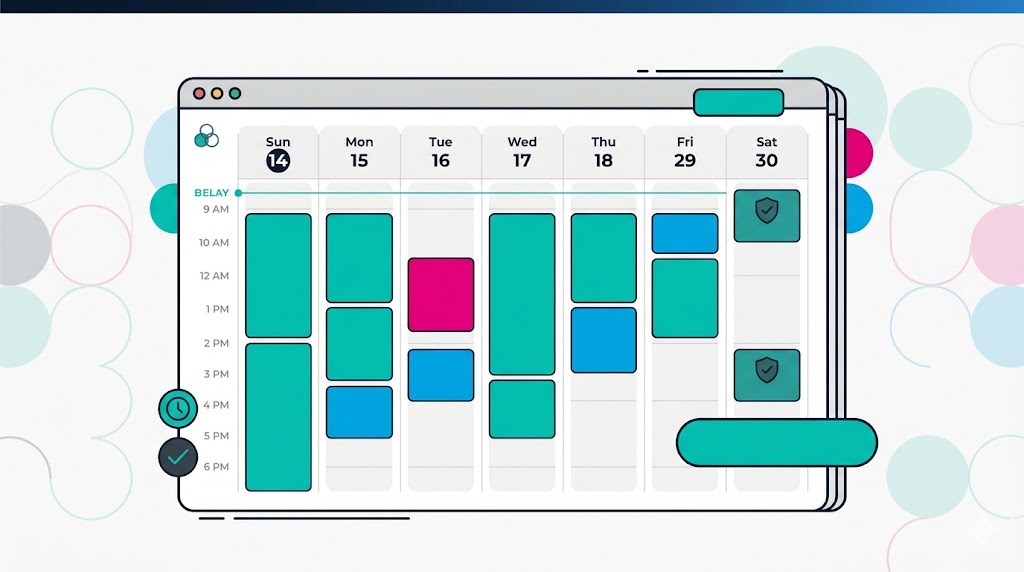
Calendar Management With a Virtual Assistant: The Complete System
The Calendar Problem
A busy professional’s calendar is a battlefield. Meeting requests come in constantly. Time zones need coordinating. Your own priorities need protecting.
Without a system, your calendar becomes a reflection of everyone else’s priorities, not yours.
A VA brings order to this chaos.
What a VA Does With Your Calendar
Protecting your time
What to delegate:
- Blocking your calendar for focused work (deep work, strategy time, thinking time)
- Declining or rescheduling low-priority meetings
- Protecting your lunch and personal time
- Creating buffer time between meetings to avoid back-to-back scheduling
- Blocking time for email and admin work
Processing meeting requests
What to delegate:
- Reviewing all meeting requests and deciding if you should attend
- Finding the best time across multiple stakeholders’ calendars
- Sending invites and confirmations
- Managing time zone differences
- Rescheduling when conflicts arise
Preparing you for meetings
What to delegate:
- Gathering agenda and relevant documents before the meeting
- Creating pre-meeting briefing materials
- Preparing talking points or questions
- Setting up video conference links and testing technology
- Sending pre-meeting context to other attendees
Following up after meetings
What to delegate:
- Recording action items from your notes
- Sending meeting summaries and action items to attendees
- Scheduling follow-up meetings
- Tracking action item completion
- Scheduling the next review or check-in
Calendar analysis and optimization
What to delegate:
- Identifying patterns in your calendar (too many meetings in one day, meeting overload on certain days)
- Suggesting calendar optimizations (batch meetings on certain days, protect focus time on others)
- Analyzing how much of your calendar is reactive vs. strategic
- Identifying and eliminating unnecessary recurring meetings
The System
Calendar structure
Create calendar categories:
- Focus time: Blocked, non-negotiable, protected. This is your deep work time. The VA defends this fiercely.
- Strategic meetings: Client meetings, investor meetings, key relationship meetings. These are scheduled by the VA but require your input.
- Operations: Team meetings, check-ins, internal operations. The VA can often handle rescheduling if conflicts arise.
- Ad-hoc/flexibility: Buffer time for urgent meetings that pop up.
- Personal: Lunch, exercise, personal time. Blocked and protected.
The meeting request process
External meeting requests: The VA reviews and responds. For strategic meetings, they check with you. For operational meetings, they find time.
Internal meeting requests: The VA consolidates. Rather than 10 separate one-on-ones with your team, they batch them into one team sync or two focused one-on-ones.
Your own meeting needs: You tell the VA “I need to meet with Sarah and Mark.” The VA finds time, sends invites, and prepares briefing materials.
Scheduling tools
Use tools that make calendar sharing easy:
- Calendar platform: Google Calendar, Outlook, or similar. The VA has access to manage on your behalf.
- Scheduling tool: Calendly, Acuity, or similar. People can self-serve find open times (within parameters the VA sets).
- Meeting notes: Notion, Google Docs, or Confluence for storing meeting notes and action items.
The Impact
Before VA:
- Calendar is reactive and constantly shifting
- Back-to-back meetings with no thinking time
- You’re attending meetings you don’t need to attend
- You’re spending 30+ minutes per day managing calendar logistics
After VA:
- Focus time is protected
- Meetings are relevant and batched efficiently
- You have 30 minutes thinking time between meetings
- You’re spending 5 minutes per day on calendar management
Calendar is structured and intentional
Frequently Asked Questions
“Won’t people resent having to go through a VA to book time with me?”
No. Most people appreciate having clear scheduling. A scheduling link or an efficient VA is faster than trying to coordinate by email. Executives have assistants — it’s expected and respected.
“What if the VA makes a mistake and double-books me?”
In the first few weeks, you review calendar changes daily. After that, mistakes are rare. When they happen, the VA reschedules immediately. The system prevents mistakes more than it causes them.
“Can the VA decline meetings on my behalf?”
Yes, within clear guidelines. The VA knows which meetings are strategic (require your review) and which are operational (can be declined or deferred without your input). You define the rules upfront.
The Bottom Line
A well-managed calendar is a reflection of your priorities, not everyone else’s. A VA protects your time and ensures your calendar serves your strategic goals, not your reactive firefighting.
This is particularly high-value for executives, founders, and professionals managing complex stakeholder relationships.
VAConnect regularly handles calendar management as part of executive assistant roles. Many VAs specialize in this.
Ready to take control of your calendar? Book a call with Karen to set up your calendar management system.
-
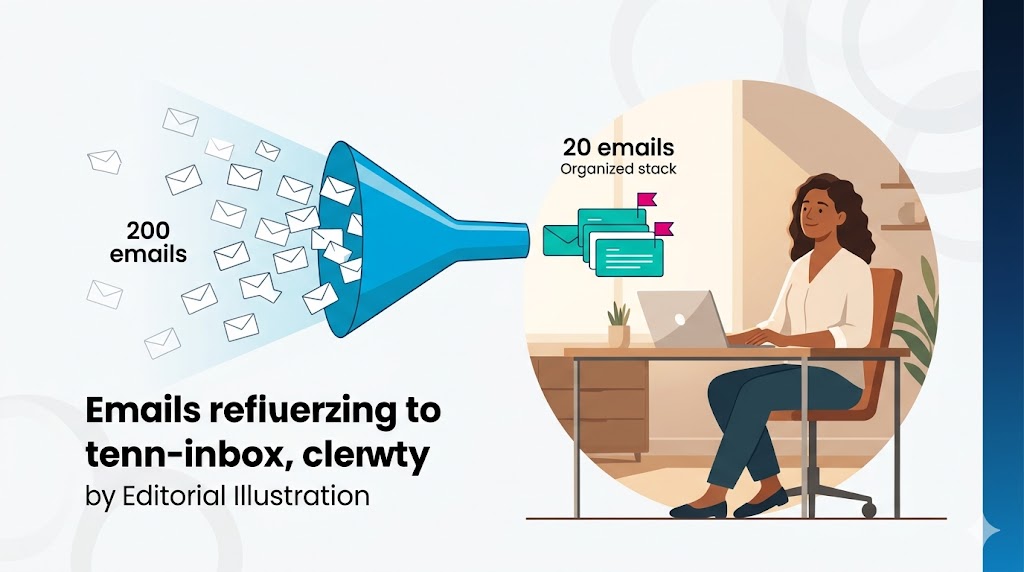
Virtual Assistant for Email Management: Reclaim 2 Hours a Day
Email as a Business Problem
Email is supposed to be a tool. For most busy professionals, it’s become the job. Studies show busy executives spend 28% of their day on email. That’s roughly 2 hours per day. For some, it’s higher.
Email doesn’t create value. Email facilitates value creation. But it steals the time needed for actual value creation.
This is the paradox a VA solves.
What a VA Can Do With Your Email
Inbox triage
What to delegate:
- Reading all incoming emails and flagging priority items
- Moving routine emails to folders (newsletters, notifications, automated messages)
- Unsubscribing from irrelevant lists
- Creating filters and rules to automatically organize mail
- Preparing a daily digest of emails that require your attention
Routine email responses
What to delegate:
- Responding to standard emails using your approved templates
- Forwarding and routing emails to the right people
- Following up on open items
- Drafting responses for you to review and approve
Email administration
What to delegate:
- Managing calendar invites and marking responses
- Organizing and archiving emails
- Finding and retrieving archived emails
- Managing email signatures and templates
The Implementation
Week 1: Your VA learns your email patterns, creates templates for standard responses, and sets up filters.
Week 2+: The VA handles triage. You see only flagged emails. Routine items are handled with your templates.
Result: Your inbox goes from 200+ emails/day that you’re reading to maybe 20–30 truly important emails that require your attention.
The Time Recovery
If you’re spending 2 hours/day on email and a VA can reduce that to 30 minutes/day:
Time recovered: 1.5 hours/day × 250 working days = 375 hours/year
At even a modest £100/hour opportunity cost, that’s £37,500/year in recovered time.
A VA costs £34,200/year. The payback is immediate.
The Common Concern
“Won’t I miss important emails?”
No, if the VA is trained properly. The VA’s job is to flag everything that requires your attention. They’re conservative: better to show you an email you don’t need than hide one you do. After 2–3 weeks, you’ll have defined what “important” means and the VA will have near-perfect accuracy.
The Bottom Line
Email is the biggest time thief in most businesses. A VA doesn’t eliminate email—they eliminate your need to process every email personally.
VAConnect regularly places VAs in email management roles. It’s one of the highest-ROI VA applications.
Ready to reclaim 2 hours per day? Book a call with Karen to design your email management system.
-

Virtual Assistant for Recruiters: Talent Acquisition Support That Actually Works
The Recruiter’s Time Problem
Recruiting is a volume game. A recruiter working on commission closes placements by managing pipelines: sourcing candidates, screening, coordinating interviews, negotiating offers, managing logistics.
But alongside the core recruiting work sits a mountain of admin:
- Email management and candidate correspondence
- Interview scheduling and coordination
- Background check and reference administration
- Offer letter generation and negotiation coordination
- CRM data entry and pipeline management
- Reporting and metrics
- Compliance documentation
This admin doesn’t close placements. But placements don’t happen without it.
A VA removes the administrative friction, freeing recruiters to focus on actual recruiting work.
What a Recruiter VA Handles
Candidate communication and screening
What to delegate:
- Initial screening calls (preliminary candidate qualification)
- Sending screening question questionnaires and collecting responses
- Collecting candidate information (resume parsing, LinkedIn details)
- Sending interview invitations and scheduling confirmations
- Candidate follow-up on application status
- Rejection emails (warm, professional rejections)
- Offer acceptance coordination
Interview and logistics coordination
What to delegate:
- Scheduling interviews across multiple stakeholders
- Sending interview confirmations to candidates and hiring team
- Preparing interview briefing materials
- Coordinating phone/video interview logistics
- Collecting feedback from interviewers
- Rescheduling cancelled interviews
- Coordinating final round logistics (travel, accommodations if in-person)
Background and reference checking
What to delegate:
- Coordinating with background check providers
- Collecting reference contact information from candidates
- Conducting reference calls (basic questions, taking notes)
- Following up on background checks
- Organizing results for the hiring team
Offer and onboarding administration
What to delegate:
- Generating and sending offer letters
- Coordinating offer negotiation (logistics, not terms)
- Collecting signed offer acceptance
- Preparing onboarding materials for accepted candidates
- Coordinating start date and first-day logistics
Pipeline and CRM management
What to delegate:
- Data entry into recruiting CRM
- Maintaining candidate records with notes and status
- Pipeline reporting and metrics
- Flagging candidates for follow-up
- Maintaining prospect lists and source tracking
Compliance and documentation
What to delegate:
- Maintaining required recruiting documentation
- Tracking anti-discrimination compliance (Equal Opportunity documentation)
- Organizing job ads and posting tracking
- Retention of hiring records as required
The Recruiter VA: Impact and Economics
A typical recruiter manages 10–15 active searches at a time. Each search involves 50–100 candidate touchpoints across sourcing, screening, interviewing, and closing.
Without VA: Recruiter does all the admin + recruiting. They’re limited to 10–15 concurrent searches. Placements take longer. Follow-up is inconsistent. Admin is sloppy.
With VA: Recruiter focuses on relationships, candidate assessment, and closing. VA handles all admin. Recruiter can manage 20–25 concurrent searches. Placements happen faster. Admin is systematic.
At a 5% commission on placements (typical for staffing), going from 10 placements/month to 15 placements/month = significant revenue increase for minimal cost.
The Right VA For Recruiting
A good recruiting VA:
- Understands candidate communication and professionalism
- Is naturally organized and detail-oriented
- Can manage multiple stakeholder schedules
- Understands recruiting processes and terminology
- Has strong customer service instincts (candidates are customers)
Prior recruiting experience is helpful but not essential. The VA can learn recruiting quickly if they have the baseline skills.
Frequently Asked Questions
Can a VA screen candidates independently?
Yes, with criteria you define. A VA can do preliminary screening (confirming basic qualifications) and knock out non-qualifiers. Final assessment stays with you.
What about candidate experience when they’re talking to a VA?
Most candidates expect recruiter support staff. If the VA is professional and responsive, candidates appreciate it. For sensitive conversations (offer negotiation, salary discussion), the recruiter takes the call directly.
How does this work across multiple recruiters?
A VA can support multiple recruiters if the work is organized by recruiter. Typically: one VA per 2–3 recruiters, depending on search volume.
The Bottom Line
Recruiting is a relationship and pipeline business. The recruiter wins by managing more relationships and pipelines. A VA removes the administrative friction that prevents that. Simple economics: if a VA frees time to complete one additional placement per month, they pay for themselves.
VAConnect places VAs with recruiting firms regularly. Many have recruiting or staffing background and understand the specific demands of the space.
Ready to free your recruiters from admin and close more placements? Book a call with Karen to discuss the right VA structure for your team.
-

How Funded Startups Use Virtual Assistants to Move Faster
The Operational Scaling Problem
Here’s the startup scaling problem nobody talks about openly: the moment you raise money, you have a new constraint. It’s not product development or sales. It’s operations.
Pre-funding, you’re lean. You and your co-founders do everything. Decisions are fast. Communication is direct. You move.
Post-funding, you have resources but also complexity. You have investors who need updates. You have employees who need managing. You have vendor relationships, compliance requirements, HR processes, and financial reporting. You have board meetings, quarterly reviews, and investor updates.
The product team wants to focus on product. The sales team wants to focus on sales. But someone has to manage the operational layer. That’s often the CEO, which means the CEO stops doing the work that actually builds the company.
A VA solves this without requiring a full-time operations hire.
The Specific Operational Needs of Funded Startups
Executive admin and calendar management
A CEO of a funded startup is in 15–20 meetings per week: board meetings, investor meetings, team meetings, customer meetings, advisor meetings. Managing a calendar that complex requires a dedicated person.
What a VA handles:
- Calendar optimization (blocking focus time, coordinating across time zones)
- Meeting logistics (invites, reminders, rescheduling)
- Preparing briefing materials before meetings
- Preparing meeting summaries and action items after meetings
- Managing email triage (CEO only sees priority items)
Investor and board relations administration
Investor relations is strategic, but investor administration is not.
What a VA handles:
- Investor update coordination (gathering information from team, compiling)
- Board meeting scheduling and logistics
- Board packet preparation and distribution
- Action item tracking across board meetings
- Cap table and shareholder record management (basic)
Team operations and HR administration
A growing team generates administrative overhead: onboarding, scheduling, benefits, feedback collection.
What a VA handles:
- New hire onboarding (sending documents, scheduling, introductions)
- Team calendar coordination (planning meetings, offsite scheduling)
- Meeting scheduling for all-hands, team standups, review cycles
- Collecting 1-on-1 feedback and organizing feedback for reviews
- Expense tracking and reimbursement processing
- Travel coordination for team and visitors
Vendor and contractor management
Funded startups work with dozens of vendors: cloud providers, legal, accounting, marketing agencies, advisors, etc.
What a VA handles:
- Vendor contract tracking and renewal dates
- License and subscription management
- Invoice processing and payment coordination
- Service escalation (when something isn’t working)
- Vendor relationship maintenance
Financial administration
A funded startup has financial complexity: accounting, payroll, tax compliance, equity management, cash flow tracking.
What a VA handles:
- Invoice processing and payment coordination
- Expense tracking and receipt management
- Payroll administration (with accounting firm)
- Cash flow tracking and reconciliation (basic)
- Cap table and equity tracking (basic, with legal counsel)
- Tax document preparation and filing coordination
Communication and documentation
A growing company needs internal communication infrastructure.
What a VA handles:
- Internal communication management (email, Slack, documentation)
- Meeting notes and decision tracking
- Action item management
- Newsletter production (internal and external)
- Company document repository (onboarding docs, policies, processes)
The VA Structure for Different Company Stages
Seed stage (£1M–£5M raised)
Structure: One full-time VA supporting the CEO
Focus: Calendar/exec admin, basic finance/admin, team logistics
Cost: £2,850/month
Series A (£5M–£15M raised)
Structure: One VA supporting the CEO + one part-time VA supporting operations/finance
Cost: £4,000–£5,000/month
Series B+ (£15M+ raised)
Structure: VA for CEO, operations coordinator, finance/admin coordinator
Cost: Transitioning to full-time operations team; VAs typically become part of that structure
Why VAs Work for Funded Startups
They’re fast to hire. A full-time ops person takes 2–3 months to hire. A VA can start in 2 weeks.
They’re flexible. As the company grows, VA hours can increase or decrease. You’re not locked into a full salary.
They reduce CEO burnout. A burnt-out CEO is expensive. A VA handling calendar, email, and administrative overhead keeps the CEO functioning.
A full-time ops coordinator costs £35,000–£50,000/year salary + benefits. A VA costs £34,200/year for full-time equivalent service.
They compress onboarding time. A new team member doesn’t have to manage their own logistical onboarding. It’s handled professionally.
Common Mistakes Funded Startups Make
Hiring too late. Many funded startups suffer through 6 months of founder admin chaos before hiring a VA. The earlier, the better.
Assigning the work to a junior team member. A junior engineer or product person doesn’t want to manage the CEO’s calendar. It’s career-limiting for them and inefficient for the company.
Unclear responsibilities. If it’s unclear what the VA is responsible for, nothing gets done. Be explicit in the brief.
No escalation protocol. If the VA can’t tell the difference between urgent and routine, things slip through the cracks. Define escalation explicitly.
The Business Case
For a funded startup with a CEO earning £150,000/year (loaded cost £250,000/year = £120/hour):
CEO time cost of administrative work: 10 hours/week admin × £120 = £1,200/week = £62,400/year
VA cost: £2,850/month = £34,200/year
Value of freed time: Even at 50% efficiency (VA handles 50% of admin and CEO does the remaining 50%), that’s 5 hours/week freed = £600/week = £31,200/year in opportunity cost
Net value: £31,200 – £34,200 = break-even in direct terms. But the real value is:
- CEO can focus on fundraising, strategy, and key relationships
- Team experience is better (professional onboarding, responsive leadership)
- Investor experience is better (professional communication, organized board materials)
- CEO doesn’t burn out (worth far more than any financial calculation)
Frequently Asked Questions
Should a VA report to the CEO or to operations?
If it’s the CEO’s executive assistant, they report to the CEO. If it’s supporting operations, it can report to the Head of Ops (once you have one) or to the CEO. Either way, make reporting lines clear.
Can a single VA support multiple executives?
Yes, but it gets complicated. A VA can support 2–3 executives if their calendars don’t overlap too much. Beyond that, you need multiple VAs.
What happens to the VA when the company hires an ops person?
Many companies keep the VA on as an operations assistant or executive assistant. Some fold the VA’s duties into the ops role. It depends on company needs.
The Bottom Line
Funded startups that move fast have operational infrastructure that enables speed.
The best time to hire is 2–4 weeks after raising money, when complexity hits and the CEO realizes they’re drowning in calendar and email.
VAConnect works with funded startups regularly. Many of their startup placements are part of the early team infrastructure.
Looking to add operational infrastructure without hiring an ops team yet? Book a call with Karen to discuss the right VA structure for your stage.