Leaning towards a managed, dedicated model? See how to hire a virtual assistant in the USA with VAConnect.
Tag: VA agency
-

Virtual Assistant Pricing: How Agencies, Contractors and Marketplaces Compare
Virtual Assistant Pricing: How Agencies, Contractors and Marketplaces Compare
It usually starts on a Tuesday.
A founder in Manchester opens her laptop at 7:40am to find forty-one unread emails, three of them from the same client asking the same question in three different tones. Her calendar has four calls stacked back to back, two of which were moved overnight by people who did not check her availability. Somewhere in a Slack channel she has not opened yet, a supplier is waiting on a purchase order she approved verbally eight days ago and never wrote down. By 11am she has spoken to five people and produced nothing. By 4pm she is answering the same client for a fourth time, this time with an apology attached. At 9pm, after her kids are asleep, she finally does the work she was actually hired by the market to do — the strategy, the pitch, the pricing model — in the tired hours nobody would choose.
She is not disorganised. She is not lazy. She is drowning in coordination, and coordination is the single most under-priced cost in modern business.
This is the context that makes virtual assistant pricing such a strange thing to talk about. Most buyers approach it as a rate comparison: $8 an hour here, £22 an hour there, $1,088 a month over there. But the rate is the least informative number in the entire decision. What actually determines whether delegation pays is the total cost of getting work out of somebody else’s hands and into a finished state — including the hours you spend explaining, correcting, re-explaining, replacing, and re-training.
Once you price that, the three main models on the market — DIY coordination, generic freelancers and marketplaces, and managed agencies — stop looking like variations on a theme. They start looking like completely different products with wildly different outcomes. And the gap between them, honestly, is wider than it has any right to be in 2026.
The Coordination Tax Nobody Puts on the Invoice
Before comparing what assistants cost, it helps to establish what not having one costs. The research here is unusually blunt.
Asana’s Anatomy of Work research — the most widely cited dataset on this — found that knowledge workers spend roughly 60% of their time on “work about work”: chasing updates, searching for information, switching between tools, sitting in status meetings, and tracking down decisions that were already made. Only about 40% of the working day is left for the skilled, strategic work people were actually hired to perform.
Microsoft’s own telemetry tells a similar story from a different angle. Analysis across Microsoft 365 apps found the average employee spends 57% of their time communicating and 43% creating, while receiving something in the order of 117 emails and 153 Teams messages a day. That is roughly 270 interruptions before a single meeting invite lands.
Broader collaboration research has tracked the same drift over two decades: time spent in meetings, email and other collaborative activity has grown by 50% or more, with some employees now spending 80% or more of their time on it. Meanwhile McKinsey Global Institute work cited in collaboration studies puts about 28% of the workweek on email alone and nearly 20% on searching for internal information.
The human texture behind those percentages is easy to find. On professional forums, the complaints have a repetitive, exhausted quality. One product manager on Blind described getting barely two hours of focus time out of an eight-hour day, with the rest lost to internal and client calls, and said plainly that it had started affecting their mental health. Another wrote that after two or three hours of back-to-back thirty-minute video calls they needed to lie down — and pointed out, tellingly, that the same number of hours spent coding or designing produced no such exhaustion. Fatigue is not a function of hours worked. It is a function of context switches.
Sixty percent of the working week goes to work about work. If you are a founder without support, that 60% is not delegated to a team. It is sitting on your own calendar, in your own inbox, at your own kitchen table at nine at night.
This is the number that should anchor every pricing conversation. If a business owner bills, or is worth, £75 an hour, and 60% of a 45-hour week is coordination, the untracked cost of doing it themselves is roughly £2,000 a week. Nobody puts that on an invoice. It comes out of growth, out of margin, and out of evenings.
What the Market Actually Charges in 2026
With that baseline in place, here is the current price map. It splits cleanly into three tiers.
Marketplaces and independent contractors
This is the entry point, and it is genuinely cheap on paper. Upwork’s own benchmarks put virtual assistants in the $10–$20 per hour band with a median around $13. Offshore freelancers hired directly through Philippines- or India-based channels can go lower still, with published 2026 guides showing entry rates from $3 to $15 per hour. US-based freelance VAs sit far higher, averaging around $35 per hour charged to clients versus roughly $19 per hour as an employee wage.
South Africa lands in an interesting middle position. South African VA rates vary widely with experience and specialisation (see this guide to virtual assistant pricing in South Africa) — and, as we will see, the qualities that determine whether the work is usable sit much closer to premium markets.
Managed monthly plans and agencies
Here you pay a flat monthly fee and the provider handles recruitment, vetting, training, replacement and performance management. Published 2026 ranges put managed plans at $699 to $899 per month for basic dedicated support, rising to $1,200 to $3,000 monthly for part-time specialist support with effective hourly rates in the $30–$75 range. Agency VAs with full support infrastructure are commonly benchmarked at $25 to $50 per hour.
VAConnect, a South African agency serving the UK, Ireland, US, Canada, Netherlands and Australia, prices a dedicated professional on 40 hours a month from $1,088 per month, with an elite executive tier from $1,688 and multi-VA team packages from $4,380. Its UK-facing pages list the equivalent sterling packages on the pricing page.
In-house hires
The comparison point most buyers actually have in mind. A US-based in-house executive assistant runs $4,300 to $8,000 per month once benefits and overhead are counted. In the UK, the arithmetic got materially worse in April 2025, when employer National Insurance rose from 13.8% to 15% and the secondary threshold dropped from £9,100 to £5,000 — changes that added, by one worked example, roughly £866 per year for a single employee on £30,000, a 30% jump in NI cost for that person alone. Add pension, holiday, sick pay, equipment and recruitment fees, and a £32,000 UK administrator costs closer to £40,000 landed.
The Fee Stack That Turns a Low Quote Into an Expensive Hire
The marketplace tier looks unbeatable until you audit what actually leaves your bank account.
A 2026 financial analysis of platform hiring found that between client marketplace fees of up to 7.99%, contract initiation charges of $0.99–$14.99 per hire, currency conversion markups, and the freelancer’s own commission typically baked into their quoted rate, the true cost of a $50/hour freelancer reaches $57–$60 per hour. For a business spending $100,000 a year on freelance talent, that is an extra $15,000 to $25,000. Fiverr’s structure is heavier still: a buyer service fee plus a 20% seller commission that gets priced into the quote produces total markup over the actual work value of roughly 25–32%. One 2026 fee guide ran the numbers on a $50,000 retainer and found the platform extracts over $7,500.
Fees are the visible part. The invisible part is worse.
Every marketplace hire carries a search cost, a ramp cost (the weeks before the person is useful), a supervision cost, a rework cost, and a replacement cost — doing all of the above again when they leave, take a better-paying client, or simply go quiet. Once you include recruiting, training, management and replacement, the comparison that matters is the cost of getting work finished, not the hourly rate on a profile. That is where a managed, dedicated assistant earns its place: one senior-level professional who stays, backed by an agency accountable for the result.
The sharpest framing came from a 2026 cost analysis that compared provider pricing against surveys of more than 500 virtual assistants: a $5-an-hour assistant who needs constant supervision can cost more per finished task than a $35-an-hour one who runs on their own.
Rate is an input. Cost per finished task is the output. They are frequently inverted.
The cheapest hourly rate in the room is often the most expensive way to get a job done, because you are paying twice: once for the hour, and again for the hour you spend fixing it.
There is also the churn problem, which marketplaces structurally cannot solve. A freelancer is a business, not an employee. Their incentive is portfolio diversification — more clients, higher rates, better hours. Yours is continuity. Those incentives diverge on a predictable schedule, usually around the point where the freelancer has finally learned your systems well enough to be genuinely valuable. This is why the retention number is the single most under-scrutinised metric in the entire category, and why the managed model exists at all.
The South African Advantage: Why the Map Matters More Than the Rate
Somewhere between 2019 and now, without much fanfare in the UK press, South Africa turned into one of the best-kept arbitrage opportunities in English-language business support. The numbers are not subtle.
According to Business Process Enabling South Africa (BPESA), the national industry body, the country’s global business services sector grew from 65,000 people servicing international clients in 2019 to an estimated 150,000 in 2024, with market revenue climbing from $1.04 billion to $2.91 billion — a near-tripling in five years, backed by an Everest Group–compiled value proposition and a national target of 500,000 cumulative jobs by 2030. In the 2025 calendar year alone the sector created 26,346 new international-facing jobs, its highest annual total since 2018, with about 90% going to young people.
Crucially for British readers: over half of South Africa’s globally focused workers serve UK clients, and UK-origin mandates have accounted for around 48% of net new job creation in the sector. This is not a theoretical fit. It is an established trade route that British firms have been quietly using for years.
Buyer sentiment backs it. In the 2026 CX Technology & Global Services Survey, which polled 815 enterprise decision-makers across 12 demand markets, South Africa tied with Poland as the third most favoured offshore delivery destination globally — dominating favourability ratings in Australia and the USA, and showing significant strength in the UK, Canada and New Zealand. South Africa has held a top-three position in that survey for years, and shared the number one spot with India in 2022.
So what is actually driving it? Four things, and only one of them is money.
Time zone: the boring advantage that changes everything
South Africa sits at GMT+2. That is one hour ahead of British Summer Time and two hours ahead of GMT in winter. In practice, a South African assistant’s working day overlaps almost completely with a UK working day, and covers US East Coast mornings without anyone working a night shift.
Compare that to the Philippines, seven to eight hours ahead of the UK. The Philippine BPO industry is excellent and enormous, but the structural consequence of that gap is asynchronous work: you write instructions at 5pm, they execute overnight, you review at 9am, you correct, they fix the following night. A task requiring three rounds of clarification takes three days instead of three hours. Nobody is at fault. The planet is at fault.
Time zone alignment is the least glamorous item on any vendor’s website and the one that most reliably determines whether delegation feels like relief or like project management.
Language and cultural affinity
South Africa ranks 13th globally for English proficiency and first in Africa on the EF English Proficiency Index. But raw proficiency undersells it. South African business English is not a second language imperfectly acquired — for a large professional cohort it is the language of schooling, university, commerce and law, with British spelling conventions, British-influenced legal drafting, and a shared vocabulary of understatement and indirectness that British clients find immediately legible.
That has a measurable commercial consequence. The South African BPO industry has been benchmarked at 18% higher customer experience satisfaction than India and the Philippines, with higher first-contact resolution, translating into 4–5% better year-on-year customer retention.
The COO & CFO of CodingIT wrote in a verified Clutch review: “As a UK based business we could hire employees that have been prescreened in South Africa.” Read the full review on Clutch A director at an FMCG recruitment company wrote: “They are straightforward, easy to deal with, and once up and running are fully self-managing.” Read the full review on Clutch
You do not pay a re-explanation tax when the person on the other end already understands what you meant.
Regulatory and legal proximity
South Africa’s POPI Act was drafted in deliberate alignment with GDPR principles, which means a South African professional handling UK client data arrives with the conceptual framework already installed rather than learning it from a compliance module. For firms in law, finance, insurance and healthcare — the sectors most nervous about offshoring — this is not a nice-to-have. It is the gate.
Cost, which turns out to be the least interesting part
South African BPO delivers 55–65% cost savings versus UK, US and Australian in-house hiring, and BPESA’s leadership has noted the country is significantly more cost-effective than markets like Poland and Malaysia.
The mechanism is currency and cost-of-living differential, not wage suppression. A senior executive assistant in Cape Town or Johannesburg earning R18,000–R28,000 a month is earning a solid middle-class professional salary in local terms. Published analysis of the model notes that a good agency pays at the upper end of that range, adds employer costs, provides equipment and training, and still lands well under UK employment cost.
That is the part people get wrong about South Africa. You are buying an equivalently qualified professional whose cost base happens to be denominated in a weaker currency. Those are entirely different transactions.
The Human in the Loop: Why Automation Alone Keeps Losing
Now for the argument that most vendors in this category are getting badly wrong.
The obvious 2026 objection to hiring any assistant is: why not automate it? Inbox triage, meeting summaries, first-draft copy, CRM updates, research briefs, social scheduling — all of it is nominally within reach of current AI tooling, at a fraction of even a South African monthly rate. Plenty of businesses have tried exactly that. The results have been instructive, and not in the direction the tooling companies expected.
Start with the consumer evidence, because it is stark. Capgemini’s tracking of consumer sentiment found trust in AI-generated content fell from 73% to 55% between 2023 and 2025 — a decline across every age group including Gen Z. YouGov’s 2026 data found 32% of consumers would trust a brand less if they knew its content was AI-generated, against 15% who would trust it more. In controlled testing, participants shown identical articles reported 52% lower engagement when told the content was AI-generated. Same words. Different reaction.
The academic work explains why. Researchers at the Nuremberg Institute for Market Decisions ran experiments showing that simply knowing content was machine-made made people trust it less and engage with it less, even when quality was high — a phenomenon they term the “trust penalty.” Work published in the Journal of Business Research found that when consumers believe emotionally-pitched communications were AI-authored, the response includes reduced positive word of mouth and diminished brand loyalty. A systematic literature review published in 2026 covering 35 studies from 2020–2026 identified authenticity as the central mediating mechanism across the entire body of research.
Professional communities have reached the same conclusion faster and less politely. In March 2026, Hacker News formally added a rule to its guidelines banning generated or AI-edited comments, with moderator Daniel Gackle explaining that the site exists for conversation between humans. A peer-reviewed qualitative study analysing 1,154 posts across 15 Reddit and Hacker News threads on AI-assisted software development framed the phenomenon as a tragedy of the commons: individual productivity gains that externalise their costs onto reviewers, maintainers and everyone downstream. “AI slop” was Merriam-Webster’s word of the year for 2025.
And in a detail that should terrify anyone running an unattended content operation, one study found that accusations of AI authorship on Reddit and Hacker News rose sharply between 2023 and 2026 even against comments showing no evidence of being AI-generated. The penalty now attaches to the suspicion, not just the fact.
Consumers cannot reliably detect AI-written communication — only about 43% feel confident they can. Which means the trust penalty is not triggered by detection. It is triggered by the feeling that nobody is home.
This is precisely where a trained assistant beats a workflow. Not because the assistant types faster than a model — obviously not — but because the assistant is the judgment layer. She knows that this particular client hates being chased on a Friday. She recognises that the terse two-line reply from the prospect means something different than it reads. She notices that the invoice query and the complaint from last month are the same underlying problem. She writes in your voice because she has sat in your business for eighteen months, not because she was handed a style guide.
The most effective operators are not choosing between people and machines. They are pairing them. A well-equipped VA runs the AI tools and owns the output — capturing the efficiency gains while keeping a human accountable at the point where tone, judgment and relationship are on the line. VAConnect’s training platform, VAVarsity, includes modules on advanced AI tool utilisation alongside British business culture immersion, which is a reasonable summary of what the role has become: someone who can drive the machines and still sound like a person.
Pure automation is cheaper. It is also, in every market where trust drives revenue, measurably worse. That is the trade most businesses have now run and quietly reversed.
What “Managed” Actually Buys, and Why Retention Is the Number to Interrogate
If the freelance model’s structural weakness is churn, the managed model’s entire value proposition is the machinery built to prevent it. This is where price comparisons get genuinely uncomfortable for the cheap end of the market, because most of what you are buying is invisible on the invoice.
Take VAConnect’s stack as a worked example, since it is unusually explicit about its internals. Candidates are sourced through VAJobs.co.za, trained through VAVarsity.co.za, monitored for performance and wellbeing through a programme called Atomic Energy, and held accountable through a proprietary feedback framework called VAPIness, with monthly performance reviews and proactive issue flagging. Matching is done by hand — a specialist presents three to four candidates within 5–7 business days rather than an algorithmic shortlist of twenty. Placement typically completes within two weeks. Onboarding includes a custom SOP so the assistant has documented process from day one, with full independent operation typically reached in two to four weeks.
The output metric the company points to is 98% client retention over 14 months, verified from VAConnect’s invoice records, alongside a 13 reviews on Clutch across 13 reviews. Non-performing placements are replaced at no cost, with the agency managing the rematch and transition.
Whether or not you take any single vendor’s self-reported figure at face value — and you should always ask for the methodology — the structural point stands and is worth stating plainly: retention is the metric that converts a rate into a real cost. An assistant who stays three years amortises her ramp-up across 36 months. An assistant who stays five months means you pay the ramp cost twice a year, forever, and never reach the stage where she anticipates rather than waits for instruction.
The gap compounds in a way that is easy to underestimate. A freelancer at $10/hour who turns over twice a year, needs six weeks to become useful each time, and requires two hours a week of your supervision is not a $10/hour resource. Priced properly against your own time, she is comfortably north of $30/hour of finished output — and she never reaches the level of contextual judgment where the real value sits.
Meanwhile the academic literature on remote work has quietly settled the question that used to justify all this hesitation. The largest randomised controlled trial on hybrid work — Bloom, Han and Liang’s 1,612-employee study published in Nature in June 2024 — found that remote arrangements improved job satisfaction and cut quit rates by a third, with null equivalence tests showing no effect on performance grades across two subsequent years of reviews. Notably, managers in the trial predicted remote work would damage productivity, then changed their minds by the time it ended.
The instinct that distance degrades output is a well-documented bias, not a finding. What degrades output is bad management, weak process and constant turnover — which is exactly the list the managed model is built to remove.
Running the Numbers on a Full Year
Abstract percentages are easy to nod at and hard to act on, so here is the arithmetic for a mid-sized UK firm needing full-time administrative and executive support.
Option A — do it yourself. Zero cash cost. Roughly 24 hours a week of founder time consumed by coordination, based on the 60% figure applied to a 40-hour week. At a conservative £60/hour opportunity cost, that is £74,880 a year of the most expensive labour in the business, spent on calendar management. Output quality is high on the tasks that get done and zero on the ones that do not, because there is no capacity left. This is the option most businesses are unknowingly choosing right now.
Option B — UK in-house hire. A £32,000 administrator costs roughly £40,000 landed once employer NI at 15% above the £5,000 threshold, pension, holiday, sick cover, equipment and recruitment fees are counted. Add management time. Add the risk that you are back at the start in eleven months.
Option C — marketplace freelancer at $13/hour. Nominal cost around $27,000 for full-time equivalent hours. Add platform fees at 15–18%, add your search and screening time, add six weeks of ramp, add two hours a week of supervision, add a replacement cycle mid-year. Real cost lands materially higher, and the ceiling on what you can safely delegate stays low because the relationship never accumulates institutional knowledge.
Option D — managed South African executive assistant, full day (150 hours), at $3,880/month. Around $46,560 a year, all-in, with recruitment, training, replacement cover, performance management and payroll compliance included. No NI, no pension, no holiday accrual, no equipment budget, no recruitment fee. VAConnect’s own comparison sets its packages against the cost of a local executive assistant.
The differences between B, C and D are meaningful. The difference between all of them and A is a different order of magnitude entirely — and A is the incumbent.
The Gap Has Become Absurd, and That Is the Actual Story
Step back from the individual line items and something slightly shocking comes into focus.
The efficiency gap between a business running with properly matched, well-managed, culturally aligned support and one running on founder heroics has never been this wide. The support side has gotten dramatically better: the talent pool has professionalised (26,346 new international-facing roles in South Africa in 2025 alone), the time zone problem has been solved by geography, the trust problem has been solved by shared language and legal frameworks, the churn problem has been solved by managed infrastructure, and the tooling has made a single competent assistant more productive than a three-person admin team was a decade ago.
The unsupported side, meanwhile, has gotten worse. More tools. More channels. More notifications. More meetings that could have been messages. The coordination tax rose while the cost of eliminating it fell — which is a strange and quite specific historical moment, and one that will not stay open indefinitely as competitors work it out.
What is genuinely surprising is how many capable businesses are still on the wrong side of it, not because they ran the numbers and disagreed, but because they never ran them. They compared an hourly rate to their own free labour and concluded the free labour was cheaper. It never was.
The businesses pulling ahead have made a decision that looks, from the outside, almost boringly administrative: they hired someone good, in a time zone that works, through a partner who keeps them. Then they got their Tuesdays back.
Comparative Summary: Three Models, Three Outcomes
DIY Coordination Generic Freelancers / Marketplaces VAConnect (Managed South African VA) Headline cost £0 cash $10–$20/hr (median ~$13) From $1,088/month all-in True annual cost ~£75,000 in founder opportunity cost Nominal + 15–18% platform fees + ramp + supervision + replacement cycles See the pricing page Time to productive output Immediate but capped by your own capacity 4–8 weeks per hire, repeated each turnover Meaningful output in week one; full independence in 2–4 weeks Who manages performance You You Agency: monthly reviews, VAPIness accountability, Atomic Energy wellbeing tracking Retention N/A High churn; incentives favour portfolio diversification 98% client retention over 14 months, verified from VAConnect’s invoice records; free replacement if standards are not met Time zone overlap with UK Full Variable; Philippines/India 5–8 hrs ahead GMT+2 — 1–2 hrs offset, near-full working-day overlap Language & cultural fit Perfect Highly variable; re-explanation tax common British-inflected professional English; UK business norms; POPI/GDPR alignment Training & upskilling None Your responsibility, lost at turnover VAVarsity platform: AI tooling, compliance, sector modules, UK business culture Human judgment layer Yours only, and rationed Task execution; limited context accumulation Owns output, drives AI tooling, accumulates institutional knowledge Scalability None — you are the bottleneck Linear and fragile; each new hire restarts the cycle Single point of contact, multi-VA teams from $4,380/month What breaks You do The relationship, usually around month five Replaced and rematched at no cost Best suited to Nobody, honestly Discrete, well-specified, low-context project work Ongoing operational, executive, sales and marketing support where continuity compounds
Sources referenced include: Bloom, Han & Liang, “Hybrid working from home improves retention without damaging performance,” Nature (2024); Asana Anatomy of Work Index; Microsoft Work Trend Index; BPESA / Everest Group GBS sector reporting (2025–2026); Ryan Strategic Advisory, 2026 CX Technology & Global Services Survey; Nuremberg Institute for Market Decisions consumer trust research; Capgemini and YouGov consumer sentiment tracking; Hacker News community guidelines (2026); arXiv qualitative study of Reddit and Hacker News developer discourse (2026); Upwork, Fiverr and platform fee analyses (2026); Xero and HMRC guidance on April 2025 employer National Insurance changes; and published pricing, review and programme data from VAConnect (vaconnect.co.za / vaconnect.co.uk).
Frequently asked questions
How does virtual assistant pricing compare across agencies and marketplaces?
Marketplaces show hourly rates, but you handle sourcing, vetting and management yourself. Agencies charge a monthly package that bundles recruitment, oversight and replacement. Direct hires add payroll and cover. Compare total cost of delegation, including your own management time, rather than the hourly rate alone, to see which model actually frees up your week.
-

Calendar Management With a Virtual Assistant: The Complete System
The Calendar Problem
A busy professional’s calendar is a battlefield. Meeting requests come in constantly. Time zones need coordinating. Your own priorities need protecting.
Without a system, your calendar becomes a reflection of everyone else’s priorities, not yours.
A VA brings order to this chaos.
What a VA Does With Your Calendar
Protecting your time
What to delegate:
- Blocking your calendar for focused work (deep work, strategy time, thinking time)
- Declining or rescheduling low-priority meetings
- Protecting your lunch and personal time
- Creating buffer time between meetings to avoid back-to-back scheduling
- Blocking time for email and admin work
Processing meeting requests
What to delegate:
- Reviewing all meeting requests and deciding if you should attend
- Finding the best time across multiple stakeholders’ calendars
- Sending invites and confirmations
- Managing time zone differences
- Rescheduling when conflicts arise
Preparing you for meetings
What to delegate:
- Gathering agenda and relevant documents before the meeting
- Creating pre-meeting briefing materials
- Preparing talking points or questions
- Setting up video conference links and testing technology
- Sending pre-meeting context to other attendees
Following up after meetings
What to delegate:
- Recording action items from your notes
- Sending meeting summaries and action items to attendees
- Scheduling follow-up meetings
- Tracking action item completion
- Scheduling the next review or check-in
Calendar analysis and optimization
What to delegate:
- Identifying patterns in your calendar (too many meetings in one day, meeting overload on certain days)
- Suggesting calendar optimizations (batch meetings on certain days, protect focus time on others)
- Analyzing how much of your calendar is reactive vs. strategic
- Identifying and eliminating unnecessary recurring meetings
The System
Calendar structure
Create calendar categories:
- Focus time: Blocked, non-negotiable, protected. This is your deep work time. The VA defends this fiercely.
- Strategic meetings: Client meetings, investor meetings, key relationship meetings. These are scheduled by the VA but require your input.
- Operations: Team meetings, check-ins, internal operations. The VA can often handle rescheduling if conflicts arise.
- Ad-hoc/flexibility: Buffer time for urgent meetings that pop up.
- Personal: Lunch, exercise, personal time. Blocked and protected.
The meeting request process
External meeting requests: The VA reviews and responds. For strategic meetings, they check with you. For operational meetings, they find time.
Internal meeting requests: The VA consolidates. Rather than 10 separate one-on-ones with your team, they batch them into one team sync or two focused one-on-ones.
Your own meeting needs: You tell the VA “I need to meet with Sarah and Mark.” The VA finds time, sends invites, and prepares briefing materials.
Scheduling tools
Use tools that make calendar sharing easy:
- Calendar platform: Google Calendar, Outlook, or similar. The VA has access to manage on your behalf.
- Scheduling tool: Calendly, Acuity, or similar. People can self-serve find open times (within parameters the VA sets).
- Meeting notes: Notion, Google Docs, or Confluence for storing meeting notes and action items.
The Impact
Before VA:
- Calendar is reactive and constantly shifting
- Back-to-back meetings with no thinking time
- You’re attending meetings you don’t need to attend
- You’re spending 30+ minutes per day managing calendar logistics
After VA:
- Focus time is protected
- Meetings are relevant and batched efficiently
- You have 30 minutes thinking time between meetings
- You’re spending 5 minutes per day on calendar management
Calendar is structured and intentional
Frequently Asked Questions
“Won’t people resent having to go through a VA to book time with me?”
No. Most people appreciate having clear scheduling. A scheduling link or an efficient VA is faster than trying to coordinate by email. Executives have assistants — it’s expected and respected.
“What if the VA makes a mistake and double-books me?”
In the first few weeks, you review calendar changes daily. After that, mistakes are rare. When they happen, the VA reschedules immediately. The system prevents mistakes more than it causes them.
“Can the VA decline meetings on my behalf?”
Yes, within clear guidelines. The VA knows which meetings are strategic (require your review) and which are operational (can be declined or deferred without your input). You define the rules upfront.
The Bottom Line
A well-managed calendar is a reflection of your priorities, not everyone else’s. A VA protects your time and ensures your calendar serves your strategic goals, not your reactive firefighting.
This is particularly high-value for executives, founders, and professionals managing complex stakeholder relationships.
VAConnect regularly handles calendar management as part of executive assistant roles. Many VAs specialize in this.
Ready to take control of your calendar? Book a call with Karen to set up your calendar management system.
-
Virtual Assistant for Email Management: Reclaim 2 Hours a Day
Email as a Business Problem
Email is supposed to be a tool. For most busy professionals, it’s become the job. Studies show busy executives spend 28% of their day on email. That’s roughly 2 hours per day. For some, it’s higher.
Email doesn’t create value. Email facilitates value creation. But it steals the time needed for actual value creation.
This is the paradox a VA solves.
What a VA Can Do With Your Email
Inbox triage
What to delegate:
- Reading all incoming emails and flagging priority items
- Moving routine emails to folders (newsletters, notifications, automated messages)
- Unsubscribing from irrelevant lists
- Creating filters and rules to automatically organize mail
- Preparing a daily digest of emails that require your attention
Routine email responses
What to delegate:
- Responding to standard emails using your approved templates
- Forwarding and routing emails to the right people
- Following up on open items
- Drafting responses for you to review and approve
Email administration
What to delegate:
- Managing calendar invites and marking responses
- Organizing and archiving emails
- Finding and retrieving archived emails
- Managing email signatures and templates
The Implementation
Week 1: Your VA learns your email patterns, creates templates for standard responses, and sets up filters.
Week 2+: The VA handles triage. You see only flagged emails. Routine items are handled with your templates.
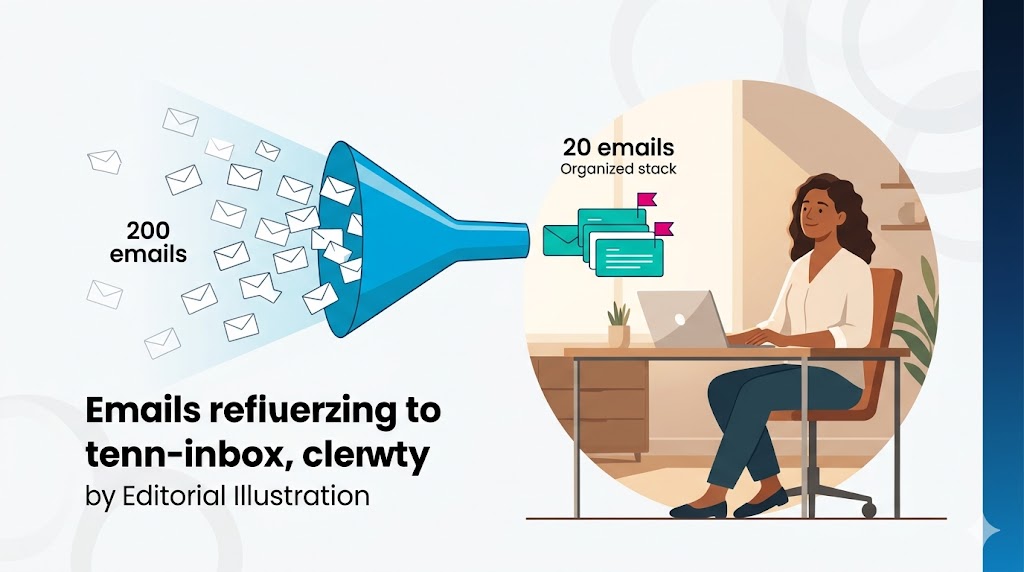
Result: Your inbox goes from 200+ emails/day that you’re reading to maybe 20–30 truly important emails that require your attention.
The Time Recovery
If you’re spending 2 hours/day on email and a VA can reduce that to 30 minutes/day:
Time recovered: 1.5 hours/day × 250 working days = 375 hours/year
At even a modest £100/hour opportunity cost, that’s £37,500/year in recovered time.
A VA costs £34,200/year. The payback is immediate.
The Common Concern
“Won’t I miss important emails?”
No, if the VA is trained properly. The VA’s job is to flag everything that requires your attention. They’re conservative: better to show you an email you don’t need than hide one you do. After 2–3 weeks, you’ll have defined what “important” means and the VA will have near-perfect accuracy.
The Bottom Line
Email is the biggest time thief in most businesses. A VA doesn’t eliminate email—they eliminate your need to process every email personally.
VAConnect regularly places VAs in email management roles. It’s one of the highest-ROI VA applications.
Ready to reclaim 2 hours per day? Book a call with Karen to design your email management system.
-

Virtual Assistant for Recruiters: Talent Acquisition Support That Actually Works
The Recruiter’s Time Problem
Recruiting is a volume game. A recruiter working on commission closes placements by managing pipelines: sourcing candidates, screening, coordinating interviews, negotiating offers, managing logistics.
But alongside the core recruiting work sits a mountain of admin:
- Email management and candidate correspondence
- Interview scheduling and coordination
- Background check and reference administration
- Offer letter generation and negotiation coordination
- CRM data entry and pipeline management
- Reporting and metrics
- Compliance documentation
This admin doesn’t close placements. But placements don’t happen without it.
A VA removes the administrative friction, freeing recruiters to focus on actual recruiting work.
What a Recruiter VA Handles
Candidate communication and screening
What to delegate:
- Initial screening calls (preliminary candidate qualification)
- Sending screening question questionnaires and collecting responses
- Collecting candidate information (resume parsing, LinkedIn details)
- Sending interview invitations and scheduling confirmations
- Candidate follow-up on application status
- Rejection emails (warm, professional rejections)
- Offer acceptance coordination
Interview and logistics coordination
What to delegate:
- Scheduling interviews across multiple stakeholders
- Sending interview confirmations to candidates and hiring team
- Preparing interview briefing materials
- Coordinating phone/video interview logistics
- Collecting feedback from interviewers
- Rescheduling cancelled interviews
- Coordinating final round logistics (travel, accommodations if in-person)
Background and reference checking
What to delegate:
- Coordinating with background check providers
- Collecting reference contact information from candidates
- Conducting reference calls (basic questions, taking notes)
- Following up on background checks
- Organizing results for the hiring team
Offer and onboarding administration
What to delegate:
- Generating and sending offer letters
- Coordinating offer negotiation (logistics, not terms)
- Collecting signed offer acceptance
- Preparing onboarding materials for accepted candidates
- Coordinating start date and first-day logistics
Pipeline and CRM management
What to delegate:
- Data entry into recruiting CRM
- Maintaining candidate records with notes and status
- Pipeline reporting and metrics
- Flagging candidates for follow-up
- Maintaining prospect lists and source tracking
Compliance and documentation
What to delegate:
- Maintaining required recruiting documentation
- Tracking anti-discrimination compliance (Equal Opportunity documentation)
- Organizing job ads and posting tracking
- Retention of hiring records as required
The Recruiter VA: Impact and Economics
A typical recruiter manages 10–15 active searches at a time. Each search involves 50–100 candidate touchpoints across sourcing, screening, interviewing, and closing.
Without VA: Recruiter does all the admin + recruiting. They’re limited to 10–15 concurrent searches. Placements take longer. Follow-up is inconsistent. Admin is sloppy.
With VA: Recruiter focuses on relationships, candidate assessment, and closing. VA handles all admin. Recruiter can manage 20–25 concurrent searches. Placements happen faster. Admin is systematic.
At a 5% commission on placements (typical for staffing), going from 10 placements/month to 15 placements/month = significant revenue increase for minimal cost.
The Right VA For Recruiting
A good recruiting VA:
- Understands candidate communication and professionalism
- Is naturally organized and detail-oriented
- Can manage multiple stakeholder schedules
- Understands recruiting processes and terminology
- Has strong customer service instincts (candidates are customers)
Prior recruiting experience is helpful but not essential. The VA can learn recruiting quickly if they have the baseline skills.
Frequently Asked Questions
Can a VA screen candidates independently?
Yes, with criteria you define. A VA can do preliminary screening (confirming basic qualifications) and knock out non-qualifiers. Final assessment stays with you.
What about candidate experience when they’re talking to a VA?
Most candidates expect recruiter support staff. If the VA is professional and responsive, candidates appreciate it. For sensitive conversations (offer negotiation, salary discussion), the recruiter takes the call directly.
How does this work across multiple recruiters?
A VA can support multiple recruiters if the work is organized by recruiter. Typically: one VA per 2–3 recruiters, depending on search volume.
The Bottom Line
Recruiting is a relationship and pipeline business. The recruiter wins by managing more relationships and pipelines. A VA removes the administrative friction that prevents that. Simple economics: if a VA frees time to complete one additional placement per month, they pay for themselves.
VAConnect places VAs with recruiting firms regularly. Many have recruiting or staffing background and understand the specific demands of the space.
Ready to free your recruiters from admin and close more placements? Book a call with Karen to discuss the right VA structure for your team.
-

How Funded Startups Use Virtual Assistants to Move Faster
The Operational Scaling Problem
Here’s the startup scaling problem nobody talks about openly: the moment you raise money, you have a new constraint. It’s not product development or sales. It’s operations.
Pre-funding, you’re lean. You and your co-founders do everything. Decisions are fast. Communication is direct. You move.
Post-funding, you have resources but also complexity. You have investors who need updates. You have employees who need managing. You have vendor relationships, compliance requirements, HR processes, and financial reporting. You have board meetings, quarterly reviews, and investor updates.
The product team wants to focus on product. The sales team wants to focus on sales. But someone has to manage the operational layer. That’s often the CEO, which means the CEO stops doing the work that actually builds the company.
A VA solves this without requiring a full-time operations hire.
The Specific Operational Needs of Funded Startups
Executive admin and calendar management
A CEO of a funded startup is in 15–20 meetings per week: board meetings, investor meetings, team meetings, customer meetings, advisor meetings. Managing a calendar that complex requires a dedicated person.
What a VA handles:
- Calendar optimization (blocking focus time, coordinating across time zones)
- Meeting logistics (invites, reminders, rescheduling)
- Preparing briefing materials before meetings
- Preparing meeting summaries and action items after meetings
- Managing email triage (CEO only sees priority items)
Investor and board relations administration
Investor relations is strategic, but investor administration is not.
What a VA handles:
- Investor update coordination (gathering information from team, compiling)
- Board meeting scheduling and logistics
- Board packet preparation and distribution
- Action item tracking across board meetings
- Cap table and shareholder record management (basic)
Team operations and HR administration
A growing team generates administrative overhead: onboarding, scheduling, benefits, feedback collection.
What a VA handles:
- New hire onboarding (sending documents, scheduling, introductions)
- Team calendar coordination (planning meetings, offsite scheduling)
- Meeting scheduling for all-hands, team standups, review cycles
- Collecting 1-on-1 feedback and organizing feedback for reviews
- Expense tracking and reimbursement processing
- Travel coordination for team and visitors
Vendor and contractor management
Funded startups work with dozens of vendors: cloud providers, legal, accounting, marketing agencies, advisors, etc.
What a VA handles:
- Vendor contract tracking and renewal dates
- License and subscription management
- Invoice processing and payment coordination
- Service escalation (when something isn’t working)
- Vendor relationship maintenance
Financial administration
A funded startup has financial complexity: accounting, payroll, tax compliance, equity management, cash flow tracking.
What a VA handles:
- Invoice processing and payment coordination
- Expense tracking and receipt management
- Payroll administration (with accounting firm)
- Cash flow tracking and reconciliation (basic)
- Cap table and equity tracking (basic, with legal counsel)
- Tax document preparation and filing coordination
Communication and documentation
A growing company needs internal communication infrastructure.
What a VA handles:
- Internal communication management (email, Slack, documentation)
- Meeting notes and decision tracking
- Action item management
- Newsletter production (internal and external)
- Company document repository (onboarding docs, policies, processes)
The VA Structure for Different Company Stages
Seed stage (£1M–£5M raised)
Structure: One full-time VA supporting the CEO
Focus: Calendar/exec admin, basic finance/admin, team logistics
Cost: £2,850/month
Series A (£5M–£15M raised)
Structure: One VA supporting the CEO + one part-time VA supporting operations/finance
Cost: £4,000–£5,000/month
Series B+ (£15M+ raised)
Structure: VA for CEO, operations coordinator, finance/admin coordinator
Cost: Transitioning to full-time operations team; VAs typically become part of that structure
Why VAs Work for Funded Startups
They’re fast to hire. A full-time ops person takes 2–3 months to hire. A VA can start in 2 weeks.
They’re flexible. As the company grows, VA hours can increase or decrease. You’re not locked into a full salary.
They reduce CEO burnout. A burnt-out CEO is expensive. A VA handling calendar, email, and administrative overhead keeps the CEO functioning.
A full-time ops coordinator costs £35,000–£50,000/year salary + benefits. A VA costs £34,200/year for full-time equivalent service.
They compress onboarding time. A new team member doesn’t have to manage their own logistical onboarding. It’s handled professionally.
Common Mistakes Funded Startups Make
Hiring too late. Many funded startups suffer through 6 months of founder admin chaos before hiring a VA. The earlier, the better.
Assigning the work to a junior team member. A junior engineer or product person doesn’t want to manage the CEO’s calendar. It’s career-limiting for them and inefficient for the company.
Unclear responsibilities. If it’s unclear what the VA is responsible for, nothing gets done. Be explicit in the brief.
No escalation protocol. If the VA can’t tell the difference between urgent and routine, things slip through the cracks. Define escalation explicitly.
The Business Case
For a funded startup with a CEO earning £150,000/year (loaded cost £250,000/year = £120/hour):
CEO time cost of administrative work: 10 hours/week admin × £120 = £1,200/week = £62,400/year
VA cost: £2,850/month = £34,200/year
Value of freed time: Even at 50% efficiency (VA handles 50% of admin and CEO does the remaining 50%), that’s 5 hours/week freed = £600/week = £31,200/year in opportunity cost
Net value: £31,200 – £34,200 = break-even in direct terms. But the real value is:
- CEO can focus on fundraising, strategy, and key relationships
- Team experience is better (professional onboarding, responsive leadership)
- Investor experience is better (professional communication, organized board materials)
- CEO doesn’t burn out (worth far more than any financial calculation)
Frequently Asked Questions
Should a VA report to the CEO or to operations?
If it’s the CEO’s executive assistant, they report to the CEO. If it’s supporting operations, it can report to the Head of Ops (once you have one) or to the CEO. Either way, make reporting lines clear.
Can a single VA support multiple executives?
Yes, but it gets complicated. A VA can support 2–3 executives if their calendars don’t overlap too much. Beyond that, you need multiple VAs.
What happens to the VA when the company hires an ops person?
Many companies keep the VA on as an operations assistant or executive assistant. Some fold the VA’s duties into the ops role. It depends on company needs.
The Bottom Line
Funded startups that move fast have operational infrastructure that enables speed.
The best time to hire is 2–4 weeks after raising money, when complexity hits and the CEO realizes they’re drowning in calendar and email.
VAConnect works with funded startups regularly. Many of their startup placements are part of the early team infrastructure.
Looking to add operational infrastructure without hiring an ops team yet? Book a call with Karen to discuss the right VA structure for your stage.
-

What Is a Managed VA Service? (And Why It Beats a Contractor)
What Is a Managed VA Service? (And Why It Beats a Contractor)
It usually starts on a Tuesday. You open your laptop to find nineteen unread emails, a client asking where the proposal is, three calendar invites you didn’t accept, and a Slack thread that somehow ballooned overnight into a decision you now have to un-make. Before you’ve done a single piece of the work you’re actually paid to do, ninety minutes have evaporated into the business of organising the work. By Thursday you’re rescheduling the things you rescheduled on Monday. By Friday you’re wondering why a five-person company feels like it’s run by committee.
This is the quiet crisis that almost nobody puts on a balance sheet: coordination overhead. Not the work itself, but the endless negotiation around the work — the chasing, the diary-juggling, the “just circling back,” the meetings that should have been a sentence. And here’s the part that should genuinely unsettle anyone still doing all of this alone: the businesses that have solved it have pulled so far ahead that the gap no longer looks like a productivity difference. It looks like two different sports.
The fix that the smartest small and mid-sized firms have landed on isn’t another app. It’s a person — but a very specific kind of person, hired in a very specific way. This piece is about what a managed virtual assistant service actually is, why it consistently outperforms hiring a freelancer off a marketplace, why a human in the loop still beats throwing AI at the problem, and why a surprising number of UK firms have quietly built their answer around talent sitting 9,000 kilometres south, in South Africa.
The Hidden Tax on Your Calendar
Let’s start with the size of the problem, because most people underestimate it badly.
Meetings have metastasised. According to research published in MIT Sloan Management Review, the average executive now spends around 23 hours a week in meetings — more than double the roughly 10 hours their counterparts logged back in the 1960s. A separate analysis by the calendar firm Reclaim.ai found that professionals were sitting in 21.5 hours of meetings a week, up from 14.2 hours pre-pandemic, and that the working day itself had stretched to nearly 9 hours largely because of that meeting load. The commute disappeared; the calendar simply filled the space.
The cruellest finding comes from Atlassian, the Australian software company, which surveyed 5,000 knowledge workers across four continents. Their respondents’ near-unanimous verdict was that nothing wasted more of their time than meetings — and that roughly three in every four were essentially ineffective. Read that again. Most of the meetings clogging your week are, by the participants’ own assessment, not working.
Three out of four meetings are, by the people sitting in them, a waste of time. That isn’t a scheduling problem. It’s a structural leak in how small businesses operate.
You don’t need a survey to feel this, of course. Spend ten minutes on professional forums and the exhaustion is right there in plain language. On Blind, the anonymous workplace network, one engineer at a major tech firm wrote bluntly that the company had too many meetings and that he felt exhausted — and was met with a chorus of people describing 15 to 20 meetings a day as normal. A technology chief quoted by Fortune put his finger on the real damage: it isn’t always the quantity, he said, it’s that meetings get “sprinkled throughout the day” just enough to prevent any real work happening in the gaps between them.
That fragmentation is the tax. Every context-switch, every “quick sync,” every reshuffled diary costs you not just the minutes inside the meeting but the deep-work time on either side of it. For a founder or a small team, this is the single biggest reason the days feel full and the needle doesn’t move. The work is fine. The coordination is killing you.
So What Is a Managed VA Service, Exactly?
A managed virtual assistant service is, at its simplest, the difference between being handed a competent person and being handed a system that keeps that person competent, accountable, and replaceable without disaster.
When you hire a virtual assistant the do-it-yourself way, you do everything. You write the job spec, post it, wade through 200 applications, run the interviews, check the references (or don’t), negotiate the rate, handle the contract, manage the onboarding, build the training, monitor the quality, chase the invoices, and — when it inevitably wobbles — fire, grieve, and start the whole cycle again. You are now running a one-person HR, recruitment, payroll and operations department on top of the job you hired help to escape.
A managed service absorbs all of that. The agency sources and vets the candidate, matches them to your working style, handles the employment relationship and compliance on its side, trains them on the tools your industry actually uses, supervises performance against an agreed standard, and — crucially — guarantees a replacement if it isn’t working, at no extra cost and without you losing the time you sank into onboarding. You get the output. Someone else carries the operational weight of making sure that output keeps arriving.
The distinction matters because the failure mode of going it alone isn’t usually the assistant. It’s the management of the assistant. A talented VA with no structure around them drifts. A mediocre arrangement with strong management around it often outperforms a brilliant hire left to fend for themselves. The managed model exists precisely because the thing that breaks is rarely the talent — it’s everything surrounding the talent.
VAConnect, a Cape Town–based agency that’s been doing this since 2008, describes itself as more than a matching service — an entire ecosystem built to make the relationship last on both sides. Its founder is refreshingly blunt about the goal. She puts it plainly: the aim was never to build the biggest VA company, but one that clients and assistants don’t want to leave. That single sentence is the whole philosophy of managed service compressed into a business model: retention as the product.
Why a Contractor Usually Isn’t the Answer
The obvious objection at this point is: why not just hire a freelancer? They’re cheap, they’re everywhere, and you can have one by lunchtime.
You can. And for a one-off, defined task — design this logo, build this landing page, transcribe these files — a freelancer is often exactly right. The trouble begins the moment you need ongoing, embedded, growing support rather than a discrete deliverable.
A generic freelancer is, by design, not yours. They’re juggling six other clients, and you are competing for attention against all five of the others on any given Tuesday. There’s no continuity guarantee: the person who learned your systems last month can vanish this month with a two-line message and no handover. There’s no quality backstop — if the work slips, that’s a conversation you have to have, alone, with no agency standing behind an agreed standard. There’s no institutional memory being built. And there’s nobody managing the relationship except you, which lands you right back in the coordination trap you were trying to escape.
The freelancer model optimises for the transaction. The managed model optimises for the relationship. Most businesses think they have a task problem. They actually have a continuity problem.
The cost comparison is also more deceptive than it looks. A freelancer’s hourly rate is only the visible price. The hidden costs — the hours you spend managing, the gaps when they’re unavailable, the rework when the brief gets misread, the cost of replacing them when they ghost — rarely make it into the spreadsheet. A managed VA carries a higher headline rate and a lower total cost once you price in the management, the reliability, and the replacement guarantee. The freelancer feels cheaper right up until the week it falls apart.
None of this is a knock on freelancers as people. It’s a structural observation. You are buying two different things. One is labour. The other is a relationship with a safety net under it.
The Human in the Loop: Why Humanised Beats Pure Automation
Here’s where a lot of 2026 business advice goes quietly wrong. The reflex now is to ask whether AI can do it instead — whether the inbox, the scheduling, the social posts, the client follow-ups can all be handed to software and the human cut out entirely.
Some of it can. AI is genuinely excellent at the mechanical middle of a task: drafting a first pass, summarising a thread, sorting a calendar, generating ten subject-line options in a second. If you are not using these tools, you’re leaving real time on the table, and any good VA in 2026 uses them constantly. That’s not in dispute.
What AI cannot do is hold the relationship. It can’t read that a client’s terse one-line email means they’re annoyed rather than busy, and adjust the tone of the reply accordingly. It can’t decide that this particular follow-up should wait two days because the prospect just had a bad quarter and a nudge today would land wrong. It can’t sit in the ambiguity of “handle this, you know what I mean” and actually know what you mean. It produces output that is fluent, confident, generic — and frequently, subtly, wrong in exactly the ways that erode trust with the people you’re trying to keep.
This is the case for the human in the loop, and it’s not sentimental — it’s operational. The most expensive mistakes in a small business are relationship mistakes: the client who quietly stops replying because three automated-feeling messages in a row made them feel processed rather than served; the partner who got a technically correct but tone-deaf reply at the worst possible moment. A managed VA sits in exactly that gap. They take the AI-generated draft and humanise it — softening the edge, catching the thing the model didn’t know, deciding what not to send. The automation handles volume. The human handles judgement. And judgement is the part that protects the revenue.
There’s research that quietly backs this up. Microsoft’s 2025 Work Trend Index found that cross-team collaboration scores dropped by around 17% in fully remote settings compared with hybrid ones, and that fully remote new starters took roughly 28% longer to reach full productivity. An earlier study of 60,000 Microsoft employees, published in Nature Human Behaviour, found that without deliberate human connection, professional networks become siloed — people stop reaching across the organisation. The lesson isn’t “remote doesn’t work.” It’s that the relational layer of work doesn’t maintain itself. Someone has to actively tend it. A pure-automation stack doesn’t tend anything; it just processes faster. A human in the loop is the thing that keeps the connective tissue alive — which is precisely why the businesses that win aren’t the ones with the most automation, but the ones who put a capable person in charge of using it well.
The South African Advantage
Now to the part that genuinely surprised me when I dug into the numbers, because it cuts against the lazy assumption that “offshore” means India or the Philippines by default.
For a UK or European business, South Africa has become one of the most compelling places on earth to source a virtual assistant — and the reasons stack up in a way that’s hard to argue with once you see them laid out.
Start with the clock. South Africa runs on GMT+2 year-round, which puts it one to two hours ahead of the UK depending on the season. In practice that means a South African working day overlaps almost entirely with a British one. While a VA in Manila is asleep when your UK clients are emailing, a VA in Cape Town is online, in real time, on Teams or Slack or Zoom, through the bulk of your working day. There are no overnight gaps to manage, no “I’ll see it in 12 hours” delays. For ongoing assistant work — which lives or dies on responsiveness — this single factor outweighs almost everything else. It’s the reason South Africa consistently ranks among the top three preferred offshore destinations for UK firms in industry rankings.
Then there’s language and culture. South Africa has one of the largest English-speaking professional workforces outside the UK, and the country ranks roughly 10th globally for English proficiency — ahead of most traditional outsourcing hubs — alongside a national literacy rate above 95%. But proficiency isn’t the whole story. The cultural affinity with Britain runs deep and genuine: shared sporting obsessions, similar humour, Commonwealth business norms, an instinctive grasp of British understatement and politeness. As one BPO operator put it, South African professionals understand UK clients in a way that goes beyond grammar — they get the subtext. That’s the difference between a reply that’s correct and a reply that lands.
And then the cost-versus-quality equation, which is where it gets stark. The instinctive worry — that cheaper means worse — is exactly backwards here. South Africa scores around 18% higher on customer-experience satisfaction than its developing-world peers, and the case studies are concrete: one UK retailer that moved customer service to South Africa lifted first-call resolution by 35% while cutting costs by a third; a UK law firm collapsed document-review turnaround from weeks to days.
A UK firm can cut its support costs by half to two-thirds and raise its service quality at the same time. When two things that are supposed to move in opposite directions both move in your favour, that’s not a saving. That’s an unfair advantage.
There’s also a compliance dimension that matters more than people expect. South Africa’s outsourcing sector is built around GDPR, PCI and ISO standards, which removes a whole category of risk for UK firms handling client data. This is partly why the UK financial, legal and insurance sectors — the most compliance-sensitive of all — have become some of the most active buyers of South African talent.
VAConnect sits squarely inside this advantage, and has shaped its service around it specifically for the UK market. Its assistants are matched for British-English fluency and an understanding of UK business culture for client-facing roles, trained on the tools UK firms actually run — Xero, HubSpot, Monday.com, Microsoft 365 — and the agency carries the employment and compliance burden on its side, so UK clients sidestep PAYE, employer National Insurance and pension auto-enrolment admin entirely. You get the output and the overlap; they carry the paperwork.
What the Productivity Research Actually Shows
It would be easy to wave all this away as marketing if the underlying productivity case weren’t so well-documented. It is.
The most rigorous evidence comes from Stanford economist Nicholas Bloom, whose 2024 randomised controlled trial — published in Nature, one of the most demanding journals there is — followed 1,612 graduate employees at the travel firm Trip.com. The headline finding was that a well-structured hybrid arrangement produced no drop in productivity at all, while sharply reducing staff turnover as job satisfaction rose. Lower turnover, in turn, slashes the brutal hidden cost of constantly rehiring — which is exactly the cost a managed VA service is designed to eliminate.
At the macro level, the US Bureau of Labor Statistics published analysis in October 2024 finding that across 61 industries, a one-percentage-point increase in remote-work participation was associated with a measurable rise in total factor productivity. The Federal Reserve, in an August 2025 note, framed the whole question as a “productivity puzzle” — the truth being that remote work helps or hurts depending entirely on how it’s structured and managed. That qualifier is the entire ball game. Remote talent without a management layer is a gamble. Remote talent with one is a documented edge.
And the edge shows up on the bottom line, not just in surveys. The Flex Index found that fully flexible companies grew their revenues around 1.7 times faster than mandate-driven rivals between 2019 and 2024, even after adjusting for industry and size. The research is unusually consistent on the central point: the deciding variable was never location. It was whether someone had built a deliberate structure around the work. The firms that did pulled away. The ones still improvising are the ones drowning in the Tuesday-morning inbox.
Which brings the two halves of this together. The productivity literature says structure wins. The coordination data says most small firms have no structure and are bleeding hours to chaos. A managed VA service is, quite literally, structure you can rent — the missing management layer, delivered as a service, attached to a real and responsive human being.
Inside the Managed Model: Why VAConnect Keeps Coming Up
Spend enough time looking at this market and the same name keeps surfacing among UK firms, so it’s worth examining what the managed model looks like when it’s actually built properly rather than bolted together.
The first thing that stands out is how much of the model is engineered around the failure points of the alternatives. The single biggest risk of hiring a VA — that they’ll leave, or underperform, and take your onboarding investment with them — is met head-on with a no-cost replacement guarantee: if the assistant isn’t meeting the agreed standard, the agency rematches you and manages the full transition, so you don’t lose the time you’ve already sunk in. That one provision quietly solves the thing that makes solo hiring so terrifying.
The second is the investment in keeping the talent sharp and content. VAConnect runs its own training arm and wellness initiatives for its assistants — the unglamorous infrastructure of retention. It sounds like soft stuff until you remember that the entire weakness of the freelancer model is churn. A VA who is trained, supported and not looking to leave is worth more than a marginally cheaper one who’ll be gone in four months, because continuity is the actual product you’re buying.
The third is the deliberate market fit. This isn’t a generic global pool; it’s South African talent matched specifically to UK working hours, UK English, UK tools and UK compliance norms. The UK virtual-assistant market itself, worth around £773 million in 2024, is projected to reach £4.3 billion by 2030 — a compound growth rate near 34%, according to figures cited from Mark & Spark Solutions. That’s not the growth curve of a cost-cutting fad. That’s a structural shift in how British businesses are choosing to staff, and South African providers are taking a growing share of it for all the reasons above.
The shock, when you sit with the full picture, isn’t that managed services work. It’s how wide the resulting gap has become. A UK founder still doing their own inbox, their own diary, their own follow-ups and their own meeting-juggling is competing against a UK founder who has a trained, UK-hours, native-English assistant absorbing all of it — with an agency guaranteeing the quality. Those two founders are nominally in the same market. They are not, in any real sense, running the same race.
The Competitive Gap, Stated Plainly
Strip away the jargon and the choice resolves into something simple. You can coordinate everything yourself and pay for it in fragmented days, lost deep work, and the slow grind of doing your own admin forever. You can hire a freelancer and buy cheap labour with no safety net, no continuity and the management burden landing right back on your desk. Or you can rent the whole structure — a vetted, trained, managed human in the loop, working your hours, backed by a guarantee, at a cost that undercuts a local hire.
The research is no longer ambiguous about which of these wins. Structure beats improvisation. Managed beats unmanaged. A real person making real judgement calls, armed with the best automation but not replaced by it, beats both raw software and an unsupported gig worker. And for UK firms specifically, the South African route turns what is usually a cost-versus-quality trade-off into a rare case of getting both at once.
The businesses that worked this out a few years ago aren’t slightly more productive than their peers. They’ve opened a gap that compounds week after week — every hour not lost to coordination chaos reinvested into the work that actually grows the company. The longer you run the old way, the wider that gap gets. The question stopped being whether a managed VA service is worth it. The question is how much further ahead your competitors get every quarter you don’t have one.
DIY Coordination vs. Marketplace Hires vs. VAConnect
Factor DIY Coordination Generic Freelancer VAConnect (Managed VA) Who manages the work You — on top of your real job You, alone, with no backstop The agency manages performance and the relationship Vetting & matching None — you guess You sift dozens of applicants yourself Sourced, vetted and matched to your working style Continuity if they leave N/A — you absorb it all Can vanish with no handover Free replacement + managed transition; onboarding preserved Quality backstop Your own time and patience None — your problem to chase Agreed standard, supervised, guaranteed Time-zone overlap (UK) All on you Often none / overnight gaps 6+ hours real-time daily (GMT+2) English & cultural fit — Variable, unknown Native-level English, UK-trained, strong cultural affinity Compliance (PAYE/NI/GDPR) Your burden Your burden Handled agency-side; GDPR/PCI/ISO aligned Cost vs. UK in-house Opportunity cost of your hours Low headline, high hidden cost With a quality safety net Use of AI tools Whatever you manage Inconsistent Automation used and humanised by a person Real cost over time High (your lost output) Deceptively high (churn + rework) Predictable, lower total cost of ownership Best for Almost nothing, long-term One-off, defined tasks Ongoing, embedded, growing support
Sources
- Atlassian, State of Teams survey of 5,000 knowledge workers — meeting ineffectiveness (via Fortune, March 2024).
- Reclaim.ai / MIT Sloan Management Review — weekly meeting hours and executive meeting load.
- Blind (workplace forum) and Fortune — real-world meeting-fatigue sentiment.
- Nicholas Bloom et al., randomised controlled trial at Trip.com, Nature (2024) — hybrid productivity and turnover.
- US Bureau of Labor Statistics (October 2024) — remote work and total factor productivity across 61 industries.
- US Federal Reserve, FEDS Note (August 2025) — the remote-work “productivity puzzle.”
- Microsoft Work Trend Index (2025) and Nature Human Behaviour (60,000 employees) — collaboration, onboarding speed, network siloing.
- Flex Index — revenue growth of flexible vs. mandate-driven firms, 2019–2024.
- BPESA, Investec, Sourcefit, Alpha BPO, Ventrica, Ryan Strategic Advisory — South African outsourcing cost, quality, time-zone and compliance data.
- VAConnect (vaconnect.co.za / vaconnect.co.uk) — UK market positioning, talent model, replacement guarantee, and UK VA market sizing (Mark & Spark Solutions, 2025).
-

Virtual Assistant Agency vs Contractor: Which Is Right for You?
Two people start their search for a virtual assistant at roughly the same time. Both have the same problem: they’re overwhelmed. Too much admin, too little time. Something needs to change.
Person A goes to Upwork, finds a VA charging £14/hour, hires them within 48 hours, and feels immediately clever. Person B contacts a managed VA agency, has a 45-minute intake call, waits a week, and pays three times as much per month.
Six months later, Person A is interviewing their third VA. Person B hasn’t thought about it since.
This is the story that gets lost in every “agency vs. freelancer” comparison—the one where the comparison is framed entirely as a cost-per-hour conversation and never touches the real question: what does it actually cost you over time?
That’s what this guide covers.
What We’re Actually Comparing
Before diving in, let’s define the options properly, because “freelancer” and “agency” can mean different things.
A freelancer in this context is an independent contractor you hire directly—either through a platform like Upwork or PeoplePerHour, or through a referral. You pay them directly, you manage them directly, and the relationship is between you and them with no intermediary.
A managed VA agency is a company that recruits, vets, trains, and places virtual assistants with client businesses—handling the full employment and management infrastructure. The client pays the agency a monthly fee; the VA is employed or contracted by the agency. The agency manages quality, retention, backup cover, and performance.
This is different from:
- VA platforms/marketplaces (Upwork, Fiverr) — which facilitate hiring but don’t manage quality
- Staffing agencies that just provide bodies — which source candidates but don’t manage them
- VA matching services — which make introductions but step back after placement
A genuine managed agency continues to be accountable for the VA’s performance throughout the engagement. That distinction matters enormously.
Round 1: Cost
Let’s start with the number everyone asks about first.
Contractor pricing
The range is wide. UK-based freelance VAs typically charge £20–£45/hour. Offshore freelancers—especially those in South Africa, the Philippines, and India—charge £8–£25/hour depending on skills and experience. You can find outliers in both directions.
Agency pricing
Managed VA agencies charge more per month. Current VAConnect packages are listed on the pricing page.
That’s a 12–40% premium over a direct freelancer hire at similar skill levels. On paper: more expensive.
But what are you actually paying for?
The freelancer rate pays for the VA’s time. That’s it.
The agency rate pays for:
- The recruitment process (the agency did it, not you)
- The vetting (skills testing, reference checks, communication assessment)
- The training and upskilling (VAConnect runs VA Varsity, a proprietary development program)
- Quality monitoring (the VAPI system tracks VA performance and wellbeing)
- Retention infrastructure (the Atomic Energy program prevents burnout; 98% client retention over 14 months, verified from our invoice records)
- Backup cover when the VA is unavailable
- Replacement guarantee if the match doesn’t work out
- Ongoing performance support
When you price a freelancer at £14/hour, you’re also implicitly pricing in:
- Your recruitment time (10–20 hours = £500–£1,000 of your time at even modest rates)
- Your ongoing management overhead (5–10 hours/month)
- Turnover risk (40–60% of direct VA relationships end within 6 months)
- Quality variability
Do the full cost accounting and the gap between agency and freelancer narrows significantly. For full-time roles, it often disappears entirely.
Round 2: Quality and Vetting
This is where the agency model earns its premium most clearly.
How most contractors are hired
You post a job. You get proposals. You read profiles. You review star ratings (which are often gamed or based on irrelevant past work). You run a short test task. You make a decision.
This process is better than nothing. But it relies almost entirely on:
- The VA’s self-presentation (which is not an objective view of their capability)
- Rating history (which may not correlate with your specific requirements)
- Your ability to assess remote work capability in a 30-minute interview (which most people aren’t trained to do)
The result: lots of hires that seem fine, then drift. Communication is ok but not great. Tasks get done, but never proactively. Calibre is “acceptable” but not impressive.
How managed agencies vet
A quality VA agency runs multi-stage assessment:
Background checks. Reference verification from prior employers, professional conduct screening.
Skills testing. Written and practical tests for the specific functions the VA will perform—calendar management, inbox management, research, communication under pressure, technology proficiency.
Scenario assessments. Real-world scenarios (not hypotheticals): “Here’s an inbox. Prioritise it.” “Here’s a scheduling conflict. How do you resolve it?” “Here’s an ambiguous request. What do you do?”
Communication evaluation. Written and verbal communication assessed against the standards of a senior EA. Grammar, clarity, tone, the ability to write on behalf of someone else.
Cultural and personality fit screening. Not just “are they nice” but “will they work effectively in the kinds of businesses we place with.”
VAConnect adds a final layer: Nikki’s bespoke matching process. Not algorithmic. Not “here’s the next available person.” A specialist who understands both the client’s business and the VA’s strengths, and makes a considered match.
The result is a placement rate that sticks. 98% client retention over 14 months, verified from our invoice records. That’s not a lucky streak—it’s the output of a quality-first approach.
Round 3: Reliability and Consistency
Ask anyone who’s managed a freelancer relationship for more than a year what the single biggest frustration is. The answer is almost always the same: inconsistency.
Not bad work, necessarily. Just variable. Great one week, needs chasing the next. Responsive Tuesday, silent Wednesday afternoon for reasons that are never fully explained.
This is structural to freelancer relationships, not a character flaw in freelancers. Freelancers typically work across multiple clients simultaneously. Their availability, focus, and energy are shared. When they have a heavy week, some clients feel it.
The stability of agency placements
In a managed agency model, the VA is matched to you, often exclusively or with limited additional clients. They’re accountable to the agency as well as to you, which creates additional structure around availability, responsiveness, and performance standards.
VAConnect’s VAPI system monitors engagement, satisfaction, and performance on an ongoing basis. If something starts to slip, the agency catches it before it becomes a problem—and before you’ve spent weeks frustrated without knowing why.
There’s also the backup question. What happens when your VA is ill? Takes holiday? Has a personal emergency?
With a freelancer: work stops. Maybe they let you know, maybe they don’t. You scramble.
With a managed agency: there’s a cover process. Continuity is maintained. You might notice slightly different hands on the wheel for a day or two, but the work doesn’t fall off a cliff.
Round 4: Setup Time and Administrative Burden
Hiring a freelancer is fast. You can have someone starting within 48 hours of posting a job.
But “starting” and “productive” are different things.
The contractor onboarding reality
After hire comes:
- Explaining your systems and tools
- Walking through your preferences and working style
- Clarifying what good output looks like
- Answering questions (lots of them, early on)
- Checking and correcting early work
- Managing the relationship
Most of this falls on you. If you’re a busy founder or executive—and you are, because that’s who hires VAs—this overhead is significant. It typically takes 4–6 weeks before a freelancer is genuinely operating independently at a useful level.
That’s not a complaint against freelancers. It’s the reality of any onboarding process. The question is who bears the cost.
Agency onboarding
A managed agency compresses this timeline because:
- The VA arrives already trained in professional EA standards
- The agency conducts intake to understand your business before the placement
- There’s structured onboarding support for the first 2–4 weeks
- The VA has experience working at this level and needs less hand-holding
VAConnect’s placement process includes a thorough intake conversation to understand your requirements, communication preferences, and working style—before matching begins. The VA starts with context, not cold.
You still need to invest in the relationship (more on that below). But the “getting to useful” timeline is shorter.
Round 5: Turnover and the Hidden Cost of Churn
This is the round that most business owners don’t think about—until they’ve experienced it twice.
Contractor turnover rates
Freelance relationships are inherently fragile. People move to better-paying clients. They find full-time employment. They have life changes. They lose motivation without the structure of an employment relationship.
The numbers vary by market and study, but consistently: 40–60% of freelance VA relationships end within 6 months, and the average tenure of a successful one is often under 12 months.
When turnover happens, you lose:
- The institutional knowledge the VA had accumulated
- The investment you made in onboarding them
- Your time—again—to recruit and train a replacement
For a business where the VA holds significant context (your calendar, your inbox, your stakeholder relationships, your projects), turnover is genuinely disruptive. It’s not just inconvenient. It sets your operational maturity back months.
Agency retention
VAConnect’s 14-month average tenure and 98% client retention over 14 months, verified from our invoice records, exist because the agency has invested directly in making it so. Fair pay. Wellbeing support. Career development. The Atomic Energy program addresses burnout specifically—because a VA who burns out leaves, and that’s bad for everyone.
This isn’t altruism. It’s economics. Agencies live and die by their retention rates. An agency with 50% turnover can’t build a reputation, can’t scale, and can’t deliver the consistent quality that clients pay for.
Our 98% client retention over 14 months, verified from our invoice records, is a number worth pausing on. In a market where freelancer turnover is endemic, it represents a fundamentally different kind of commitment to making placements last.
Round 6: Specialisation and Growth
Early on, most VA roles are generalist—inbox management, scheduling, travel booking, basic research. But businesses grow and VA roles often evolve with them.
Specialisation with contractors
The freelancer who started as your general admin VA may not be the right person when you need someone to manage complex project coordination, handle sensitive stakeholder communication, or operate with significant autonomy.
Freelancers specialise in what they’ve been doing—and have limited incentive to upskill unless you create that incentive deliberately.
Specialisation with agencies
A quality managed agency invests in VA development as a business function. VAConnect’s VA Varsity program is a structured upskilling initiative that keeps VAs current and expanding their capabilities.
If your needs evolve—from basic EA support toward more complex operations management—an agency-placed VA who’s been through ongoing training is better positioned to grow into the role than a freelancer who’s been executing repeatable tasks.
And if the role evolves beyond what your current VA can handle, a managed agency can facilitate a transition to a better-matched placement—without you going back through the full recruitment process.
Round 7: The Relationship Quality
This is the softest factor, but it matters more than most people expect.
A great VA relationship is one where the VA genuinely understands your business, anticipates your needs, and acts as an extension of your judgment—not just an executor of your instructions.
That kind of relationship takes time to develop. It requires stability, trust, and ongoing investment from both sides.
Freelancer relationships, structurally, tend toward transactional. You post tasks. They complete tasks. Occasionally you have a check-in. It works for discrete, clearly defined work.
The kind of deep-trust relationship where a VA can independently manage your inbox, represent you in communications, make scheduling decisions without checking every detail—that typically requires:
- Enough tenure that the VA knows your context
- Enough stability that the VA has invested in understanding your business
- Enough structural accountability that the VA is genuinely committed to the role
Managed agency placements create the conditions for that relationship to develop more readily. The VA is placed with you, not spread across five clients simultaneously. The agency supports the relationship. The retention infrastructure keeps the person in the role long enough for trust to compound.
The Decision Framework
Based on everything above, here’s a clear guide to which option fits your situation:
Hire a contractor if:
- You have a clearly scoped, time-limited project (weeks, not months)
- You need a specific specialist skill for a short engagement
- Your total VA hours need is under 10 hours/week and the work is highly defined
- You have the time and inclination to manage the recruitment and relationship
- Budget is genuinely constrained and you accept the associated risk
Use a VA marketplace if:
- Your work volume is variable and unpredictable
- You need fast access to different skills on demand
- Task-based support (10–30 tasks/week) is sufficient
- You don’t need someone who deeply learns your business
Use a managed agency if:
- You need full-time or near-full-time EA support (20+ hours/week)
- You want a dedicated VA who integrates into your team
- You’ve had bad freelancer experiences and understand why
- Your time is too valuable to absorb recruitment and management overhead
- You want predictability: same person, same quality, month after month
- You’re at a stage where operational reliability directly affects your business performance
The Questions That Actually Settle It
If you’re still unsure, answer these:
How much is your time worth? If your hourly rate is £100+, the management overhead of a direct freelancer relationship is expensive. At £200/hour, 8 hours/month managing a freelancer costs you £1,600 in opportunity cost. That’s significant.
How many times have you replaced a VA (or other contractor) in the last two years? If the answer is more than once, the total cost of that churn almost certainly exceeds what an agency would have cost you.
What would you lose if your VA left tomorrow? If the honest answer is “weeks of productivity and months of relationship-building,” you’re in agency territory.
Do you need someone who understands your business, or someone who follows instructions? Both are valuable—but they’re different products. Instructions-following can be done by a good freelancer. Business-understanding requires tenure, investment, and structure.
What Clients Say About Both
That “it just runs” quality is what people are actually paying for when they choose a managed agency. It’s not primarily about the VA’s skill level—though that matters. It’s about the reliability of the system around the VA.
VAConnect has 13 reviews on Clutch, and clients keep describing the same thing: their VA settles in fast and feels like a permanent team member, not a contractor they have to manage.
“The team is well organized, formulates to-do lists, communicates on each task, and consistently meets deadlines.” — Founder & Advocate, boutique law firm, verified Clutch review. Read the full review on Clutch
That’s not a selling point. It’s a description of what good looks like.
The Bottom Line
Neither freelancers nor agencies are right for everyone. But the “freelancers are cheaper” narrative is systematically incomplete.
When you do the full accounting—your time, turnover risk, quality variability, management overhead—the gap between the two models is much smaller than the headline rates suggest.
And on dimensions that hourly rates can’t capture—reliability, consistency, the depth of a lasting working relationship—managed agencies have a structural advantage that compounds over time.
If you’re ready to explore what a managed VA placement would look like for your business, book a strategy call with the VAConnect team. We’ll be direct about whether we’re the right fit—no pressure, no hard sell.
Comparison Summary
Factor Freelancer Managed Agency Upfront cost Lower Higher Total 6-month cost (full-time) Often comparable Often comparable Recruitment overhead You absorb it Agency handles it Vetting quality Variable Structured, thorough Consistency Variable High Turnover risk High (40–60% in 6 months) Low (VAConnect: 98% client retention over 14 months, verified from VAConnect’s invoice records) Backup cover None Yes VA development Your responsibility Agency-supported Relationship depth Transactional Integrative Best for Projects, short engagements Ongoing full-time roles
VAConnect is a managed VA agency founded in 2008 and placing skilled South African virtual assistants with UK, US, Australian and European businesses. Learn more about our placement process.
Internal links:
- /contact
- /about
- /blog/virtual-assistant-pricing-agencies-freelancers-marketplaces (Post-55)
- /blog/how-much-should-you-pay-a-virtual-assistant (Post-150)
- /blog/how-to-onboard-a-virtual-assistant (Post-09)
External links:
- Clutch.co/profile/va-connect
- Upwork, PeoplePerHour (marketplace references)
-

Virtual Assistant vs Employee: Which Is Right for Your Business?
The Fundamental Difference: Employment vs. Engagement
An employee is a person you employ. You take on legal obligations: employment contracts, statutory rights, holiday pay, sick pay, pension contributions, NI or payroll taxes, equipment provision, and termination procedures. In return, you get a professional who works exclusively for you, integrates into your team culture, and builds institutional knowledge over time.
A virtual assistant is a contractor or agency-placed professional you engage. You’re not their employer — you’re their client. The relationship is defined by a service agreement, not an employment contract. You pay for the hours or outputs you need. You don’t carry employer obligations.
That single difference ripples through every aspect of the comparison.
Cost Comparison: What You Actually Pay
Let’s start with numbers, because the cost gap is significant and worth quantifying.
The Employee Cost
Taking a mid-level executive assistant in London as the benchmark (3–5 years experience, strong generalist skill set):
Base salary: £40,000–£55,000/year (~$50,000–$70,000 at $1.27/£)
Employer National Insurance (UK): 13.8% on earnings above £9,100. On £45,000: ~£4,954/year (~$6,300)
Employer pension contribution (minimum 3%): £1,350/year (~$1,700)
Equipment (laptop, monitor, peripherals, software): ~$1,500–$2,500 initial, amortised ~$650/year
Recruitment: If using a recruiter, 15–25% of first-year salary = $7,500–$17,500. Even direct hiring costs 10–20 hours of your time, amortised over tenure = $1,000–$2,500/year
Training and professional development: ~$1,000–$2,000/year
Office space (if applicable): £3,000–£6,000/year per person in London = ~$3,800–$7,600
HR overhead: Managing a direct employee (contracts, reviews, holiday tracking, compliance) costs 2–4 hours/month at $200/hr = $4,800–$9,600/year
Total fully-loaded cost for a London EA: $70,000–$110,000/year
That’s the real number. Not the salary. The total cost.
The VA Cost
Through a managed VA agency like VAConnect, the costs are:
Package Monthly Annual Starter (40 hrs/mo) $1,038 $12,456 Half-Day (80 hrs/mo) $1,728 $20,736 Full-Day (160 hrs/mo) $2,850 $34,200 Full-Day EVA $3,228 $38,736 Employer NI: $0. You’re not the employer.
Pension: $0.
Equipment: $0. The VA provides their own.
Recruitment: $0. The agency handles all sourcing, vetting, interviewing, and matching.
Training: $0 incremental. VAConnect’s VAVarsity platform covers ongoing development.
Office space: $0.
HR overhead: Minimal — your account manager handles VA-side HR. Your time: 1–2 hours/month = $2,400–$4,800/year.
Beyond Cost: The Six Real Differences
Cost matters. But the cost comparison alone doesn’t tell you which model is right. Here are the six dimensions that actually determine which works better.
1. Fixed vs. Variable Cost Structure
An employee is a fixed cost. You pay the same whether your business has a slow month or a record month. If revenue drops, you can’t easily reduce their hours. If demand spikes, they can’t simply work 50% more without overtime costs and employment law considerations.
A VA through a managed agency is an adjustable cost. VAConnect’s month-to-month model means:
– You can upgrade your package when you need more hours
– You can step down a tier in slower periods
– You can pause or cancel on 30 days’ notice if circumstances changeFor a growing business where capacity needs change frequently — or where you’re not yet sure exactly how much support you’ll need — this flexibility has genuine financial value. You’re not locked in to a fixed overhead that doesn’t flex with your revenue.
2. Risk Profile
Hiring an employee carries legal and financial risk that VA engagement doesn’t.
Wrongful dismissal risk: Employment law in the UK, US, Australia, and most developed markets creates a series of obligations around termination. If you need to let someone go — for performance, redundancy, or restructuring — there are processes to follow, notice periods to honour, and in some cases significant financial exposure. An employment lawyer is advisable.
Recruitment risk: Hire the wrong person and the cost of the wrong hire is substantial: direct costs (recruitment fees, notice period, garden leave) plus time cost (months of underperformance before action, management overhead of a PIP process) = easily $25,000–$50,000 in total.
VA engagement risk: If the fit isn’t right, you end the contract. VAConnect’s 30-day replacement guarantee means the agency absorbs the cost of a mismatch — they find a replacement at no additional cost. The risk profile is fundamentally different.
3. Management Overhead
This is the one most business owners underestimate.
An employee needs to be managed. That means:
– Regular 1-1s and performance reviews
– Clear objectives and feedback cycles
– HR compliance (holiday approvals, sick day tracking, disciplinary procedures)
– Culture integration — they’re part of your team, and team dynamics require management
– Career development conversationsNone of this is trivial. For a business without a dedicated HR function, managing one direct employee properly takes 3–5 hours per month of management time. That’s $7,200–$12,000/year of your time at $200/hr.
A managed VA through VAConnect requires significantly less management overhead. Your account manager handles the VA relationship. You brief your VA on the work — that’s the nature of the relationship. But the HR layer, performance management layer, and wellbeing layer are handled by the agency. Most VAConnect clients spend 1–2 hours per month on VA oversight once the relationship is established.
That difference — 3–5 hours vs. 1–2 hours per month — is $600–$1,200/month in your time value.
4. Skill Access
An employee has the skills they have. When you hire someone, you’re hiring their existing skill set, and you train them toward what you need. They’re strong in some areas, weaker in others. When you need a skill they don’t have, you either train them (takes time), hire an additional person (adds cost), or outsource the task (adds complexity).
A managed VA placement can be matched to specific skill requirements. Need an EA who also manages social media? VAConnect matches for that combination. Need someone who knows HubSpot, has worked in financial services, and can write executive correspondence? The matching brief covers that.
Beyond the initial match, VAConnect’s VAVarsity training platform means the VA develops new skills after placement — so their capability set expands rather than plateauing.
And if you need a completely different skill set — say you initially needed admin support but now need sales outreach — you can work with the agency to bring in a VA with the right skills for the new need, rather than being constrained by the skills your one employee happens to have.
5. Culture and Team Integration
Here’s where employees genuinely win.
A full-time employee who has been with you for a year is embedded. They know your team, your culture, your unwritten rules. They attend all-hands, they’re in the group chat, they go to the office Christmas party. They build relationships with everyone in the organisation and those relationships create real operational value — information flows faster, collaboration is easier, trust is deeper.
A VA — even a very good one — is external. They’re dedicated to your account, but they’re not part of your team in the same way. They may not join team socials. They’re one of multiple clients (in most models) or exclusively yours (in VAConnect’s model), but they’re still working remotely from South Africa.
For businesses where culture, close team collaboration, and in-person presence matter — an employee makes sense. The relationship depth and organisational integration of a direct hire can’t be fully replicated remotely.
The honest answer: if your work is knowledge-based, digital, and relationship-maintainable through regular video calls and messaging — the VA can deliver comparable working relationship quality. If your business model depends on physical co-location, shared office energy, or deeply embedded team culture — an employee is the better fit.
6. Commitment Signal
There’s a softer dynamic worth naming: what a hire signals to your team, your clients, and yourself.
Hiring an employee says: “This work is permanent and we’re committing to this capacity.” For senior roles, in-house roles where presence matters, or positions that are foundational to your company identity — an employee signals permanence and investment.
Engaging a VA says: “We need this capacity and we’re smart about how we structure it.” For founders who are building efficiently, for businesses in growth mode where cost structure matters, for executives who understand leverage — it’s a considered business decision, not a compromise.
Neither signal is wrong. They serve different purposes.
When an Employee Is Clearly the Right Choice
There are situations where a direct hire is the better decision:
Physical presence is required. Some roles need to be in the building — reception, hands-on operations roles, roles that depend on physical access to your facility or equipment.
Deep team integration is the job. Culture management, leadership roles, and team-building positions benefit from the depth of relationship that comes from being embedded in the team.
The role is regulatory or compliance-sensitive. Some industries require certain roles to be employed in a specific jurisdiction for regulatory or legal compliance reasons. Check with your legal counsel.
The work is confidential at a level that requires an employment contract. NDAs and confidentiality are enforceable through both employment contracts and service agreements — but if you need to keep work deeply internal in ways that service agreements don’t fully address, employment may be more appropriate.
You’re scaling a team and need the permanence. If you’re building a company with long-term team infrastructure, employment is the standard. You need people who are all-in, career-invested, and part of the company story.
When a VA Is Clearly the Right Choice
You need the work done, not the person. If what you’re buying is outcomes — inbox managed, calendar organised, leads followed up, reports produced — the employment relationship adds overhead without adding value.
Flexibility matters. Your business is growing and your capacity needs change regularly. Month-to-month VA engagement matches your growth curve without creating fixed costs.
You need quality without the full overhead. You want executive assistant quality. You don’t need someone in your office five days a week. A full-day EVA through VAConnect delivers the quality at 40–55% of the total cost.
You’ve been burned by direct hires. If you’ve made a hiring mistake — and most businesses have — the risk profile of managed VA engagement is genuinely lower. Agency vetting, replacement guarantees, and ongoing support substantially reduce the probability of a bad outcome.
Your support needs are specialist. You need a combination of skills — EVA plus social media, or EA plus CRM management, or outbound sales plus content writing — that’s hard to find in one employee but achievable through matching with the right VA.
You want the leverage without the overhead. The best reason to hire a VA: you want to dramatically expand your professional capacity without taking on employer obligations. That’s a legitimate, strategic business decision.
The Hybrid Model
Many businesses — and more than you’d think — use both.
They have employees who are core to the business: the leadership team, the specialist technical roles, the people who carry institutional knowledge and build the company. And they use managed VAs for professional support functions — executive assistance, marketing execution, sales outreach, administrative operations — where the outcome matters more than the employment relationship.
This isn’t a compromise. It’s deliberate architecture. You keep the fixed cost workforce lean and focused on what only those specific people can do. You use managed VA capacity to expand operational bandwidth.
VAConnect clients who use this model consistently find that the VA handles more than expected — not just administrative tasks but genuine professional support that makes the core team more effective.
The Decision Framework
Here’s a clean decision framework. Ask yourself these questions:
1. Does this role require physical presence?
– Yes → employee
– No → keep going2. Is this role foundational to your company’s core identity?
– Yes → employee
– No → keep going3. Do you need this capacity to flex with your business?
– Yes → VA
– No → keep going4. Is your budget fully loaded (salary + all costs) above $50,000/year for this role?
– Yes → seriously consider VA at $34,000–$45,000 total annual cost
– No → depends on the market5. How much management overhead can you absorb?
– Already at capacity → VA (agency handles HR)
– Have bandwidth to manage → either works6. What’s the risk profile you’re comfortable with?
– Low risk tolerance, need replacement guarantee, want managed accountability → VA
– Comfortable with employment law, have HR support, happy to manage the relationship → employeeMost founders running growing businesses in professional services, tech, finance, or consulting will find that for executive support, operations, and marketing — the VA model is more rational than the employee model. The cost difference is meaningful. The flexibility is real. And the quality of South African VAs placed through a managed agency is genuinely comparable to mid-market local hires.
What the Numbers Look Like Over 5 Years
Let’s build a 5-year total cost of ownership model for the same role — Executive Assistant / EA-level support — comparing a London direct hire vs. a VAConnect managed EVA.
London Direct Hire (5 years)
Assumptions:
– Mid-range EA, £45,000 base salary (growing at 3% annually)
– One hire cycle per 2.5 years (average UK EA tenure)
– One recruiter fee per cycle (18% of salary)Year All-in cost Year 1 ~$76,000 (incl. recruitment) Year 2 ~$72,000 Year 3 ~$73,500 (incl. new recruitment at turnover) Year 4 ~$75,000 Year 5 ~$76,500 5-year total ~$373,000 VAConnect Full-Day EVA (5 years)
1.5 hours/month
– No replacement cost (covered by agency)Year All-in cost Year 1 ~$43,500 Year 2 ~$44,000 Year 3 ~$44,500 Year 4 ~$45,000 Year 5 ~$45,500 5-year total ~$222,500 That’s not a rounding error. That’s capital that stays in your business — available for growth, for other hires, for investment.
Real-World Examples
Clients who’ve made this transition describe a consistent pattern.
The CEO of an executive search firm described the result in a verified Clutch review: “Communication is smooth, the onboarding process is well managed, and the ongoing support from their team ensures that both the client and the assistant are set up for long-term success.” Read the full review on Clutch That is what the structure of a managed placement is designed to deliver.
Capitalixe (fintech, Dubai) uses VAConnect for EVA and marketing VA support. Founder Lissele Pratt: “I genuinely feel I have a great team behind me, and it is clear VA Connect has some of the best people on their books.” Read the full review on Clutch She has a small internal team — but for executive support and marketing execution, the VA model gives her enterprise-level capacity at a fraction of enterprise cost.
These aren’t edge cases. They’re the typical experience for founders who move from the “I need to hire someone” default toward a more considered approach to building professional capacity.
Frequently Asked Questions
Will a VA ever fully replace the need for employees?
No — and it wouldn’t make sense to expect that. Employees and VAs serve different functions. The right question isn’t “employee or VA?” but “which roles are better served by employment and which by VA engagement?” For most growing businesses, the answer is: key leadership and specialist roles → employees; professional support and operational execution → VAs.
What happens if my VA leaves?
With a managed agency like VAConnect, your account manager handles the replacement process. You’re not starting over — you have a support structure and an account manager who already knows your requirements. The replacement process is substantially faster and less disruptive than hiring a new employee from scratch. VAConnect’s 98% client retention over 14 months, verified from VAConnect’s invoice records, suggests replacements are rare — but when needed, the process is managed.
Can a VA take on management responsibilities?
Some VAs do manage small teams or coordinate across suppliers and freelancers. Project manager VAs and executive VAs regularly handle coordination roles. But complex people management — direct line management of employees, performance management, employment decisions — typically requires someone with proper management authority and employment relationship context. That’s usually better suited to an employee or an internal role.
Is a VA a good choice for my first professional hire?
For many founders, yes. The first professional hire is often the highest-risk hire — you don’t know exactly what you need, you haven’t refined the brief, and the wrong hire is expensive. A managed VA placement with a replacement guarantee reduces that risk substantially. Many VAConnect clients use their first VA engagement to get clear on exactly what they need before committing to employment relationships.
What about part-time employee vs. part-time VA?
The comparison shifts. A part-time employee at 20 hours/week in the UK costs £22,000–£28,000 base + proportionate NI, pension, and overhead = roughly $36,000–$50,000/year total.
The Bottom Line
Virtual assistant vs. employee isn’t a question with one universal answer. It depends on what you need the work to be, how much management overhead you can absorb, what risk profile you’re comfortable with, and whether your work model requires physical presence.
But for professional support roles — executive assistance, operations, marketing execution, sales outreach — the math consistently favours a managed VA over a direct employee. The cost saving is real. The flexibility is real. The quality, from a South African managed agency with proper vetting and support infrastructure, is comparable.
The $150,000 you keep over five years isn’t hypothetical. It’s a direct consequence of choosing the right model for the right role.
VAConnect helps you figure out which model fits which role — and when a VA is the right choice, builds the match that makes the relationship work.
Want to run the numbers for your specific situation? Book a 30-minute strategy call with Karen — bring the role you’re considering and we’ll work out whether a VA or a hire makes more sense for you.