
Customer Onboarding Support
Customer onboarding is where SaaS churn risk is highest and where human involvement has the most impact. Research consistently shows that customers who successfully onboard — who reach their “aha moment” and integrate the product into their workflow — churn at dramatically lower rates than those who don’t.
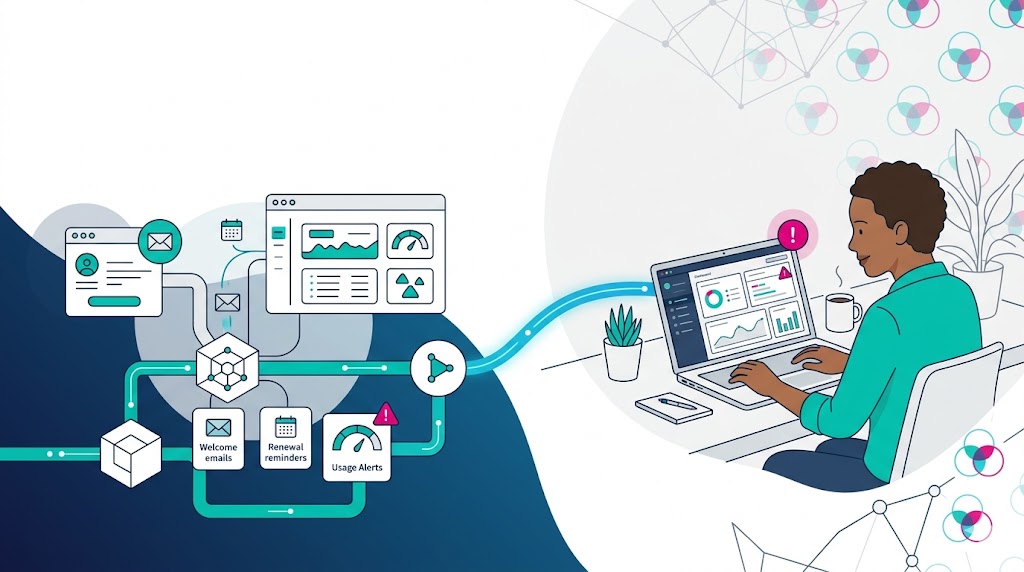
Automation handles the mechanical onboarding sequence: welcome emails, tutorial prompts, feature introduction sequences, check-in reminders. These fire reliably and at scale.
What automation doesn’t do: notice when a new customer hasn’t logged in in a week, recognize that their usage pattern suggests confusion rather than adoption, or send a personal note that opens a conversation before the customer silently churns.
VA onboarding tasks in a SaaS context:
- Monitor onboarding completion rates and flag accounts that are falling behind
- Send personalized check-in messages to customers who appear stuck
- Coordinate product demos or training sessions for customers who need additional support
- Gather and document customer feedback during the onboarding window
- Update customer records with onboarding status notes and next-action flags
The goal is an onboarding experience that feels personal at scale — which requires a human who can distinguish the customers who are progressing well from those who need intervention.
Renewal Management and Expansion
In SaaS, renewal is a revenue event, not an administrative task. The customers who renew — and who expand their usage — represent the difference between growth and churn. Yet many SaaS companies manage renewals through automated sequences and hope.
A VA who owns the renewal motion adds a human layer at critical moments.
Pre-renewal tasks:
- Flag accounts approaching renewal windows (typically 60-90 days out) and categorize by health score
- Reach out to at-risk accounts with personal communication rather than automated reminders
- Schedule renewal conversations between the account team and customers who need direct engagement
- Prepare renewal briefings: account history, usage data, any outstanding issues, talking points
- Track renewal commitments and follow up on unsigned contracts
Expansion tasks:
- Identify customers whose usage suggests they may benefit from an upgrade or additional seats
- Draft personalized expansion proposals based on account context
- Follow up on expansion conversations and coordinate the upsell process
- Document expansion outcomes and update the CRM
The key difference between an automated renewal sequence and a VA-managed renewal motion is discernment. Automation treats all expiring contracts the same. A VA recognizes that the 200-seat enterprise account and the two-person startup require completely different approaches.
Customer Success Operations
Customer success is simultaneously one of the highest-leverage functions in SaaS and one of the most administratively demanding. CSMs spend significant time on tasks that don’t require their customer relationship expertise: documentation, CRM updates, scheduling, reporting, data pulling.
A VA for customer success operations frees CSMs to spend their time on the relationship work that actually moves the needle.
CS operations tasks:
- Maintain customer health score tracking and flag accounts that drop below thresholds
- Prepare weekly CS team reports: accounts by health score, recent activity, upcoming renewals, escalations
- Schedule QBRs (quarterly business reviews) and prepare briefing documents
- Document customer calls and update CRM records with action items and next steps
- Manage the escalation queue: categorize incoming support escalations and route to the appropriate team member
- Send meeting follow-up summaries to customers after key interactions
The result: your CS team spends more time with customers and less time on the administrative overhead that currently consumes their calendar.
Content and Communications Operations
SaaS companies have high content demands: product updates, feature announcements, help documentation, case studies, email campaigns, social media, webinar logistics. A VA with content operations experience can own significant portions of this workload.
Content operations tasks:
- Research and draft blog posts, product update announcements, and help center articles
- Manage the content calendar and make sure deadlines are tracked and met
- Repurpose long-form content into social media posts, email excerpts, and newsletter sections
- Coordinate webinar logistics: promotion, registration management, reminder sequences, post-event follow-up
- Monitor social media channels and manage community engagement
- Coordinate with freelance writers, designers, or agencies and manage deliverable review
For early-stage SaaS companies that don’t yet have dedicated marketing operations staff, a VA who can own content operations provides significant output for a fraction of full-time employee cost.
Sales Support and Lead Operations
SaaS sales teams — especially in PLG (product-led growth) or self-serve models — generate significant operational demand that doesn’t require an AE’s time.
Sales support tasks:
- Research leads and prepare account briefs before sales calls
- Update CRM records after calls and flag pipeline changes
- Coordinate trial-to-paid conversion outreach for free users who hit engagement signals
- Manage SDR scheduling and follow-up sequences
- Prepare proposal documents and customize templates for individual prospects
- Track open proposals and coordinate follow-up timing
- Run win/loss analysis: gather data on churned customers, compile exit interview summaries
A VA who handles sales research and administrative support lets your AEs spend more time in conversations and less time in Salesforce.
Data, Reporting, and Intelligence
SaaS companies generate a lot of data. Turning that data into information — summaries, dashboards, competitive intelligence, user behavior analysis — is time-consuming work that often falls through the gaps because nobody owns it.
Data and reporting tasks:
- Pull weekly/monthly metrics reports from your analytics stack (Mixpanel, Amplitude, Stripe, etc.)
- Compile competitive intelligence: monitor competitor announcements, pricing changes, product updates
- Maintain your win/loss database and generate periodic analysis
- Track app store reviews and G2/Capterra reviews, and compile sentiment summaries
- Research industry trends and prepare briefing documents for leadership meetings
- Coordinate the board deck assembly: gather data from department heads, format slides, check for consistency
These tasks are genuinely valuable — your team should be making decisions based on this data — but they’re not a good use of a product manager or engineer’s time. A VA who owns reporting infrastructure makes the data accessible without pulling technical resources away from product work.
Recruiting and HR Operations Support
Growing SaaS companies hire frequently, and recruiting is operationally demanding: job postings, applicant tracking, interview scheduling, offer letter coordination, onboarding logistics.
Recruiting operations tasks:
- Manage job postings across multiple platforms
- Screen incoming applications against defined criteria and flag qualified candidates
- Schedule interviews and coordinate between candidates and interviewers
- Prepare interview briefing packets for interviewers
- Send rejection communications for candidates who don’t progress
- Coordinate offer letter creation and track signature status
- Manage new hire onboarding logistics: equipment ordering, account setup, first-week scheduling
For a team doing regular hiring cycles, a VA who owns recruiting operations saves significant engineering and management time on the administrative side of the process.
The Automation Boundary in SaaS Operations
A key principle for SaaS VA deployment: automate the predictable, delegate the judgment-dependent.
The predictable workflows — trial activation emails, renewal reminder sequences, usage threshold alerts, invoice generation — should be automated. They fire reliably, at scale, without human involvement.
The judgment-dependent moments — a customer who’s struggling with onboarding, an account that’s showing churn signals, a renewal conversation with a dissatisfied customer — need a human. The automation surfaces these situations; the VA handles them.
Building the handoff between automation and human correctly is more important than the sophistication of either element. A simple automation that reliably surfaces the right situations to the VA, combined with a skilled VA who handles those situations well, outperforms elaborate automation that tries to handle judgment calls mechanically.
Building a SaaS VA Stack
A few practical notes on tool integration for SaaS companies deploying VA support:
CRM access is table stakes. Your VA needs full read/write access to the CRM to be effective in customer-facing roles. If they can’t update records, they can’t own the workflow.
Communication tool integration. Your VA should be operating out of your company’s email domain (using an alias or a shared inbox) for customer-facing communications. A response from riley@yourcompany.com is more credible than riley@externalagency.com.
Task management integration. The automation layer should create tasks in your VA’s work queue when it surfaces situations that need human attention. This requires integration between your automation tool (Zapier, n8n, HubSpot workflows) and your task management system.
Access controls matter. Define what your VA can do independently versus what requires approval. For customer communications, this typically means: routine follow-ups and scheduling are autonomous; pricing conversations and contract changes require check-in.
Hiring for SaaS VA Roles
SaaS VA roles have specific requirements beyond general VA skills:
Tech comfort. Your VA will be operating in your product, your CRM, your analytics tools. Genuine comfort with software products and the ability to learn new tools quickly are non-negotiable.
Data literacy. The ability to pull reports, read dashboards, and synthesize data into summaries is valuable across almost every SaaS VA role.
Customer communication quality. In customer-facing roles, your VA is representing your brand. Their written communication quality should match your company’s standard.
Understanding of SaaS metrics. A VA who understands what MRR, churn, NPS, and health scores mean — and why they matter — will make better judgment calls than one who’s learning SaaS terminology on the job.
At VAConnect, our matching process for SaaS clients accounts for these requirements specifically. We don’t place generalist VAs in SaaS operations roles — we match based on tool familiarity, communication quality, and the ability to operate in a fast-moving product environment.
Getting Started
The fastest path to value in a SaaS VA deployment: start with one function, get it working well, then expand.
The highest-impact first deployment for most SaaS companies is customer onboarding support or renewal operations — the functions where human intervention has the clearest revenue impact. Start there. Build the workflows, establish the communication standards, run the first 60-day cycle, evaluate the outcomes.
Once that function is working, add the next. Customer success operations, sales support, content ops — each adds a layer of operational capability that compounds with the others.
The alternative — trying to hand over everything at once — produces confusion and suboptimal outcomes. One function done well builds the trust and context that make the next function work better.
VAConnect places virtual assistants with specific SaaS operations experience for growing software companies across the US, UK, and Australia. Our matching process ensures the VAs we place understand product environments, SaaS metrics, and customer success workflows.