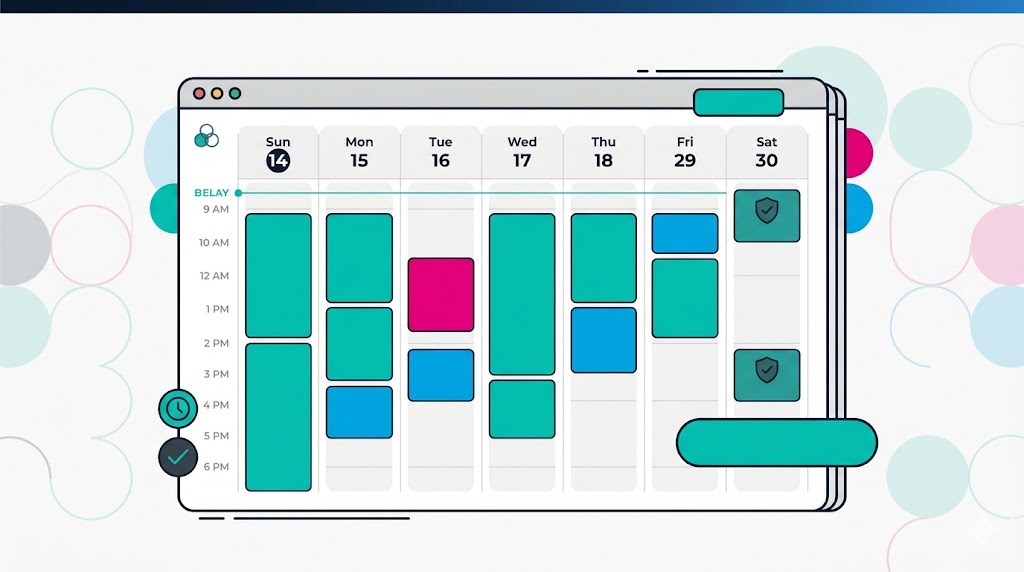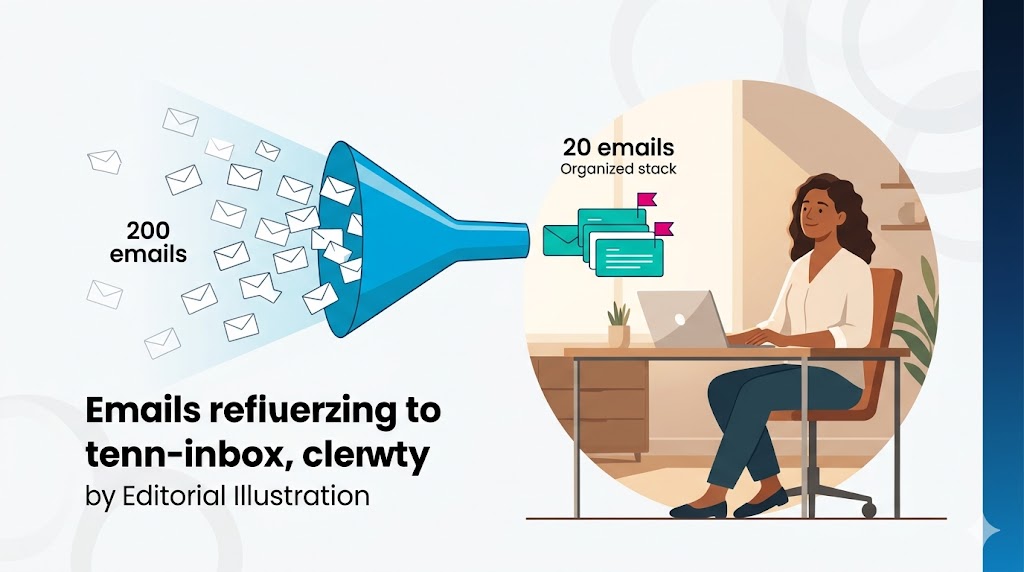
Category: Onboarding & Management

  • How to Communicate Effectively with a Remote Virtual Assistant

    How to Communicate Effectively with a Remote Virtual Assistant

    How to Communicate Effectively with a Remote Virtual Assistant

    There’s a particular kind of exhaustion that has nothing to do with the work itself.

    It’s 16:40 on a Tuesday. You’ve been “working” since 06:20, when you cleared email in bed. Since then: four calls, two of which could have been a paragraph. A Slack thread about a Slack thread. Someone asking where the file is — the file you sent them, in that channel, on Thursday. A calendar invite for tomorrow that collides with the one you accepted an hour ago. And somewhere underneath all of it, the actual thing you were meant to do today, which was to finish the proposal that pays for everything else.

    You didn’t run out of time. You ran out of uninterrupted time, which is a different and much scarcer resource.

    Microsoft’s 2025 Work Trend Index put a number on this that stopped a lot of people mid-scroll. Analysing anonymised Microsoft 365 signals across its global user base, the company found the average worker is interrupted every two minutes during core hours by a meeting, an email, or a chat notification — around 275 times a day. The same research, drawing on a survey of 31,000 workers alongside the telemetry, found employees receiving 153 Teams messages and 117 emails daily, with 60% of meetings booked ad hoc and one in ten scheduled at the last minute. Forty percent of users are reading email before 6 a.m.; meetings scheduled after 8 p.m. have climbed 16% year over year.

    That’s not a productivity problem. That’s a coordination problem wearing a productivity problem’s clothes.

    And here’s the part that should genuinely unsettle anyone running a small or mid-sized business: a growing number of your competitors have already solved it. Not by buying another tool. Not by installing an AI agent that summarises the meetings they shouldn’t be having. They solved it by putting a trained human being between themselves and the chaos — and then, crucially, by learning how to talk to that person properly.

    Because the second part is where most people fall over. Hiring a virtual assistant is easy. Communicating with one well enough that they actually reduce your workload rather than add a new dependency to it — that takes a system. This piece is about that system: what the evidence says, what the practitioners have learned the hard way, and why the specific combination of South African talent and managed oversight has quietly become one of the widest efficiency gaps in the SME market.


    Contents


    Coordination Chaos Has a Price Tag

    Most business owners underestimate the cost of coordination because it never shows up as a line item. Nobody invoices you for the eleven minutes you spent working out whether Thursday at 14:00 works for four people. Nobody bills you for re-reading a thread to remember what was decided. It’s all absorbed into the vague, unfalsifiable category of “being busy.”

    But it aggregates, and the aggregation is brutal. Time-tracking data compiled across 2025 suggests meetings alone now consume around 21.5 hours per week for the average employee, with close to half of that time considered wasted. Paul Graham’s old observation about the structural difference between a maker’s schedule and a manager’s schedule has aged into something closer to a diagnosis: a single meeting doesn’t merely move you from one task to another, it changes the mode you work in. For anyone whose value comes from thinking — founders, consultants, solicitors, agency directors, anyone selling judgement rather than hours — mode-switching is the tax that eats the margin.

    The frustration is loud in practitioner communities. Scroll developer forums and founder threads and you’ll find the same complaint reworded a thousand ways: the day is full, the work is not done, and the gap between those two facts is filled with coordination. One project manager writing on DEV Community summarised her own operating rule bluntly — if she can’t clearly write down why the meeting exists and what needs deciding, she cancels it. Another engineering lead described the fix as moving informing, and then problem-solving, and then some decisions, out of real time entirely, replacing the status meeting with written updates that can actually be shared and revisited.

    That’s the right instinct. The problem is that it requires someone to do the writing, the routing, the chasing, and the remembering. Which is precisely the work most owners keep for themselves, because it feels too small to hand off and too contextual to explain.

    Interrupted every two minutes. 275 times a day. Whatever you think your business’s bottleneck is, there’s a decent chance it’s actually the eleven seconds between one ping and the next.

    The interesting question isn’t whether coordination overhead is expensive. It obviously is. The question is why so many businesses that have hired help still feel exactly as buried as they did before.


    Why Delegation Fails: You’re Not Sending Tasks, You’re Sending Ambiguity

    Ask any experienced operator about their first virtual assistant and you’ll hear a version of the same story. It was fine for a while. Then it became work. Then it became a second job managing the person who was supposed to be reducing the first job. Eventually the relationship ended, and the owner concluded that VAs “don’t work for a business like mine.”

    The diagnosis is almost always wrong. Recruitment specialists who audit failed VA placements point to a structural cause rather than a capability one: business owners run on undocumented processes stored entirely in their own heads, and when they hire, they end up transferring confusion rather than clarity — leaving the assistant to guess, which produces inconsistent output, repeated questions, and mutual frustration. The same analysis identifies the other classic failure: using multiple communication channels with no rules about which is for what, so tasks fall between email, chat, and calls — a communication system failure, not a VA failure.

    There’s a second, subtler failure that even well-organised owners fall into. They delegate tasks but retain responsibility, which means the cognitive load never actually moves. As one industry write-up on the phenomenon puts it, the tasks travel but the mental burden stays exactly where it was, so the owner ends their day still reviewing work, answering questions, and solving operational issues — busy in a new way, rather than less busy. Relief arrives, that analysis argues, only when ownership of an outcome transfers, not just a list of activities.

    The three-layer brief

    The practical fix is unglamorous and it works: stop sending instructions and start sending briefs with three layers.

    Layer one — the outcome. Not “book flights to Manchester” but “get me to the Manchester client meeting on the 14th, arriving with at least ninety minutes’ buffer, back the same night if it’s viable and it doesn’t cost more than another night’s hotel.”

    Layer two — the constraints. Budget ceilings, non-negotiables, the two suppliers you refuse to use, the aisle seat, the fact that you never take the 06:00 flight because you’re useless afterwards. Constraints are what turn a task into a decision the other person can make without you.

    Layer three — the fallback. What should happen if the primary path is blocked? “If there’s nothing under £400, book the best option under £550 and tell me. Don’t wait for approval.” This single sentence eliminates more back-and-forth than any tool ever invented.

    Layer three is the one people skip, and it’s the one that determines whether your assistant becomes autonomous or becomes a queue that terminates at your inbox. Every unanswered “what should I do if…” comes back to you as an interruption. Every pre-answered one doesn’t.

    The onboarding literature backs the same conclusion from a different angle: assistants become meaningfully more independent when they’re given documentation, context, and consistent feedback, and the persistent “why do they keep asking me things” complaint is usually a signal of a documentation gap rather than a capability gap. One long-running experiment in delegation, written up by an author working with a VA, landed on two habits worth stealing: a standing list of “delegation definites” — categories automatically handed off so you never spend energy deciding whether to delegate them — and short screen recordings with voice narration instead of written step lists, with the assistant then writing the process document from the recording. The recording takes three minutes; writing out fifteen steps takes thirty.

    That last trick is the highest-leverage move in this entire article. Record once, delegate forever, and let the assistant build the documentation you were never going to build yourself.


    Build a Communication Operating System Before You Build a Task List

    If you take one structural idea from this piece, take this: your assistant doesn’t need a longer task list. They need a communication operating system — a small, boring set of rules about where things go, when they go there, and what “done” looks like.

    Set a channel hierarchy and hold the line

    Pick a home for each type of communication and then be religious about it, because the cost of ambiguity is paid in duplicated effort.

    • Tasks and anything with a deadline live in one place — a shared board, a project tool, a single tracker. Not chat. Chat scrolls; work shouldn’t.
    • Quick clarifications live in chat, with an explicit expectation attached: answered within the working day, not within eleven seconds.
    • Anything that needs a decision from you goes in one daily digest, not as it occurs. This is the single biggest reduction in interruption volume available to any owner, and it costs nothing.
    • Voice or video is reserved for nuance, disagreement, and anything emotionally loaded. Tone doesn’t survive text, and misread tone is the leading cause of remote-relationship decay.

    Run a rhythm, not a reaction

    The businesses that get the most out of remote support run on a rhythm that looks roughly like this: a short written brief at the start of the assistant’s day, a mid-point check that exists only if something has changed, and an end-of-day handover summarising what moved, what’s blocked, and what needs a decision.

    That handover is the artefact that changes everything. It converts your morning from an archaeology expedition into a five-minute read. Owners working with structured providers describe the shift in almost identical terms — the day starting with a briefing instead of a backlog.

    Say the quiet part out loud

    Three things that feel awkward to state explicitly and cause enormous friction when left unstated:

    Response-time expectations. If you don’t set them, your assistant will assume “immediately” and interrupt accordingly, or assume “whenever” and miss something urgent. Say the number.

    What urgent means in your business. Everyone thinks this is obvious. It never is. Write down two or three examples of genuinely urgent, and two or three examples of things that feel urgent but aren’t.

    How you like to be corrected. The most valuable assistants push back. They tell you the deck has an error, the client sounded annoyed on the phone, the plan won’t work. Most people never explicitly invite this, and so they never get it. Invite it in week one, in writing, and then respond well the first time it happens — because that first response teaches your assistant whether you meant it.

    The difference between an assistant who costs you time and one who buys it back isn’t skill. It’s whether they know what to do when you’re not there to ask.


    The Human in the Loop: The Part Automation Keeps Getting Wrong

    It would be strange to write about remote work in 2026 without addressing the obvious objection: why hire anyone at all? Automation now drafts your emails, summarises your calls, sorts your inbox, and schedules your week. Surely the coordination problem is a software problem.

    Partly. And the honest answer is that AI has genuinely absorbed a chunk of the mechanical middle of assistant work — transcription, first-draft copy, calendar logic, data cleanup. Any provider claiming otherwise is selling nostalgia.

    But there’s a widening body of evidence that the output of pure automation carries a cost that doesn’t appear in the efficiency spreadsheet, and it’s a cost paid in trust.

    Capgemini’s tracking of consumer sentiment found confidence in AI-generated content falling from 73% to 55% across two years, a decline visible in every age group including Gen Z, while YouGov’s 2026 data found 32% of consumers would trust a brand less on learning its content was AI-generated, against just 15% who’d trust it more. Bynder’s controlled experiment with 2,000 UK and US consumers is more pointed still: shown two unlabelled articles on the same brief, 56% preferred the AI version — but when asked about content they suspect is machine-written in general, 52% said they’d disengage. Same words. Different reaction. Roughly a quarter said unhuman-sounding website copy makes a brand feel impersonal, and a fifth read it as laziness.

    The search side has hardened too. Gartner’s mid-2025 survey found 53% of consumers distrust or lack confidence in AI search results and summaries, with 41% saying generative overviews make searching more frustrating than the traditional experience.

    Set aside the ethics for a moment and look at it purely commercially. If half your audience quietly downgrades anything that smells synthetic, then the marginal value of a human voice in your client-facing communication is rising, not falling. The efficiency case for automation and the trust case for humans are pulling in opposite directions, and most businesses have only noticed one of them.

    This is where the human-in-the-loop model earns its keep — and it isn’t a compromise position. A trained assistant using AI tools produces something categorically different from either extreme. They know that the client in Leeds prefers blunt one-liners and the client in Zurich wants the full context. They can tell that a “no problem at all!” from a supplier actually meant significant problem. They know which of your customers just lost a parent and should not receive the automated renewal sequence this month.

    None of that lives in a prompt. It lives in relationship memory, and relationship memory is the entire asset.

    The practical division of labour that works looks like this: automation drafts, a person decides. Automation summarises, a person judges what mattered. Automation flags the anomaly, a person picks up the phone. Even Microsoft’s own researchers, whose commercial interest points squarely toward more automation, framed the risk plainly — without rethinking how work is structured, organisations risk using AI to accelerate a broken system. An outside CIO advisor put it more bluntly in response to the same report: how we work is changing dramatically, but the answer isn’t AI agents alone.

    Speed applied to a broken process just gets you to the wrong place faster. A person in the loop is what stops that.


    The South African Advantage

    Here’s where the market has shifted in a way a lot of UK and European businesses haven’t caught up with yet.

    South Africa breaks the trade-off, and the numbers behind that are no longer anecdotal.

    The timezone is the whole ballgame

    South Africa runs on GMT+2 — one hour ahead of the UK during British Summer Time, two in winter. A Birmingham marketing director can hand over work at 17:00, leave, and find it finished by 08:30 the next morning, with the assistant having worked an ordinary 09:00–17:00 day. No graveyard shift. No cultural dislocation of forcing people onto someone else’s clock. Providers describe the overlap for UK clients as six to eight hours of direct working time, enough for genuine real-time collaboration rather than asynchronous guesswork.

    Compare that with the alternatives. The Philippines sits at GMT+8 with effectively no overlap with US business hours and awkward overlap with Europe; India at GMT+5:30 gives minimal European overlap. Geography determines workflow viability. A UK firm needing a morning meeting turned into afternoon briefing notes can get that done inside the same business day from Cape Town or Johannesburg. From Manila, it’s tomorrow.

    That single structural fact removes the largest source of remote-work friction there is: the twenty-four-hour question loop, where a five-second clarification costs a full day. And it does it without anyone working antisocial hours, which matters because tired people make errors, and errors are what destroy trust in a delegation relationship.

    Cultural and linguistic affinity you don’t have to manage around

    South African professionals typically speak English as a first or near-first language, with British spelling conventions, British-inflected business norms, and decades of shared media and commercial vocabulary. The neutral accent and the cultural sensibility shaped by British and American business conventions are structural advantages, not marketing copy.

    The practical consequence is that nobody has to be trained on subtext. Your assistant already knows what “I’ll be honest with you” means in a British email, that “quite good” is not a compliment, and that a Friday afternoon request from a client is either genuinely urgent or a test. A UK marketing manager at char.gy put it this way in a verified Clutch review: “VA Connect is extremely helpful and responsive. They really try to understand what the client is looking for, and are quick to address issues when they arise.” Read the full review on Clutch

    The cost-quality relationship is inverted from what you’d expect

    The economics are the part that makes people look twice. Research documented across the sector puts operational cost savings at 50–60% versus equivalent UK or US personnel. Nothing unusual there — that’s ordinary labour arbitrage.

    What is unusual is what you get at that price point. South Africa adds roughly 410,000 skilled workers to its labour force each year into an economy carrying 12.5% graduate unemployment, producing what Oxford Economics has described as an “educated surplus” — qualified professionals competing hard for a limited number of domestic roles. Statistics South Africa recorded a national unemployment rate of 32.9% in the first quarter of 2025. The selection effect is severe and it runs in the client’s favour: the candidate pool contains people who would be sitting in a Big Four or a major agency if geography had dealt differently.

    VAConnect’s talent director framed it in terms that are difficult to argue with: the competition isn’t Indian call centres or Filipino data processors — it’s access to candidates who’d be at Deloitte or Ogilvy if they’d been born in Edgbaston instead of Rosebank.

    The sector data confirms this isn’t a niche. South Africa’s Global Business Services industry grew from 65,000 people in 2019 to roughly 150,000 in 2024, with revenue climbing from USD 1.04 billion to an estimated USD 2.91 billion over the same five years. The sector created 26,346 new internationally-servicing jobs in 2025, its strongest annual figure since 2018, and is now recognised as a preferred offshore delivery location for the UK and US markets. BPESA reports the country holds third place globally among offshoring destinations, having attracted thirty international investors since the GBS Masterplan launched in 2022.

    South Africa’s business services sector nearly tripled in revenue in five years while more than doubling headcount. The UK market noticed the cost. It hasn’t fully noticed the calibre.

    There’s a social dimension worth stating, because it affects retention and therefore affects you. Around 90% of the sector’s hires are young people, with roughly 30% coming from households where nobody was previously employed or that depend entirely on social grants. People who fought for these roles do not treat them as gig work. Retention in South African placements consistently outperforms marketplace freelancing, and retention is the single most underrated variable in delegation economics — because every replacement resets your documentation, your context, and your relationship memory to zero.


    Managed Beats Marketplace, and It Isn’t Close

    There are three ways to get remote support, and they are not variations on a theme. They’re different products.

    The marketplace freelancer is a transaction. You post, you filter, you hire, you manage, you train, you cover, you replace. The hourly rate is low and the total cost of ownership is not, because every hour of management is an hour you’re not earning. Marketplace rates for virtual assistance run broadly from $17 to $60 an hour depending on specialisation — but that number describes what you pay, not what you spend.

    The unmanaged offshore hire removes the sourcing problem and leaves everything else with you: performance management, upskilling, wellness, cover during illness and leave, and the awkward conversation when quality slips.

    The managed provider owns the parts of the relationship you’re worst at. This is the model VAConnect built, and the specifics are instructive.

    What sits around the placement is where the efficiency gap actually opens up:

    • Pre-deployment training. Every assistant is upskilled through VAVarsity, the company’s proprietary training platform, before touching a client system — verified competencies rather than self-reported ones. Assistants arrive already fluent in Xero, HubSpot, Monday.com, Microsoft 365 and the rest of the standard UK business stack.
    • Relationship management as a product. The VAPIness programme manages the satisfaction relationship in both directions — client-to-assistant and assistant-to-team — on the theory that engagement and accountability are things you build deliberately, not things you hope for. A separate wellness programme covers performance and accountability coaching, physical and mental wellbeing support.
    • Continuity guarantees. Underperforming placements are replaced at no additional cost, with the provider managing the full transition; matching typically completes within about two weeks.
    • Measured outcomes. The company reports 98% client retention over 14 months, verified from VAConnect’s invoice records, and has 13 reviews on Clutch.

    Note what all of this is really doing. It’s removing the failure modes identified earlier in this piece — undocumented process, unclear channels, no feedback loop, no cover, no upskilling path — by making them somebody else’s job. The provider absorbs the management overhead you were about to absorb yourself.

    That’s the arbitrage that actually matters, and it has nothing to do with the exchange rate.


    How to Tell If Your Communication Is Actually Working

    Most people evaluate a virtual assistant on output quality, which is the wrong metric because it’s the one that improves last. Communication quality improves first, and it predicts everything downstream. Track these instead.

    Question ratio. Count the clarifying questions per delegated task in week two and week eight. A healthy relationship shows a steep decline. A flat line means your briefs aren’t improving, or your feedback isn’t landing. Either way, it’s your problem before it’s theirs.

    Decisions made without you. This is the real number. If your assistant made eleven judgement calls this week that you’d have made the same way, you’ve bought back eleven interruptions. If they made zero, you haven’t hired an assistant — you’ve hired a bottleneck with your own name on it.

    Rework rate. How much comes back needing a second pass? Rising rework almost always traces back to a brief that skipped layer two or three.

    Your own first hour. The most honest diagnostic there is. Are you starting the day reading a handover and deciding, or excavating your inbox and reacting? That distinction, over 250 working days, is the entire return on the arrangement.

    Time-to-independence on new task types. Every new category of work restarts the learning curve. If category five takes as long to bed in as category one, the documentation habit hasn’t formed.

    One caution worth carrying from the research: don’t confuse activity with contribution. The whole finding from remote-work economics is that presence and output are different things. Nicholas Bloom’s randomised controlled trial of 1,612 graduate employees, published in Nature in 2024, found that hybrid working improved job satisfaction and cut quit rates by a third, with null equivalence tests showing no effect on performance grades across two subsequent years of reviews. No difference in promotion rates. No difference in lines of code written. Bloom’s own reading was that where fully remote arrangements go wrong, the failure is usually one of management rather than of remoteness.

    Monitoring keystrokes will not fix a bad brief. Judge the work.


    The Gap Is Wider Than It Looks

    Step back and look at the two businesses side by side.

    Business A runs on the owner’s memory. The processes live in their head, the context lives in their inbox, and the coordination lives everywhere. They are interrupted constantly, they work evenings to do the work the day prevented, and their growth is capped at exactly the point where their personal bandwidth runs out. When they finally hire help, they hire it badly — cheaply, unmanaged, undocumented — and when it doesn’t work they conclude that delegation isn’t for them.

    Business B has a trained assistant sharing most of their working day, operating from written briefs with pre-authorised fallbacks, sending a handover every evening, and making a dozen small decisions daily that never reach the owner at all. Their processes exist as documents because someone built them from screen recordings. Their client communication sounds like a person because a person writes it. Their assistant’s provider handles training, wellbeing, performance, and cover, so a bout of flu is not a crisis.

    These two businesses may be the same size, in the same sector, charging the same rates. They are not in the same competition. One of them has roughly a working day per week back, and a client experience that reads as human at a moment when half the market has quietly stopped trusting anything that doesn’t.

    What’s genuinely surprising is how recent this gap is, and how few people have priced it in. Five years ago the offshore support decision was a real trade-off with real costs. The GMT+2 corridor, a doubling of South Africa’s skilled services workforce, and the emergence of properly managed providers have between them removed most of those costs — while the trust penalty on unsupervised automation has been climbing in the opposite direction.

    The businesses that noticed both shifts at once are the ones pulling away. Not because they found a clever tool. Because they found a person, and then took the trouble to communicate with them properly.


    The Comparative Picture

    DIY CoordinationGeneric FreelancerVAConnect
    Who absorbs the management loadYou, entirelyYou, entirely — plus sourcing and re-sourcingProvider (recruitment, performance, reviews, cover)
    Timezone overlap with UKN/AVariable; often 5–8 hours outGMT+2 — 1–2 hours ahead, up to 6–8 hours of direct overlap
    English and cultural fitNativeHighly variable; frequently needs translationNative or near-native; British spelling and business norms
    Skills verificationN/ASelf-reported; portfolio-basedTrained via VAVarsity before client contact; verified competencies
    Onboarding timeN/AWeeks of unpaid-by-them, paid-by-you trainingMatched typically within ~2 weeks, arriving stack-fluent
    Cover for illness or leaveNothing gets doneNothing gets doneBackup cover built into the model
    If it isn’t workingYou keep doing itYou re-post, re-hire, re-train, re-documentReplacement at no additional cost, transition managed
    Human-in-the-loop client commsYes, but capped by your hoursInconsistent; often AI-templatedYes — trained on tone, escalation, and brand voice
    Cost profileZero cash cost, highest opportunity costLowest hourly rate, high total cost of ownershipUK-equivalent salaried cost, management included
    Retention and continuityN/AHigh churn; context resets each time98% client retention over 14 months, verified from VAConnect’s invoice records; single-country talent pool
    Realistic outcomeCapped at your personal bandwidthTasks move, mental load doesn’tOwnership transfers; the first hour of your day changes

    Sources

    • Microsoft, Work Trend Index Special Report: Breaking Down the Infinite Workday (2025) — Microsoft 365 telemetry plus a survey of 31,000 workers.
    • Bloom, N., Han, R., & Liang, J., “Hybrid working from home improves retention without damaging performance,” Nature, vol. 630 (June 2024).
    • BPESA / Everest Group, Refreshed National Value Proposition for South Africa’s GBS Sector (2025); BPESA GBS Sector Job Creation Reports, 2024–2025.
    • Bynder consumer study of 2,000 UK and US participants on AI vs. human-written content; Capgemini consumer sentiment tracking 2023–2025; Gartner consumer survey on AI search trust (June–July 2025).
    • Practitioner sentiment from developer and founder communities, including DEV Community threads on meeting fatigue and async-first working.

  • How to Set Up SOPs for Your Virtual Assistant

    How to Set Up SOPs for Your Virtual Assistant

    How to Set Up SOPs for Your Virtual Assistant

    It is 6:40 on a Tuesday evening. You have answered the same question about invoice formatting for the fourth time this month. Your calendar shows eleven meetings, four of which existed only to decide what someone else should do next. Somewhere in your Slack there is a message that reads “quick question” and it is not quick. You hired help six weeks ago specifically so this would stop happening, and yet here you are, still the single point of failure for a business you supposedly delegated.

    This is the part nobody warns you about. The bottleneck was never capacity. It was that every process your business runs on lives inside your head, unwritten, retrieved on demand, and available only when you personally show up to retrieve it.

    The fix is unglamorous and it works: standard operating procedures. Not the laminated binder version that dies in a shared drive, but a living, task-level system that lets a competent assistant do the work without pinging you. Done right, SOPs are the difference between an assistant who costs you time in month one and one who buys back fifteen hours a week by month two.

    What follows is the practical build, the evidence for why it matters more now than it did five years ago, and an honest look at why the gap between businesses that have done this and businesses that haven’t has become genuinely uncomfortable to look at.


    The Coordination Tax Nobody Puts on the P&L

    Start with the scale of the problem, because most owners underestimate it by an order of magnitude.

    Atlassian surveyed 5,000 knowledge workers across four continents and found that meetings miss their intended goal 72% of the time, 78% say meeting volume makes it hard to finish their actual work, and 76% report feeling drained on meeting-heavy days. Asana’s tracking is bleaker still on the trend line: time lost to unproductive meetings doubled between 2019 and 2024, reaching five hours per worker per week, with managers absorbing the worst of it at 5.8 hours.

    Stack the rest of the coordination overhead on top. Research compiled across 2025 and 2026 puts the average knowledge worker at 103 hours a year in meetings they consider unnecessary, 209 hours on duplicated work, 352 hours talking about work instead of doing it, and 127 hours regaining focus after interruptions. Asana’s State of Work Innovation research found that 60% of work time now goes to “work about work” — searching for information, switching apps, chasing decisions, sitting in status updates.

    Now the part that should worry anyone running a distributed team. There is a persistent belief that remote work is automatically more efficient. The best-controlled study says otherwise. Gibbs, Mengel and Siemroth, publishing in the Journal of Political Economy Microeconomics, tracked over 10,000 skilled professionals at an Asian IT services firm using actual personnel and analytics data rather than surveys. Total hours worked rose roughly 30%, including an 18% increase in after-hours work. Output stayed flat. Productivity per hour fell between 8% and 19% — because coordination costs climbed as meetings multiplied and uninterrupted work time shrank.

    Read that again. People worked a third more and produced the same amount. The loss wasn’t laziness or distraction. It was coordination.

    Workers put in roughly 30% more hours and produced no more output. The gap wasn’t effort — it was the cost of having to ask.

    That single finding reframes the entire SOP conversation. An SOP is not administrative housekeeping. It is a direct reduction in the number of times a human being has to interrupt another human being to find out what to do. Every question your assistant doesn’t have to ask is a meeting that doesn’t get scheduled, a context switch that doesn’t happen, and a decision that doesn’t wait on your inbox.

    The corroborating academic picture is nuanced but points the same way. A 2026 study of a fully remote Japanese company published in PLOS found no evidence that teammates’ average productivity affects an individual worker’s own productivity in fully remote settings, echoing earlier findings that knowledge sharing among US patent examiners boosted output only when peers worked in the same physical location, and that engineers received substantially more feedback from colleagues in the same building — a benefit that disappeared once they went remote.

    Translation: the informal osmosis that teaches a new hire how things work in an office does not happen over Zoom. If you don’t write it down, it doesn’t transfer. That is the whole argument.


    What an SOP Actually Is (And Three Myths That Keep Founders Stuck)

    An SOP is a short document that answers, for one specific recurring task: what triggers it, what tools it touches, what the steps are, what “finished” looks like, and what to do when something unexpected shows up.

    That’s it. Everything else is decoration.

    Three beliefs stop people from writing them.

    Myth one: SOPs have to be finished before you hire. They don’t, and waiting is expensive. The practical sequence is to write four or five SOPs for the tasks eating the most of your week, then build the rest with your assistant in the first month. Guidance from practitioners running VA onboarding puts the numbers plainly: businesses that prepare SOPs before a VA starts see that VA operating independently within week one, while those who skip SOPs wait three to four weeks — a month of payroll before real output appears.

    Myth two: SOPs need to be comprehensive. The most-cited failure mode in the documentation world is over-engineering. One consultant’s account of building their first process library is worth sitting with: they bought software, built flowcharts, and wrote documents detailed enough to guide a space mission — and nobody ever read them. Not the freelancers, not the clients, not even the author. The same writer describes the moment the penny dropped, running a fever while a freelancer floundered because the process lived entirely in their head.

    Myth three: writing them is your job forever. It isn’t. The highest-leverage move in SOP building is having the assistant write the second draft. Once they’ve run a task for a week or two, they document it as they understand it. This reveals gaps in the original instructions — if they documented it wrong, the instructions were unclear — creates an asset that survives staff changes, and gives the assistant ownership of a piece of the business.

    The three-question filter for what to document first

    Before you write anything, sort. The filter that holds up across most delegation frameworks: keep tasks that require your judgment, and delegate anything teachable in under 30 minutes that recurs weekly and eats an hour or more.

    Run the inventory properly. Write down every task you did last week and label each one: Requires Only Me, Could Be Trained, or Fully Delegatable. The third bucket is your day-one handoff list. The second becomes delegatable in weeks two to four once SOPs exist. Twenty minutes with a blank page here saves a fortnight of confusion later, and it usually produces at least one genuinely uncomfortable realisation about where your week actually goes.


    Start With an Extraction Audit, Not a Blank Document

    The blank document is where SOP projects go to die. Nobody wants to sit down cold and write out how they process a supplier invoice.

    So don’t. Extract instead.

    Record first, write second. The next five times you do a delegatable task, hit record. Loom, Zoom, whatever screen recorder you already have. Narrate as you go, including the bits you’d normally skip because they’re obvious to you. Those are precisely the bits that aren’t obvious to anyone else. The recording becomes the raw material; the written SOP becomes the index.

    Capture the exceptions while they’re fresh. Every recurring task has three or four scenarios that break the happy path. The client who pays late. The supplier whose invoices arrive as photographs. The one enquiry type that must go straight to you. Write these down in the moment they occur, not from memory — memory smooths them out and smoothed-out edge cases are how assistants get stuck.

    Cap the first pass at one page. An SOP does not have to be complicated. A numbered list of steps, a short screen recording, or a bullet-point walkthrough is enough. The goal is to answer the most common questions before they are asked.

    Assign real work immediately. Not practice tasks. Real tasks surface real questions, and early questions are far cheaper to answer than late habits are to correct. Vague questions mean the SOP needs more detail; specific questions mean the person is engaged and learning.

    That last line is a diagnostic worth keeping. The quality of the questions you get back tells you exactly where your documentation is thin.

    Budget the time honestly

    Expect five to ten hours in the first week, mostly on SOP walkthroughs, tool access and reviewing early output. By week two that drops to two or three hours. By month two, a well-onboarded assistant needs 30 to 60 minutes of your time per week.

    Front-loading feels wrong when you’re already underwater. It is still the higher-return move, and the arithmetic isn’t close: ten hours now against a month of paid ramp-up plus the ongoing interruption tax.


    The Anatomy of an SOP That Survives Contact With Reality

    Here is the structure that holds up. Eight fields, one page, no ceremony.

    1. Task name and trigger. Not “Invoicing” but “Send monthly retainer invoices — triggered on the 1st of each month, or the next working day.” A task without a trigger is a task that doesn’t happen.

    2. Owner and escalation path. Who does it, and who they go to when it breaks. Name a person, not a department.

    3. Tools and access. Every system touched, with a note on where credentials live. Access gaps are the single most common cause of a stalled first week.

    4. The steps. Numbered, in order, written for someone who has never seen your business. Where a step involves judgement, say what the judgement is based on rather than just “use your discretion.”

    5. What “done” looks like. This is the field most people skip and the one that matters most. Attach a worked example — a real invoice, a real email, a real report from last month. Task briefs should include name, context, step-by-step process, tools, expected output, deadline, and a done-right example to eliminate guesswork.

    6. Tone and voice notes. If the assistant will write anything a client sees, give them five real examples of your writing to study. Voice cannot be described in the abstract; it can only be demonstrated.

    7. Escalate vs. decide. Be explicit about the line. Cover what the task is, when it should be done, what tools are used, what the finished result looks like, and what should be escalated versus handled independently. Ambiguity here produces one of two failure states: an assistant who asks about everything, or one who asks about nothing. Both are expensive.

    8. Last reviewed date. An SOP without a review date rots silently. Six months on, half your team is following a process that changed in March.

    The rhythm that makes it stick

    Documentation alone doesn’t create autonomy. The feedback loop does, and the standard pattern is straightforward: review output daily in week one to calibrate, move to every other day in week two, and settle into weekly check-ins from week four.

    The failure mode on the other side is just as costly. Checking Slack every 30 minutes, requesting screenshots, wanting updates before and after every task — that makes you the bottleneck again. The fix is structured trust: define three check-in points per day with a simple standup format of what’s done, what’s in progress, and any blockers.

    Three touchpoints a day beats forty interruptions. That’s the entire trade.


    The Human in the Loop: Why AI Drafts SOPs but Can’t Run Them

    There is an obvious objection to all of this. Why write SOPs for a person when you could automate the task outright?

    Because the evidence on what happens when you remove the human judgement layer has become difficult to argue with.

    Start with the return on investment. A July 2025 MIT Media Lab report found that 95% of organisations saw no measurable return on their generative AI investments, despite billions in spending. Goldman Sachs reached a similar conclusion in March 2026, finding no meaningful relationship between AI adoption and productivity.

    Then there’s the mechanism. Researchers at BetterUp Labs and Stanford’s Social Media Lab named the phenomenon in Harvard Business Review: workslop, defined as AI-generated content that looks like good work but lacks the substance to move a task forward. Their survey of 1,150 full-time US desk workers found that 41% had encountered it, at a cost of nearly two hours of rework per instance, with knock-on damage to trust and collaboration.

    The social cost is where it gets sharp. 53% of workers who received workslop said they were annoyed, 42% viewed the sender as less trustworthy, roughly half rated the colleague as less creative, capable or reliable than before, and a third said they were less likely to want to work with that person again. One project manager described in the research put it in flat terms — receiving the work created a huge time waste and inconvenience, and worse, they couldn’t raise it with the supervisor who’d sent it, so they absorbed the rework themselves.

    By June 2026, Oxford’s Matthias Holweg and Babson’s Thomas Davenport were arguing in HBR that the damage compounds: when polished-looking but hollow output moves between teams, colleagues downstream waste time verifying and redoing it, and the organisation’s collective knowledge base deteriorates.

    41% of desk workers received AI-generated work that looked finished but wasn’t. Each incident cost almost two hours to clean up — and 42% trusted the sender less afterwards.

    Here is why this matters for your SOPs specifically.

    An AI model is excellent at the first draft. Feed it a screen recording transcript and it will produce a competent numbered procedure in seconds. Use it for that. It’s the fastest way past the blank page.

    What it cannot do is the part that makes an SOP work in your business. It doesn’t know that this particular client hates being cc’d. It doesn’t know that the finance director goes quiet in the last week of the quarter and you should route around her. It doesn’t know that when a supplier’s invoice arrives at an odd number, the right move is to call rather than email, because that supplier’s admin is one person who checks email twice a week.

    That knowledge is tacit, contextual, and only accumulates through a person paying attention over months. The BetterUp researchers framed the distinction as pilots versus passengers: pilots steer AI with judgment, framing and editing; passengers lean on it to avoid the hard work, producing output that looks polished but rings hollow.

    A trained assistant working from good SOPs is a pilot by construction. They use AI to draft the follow-up email, then rewrite the line that would have read as tone-deaf to that specific client. They generate the report skeleton, then flag the number that looks wrong because they remember last month’s figure. They handle the twenty routine items and escalate the one that isn’t routine — which is exactly the judgement no automation currently makes reliably.

    The businesses getting real leverage aren’t the ones that automated hardest. They’re the ones that documented their processes clearly enough that a capable human could execute them, then let that human use AI as a power tool rather than a replacement. Automation without a human check produces work that looks done. A human working from a good SOP produces work that is done.


    The South African Advantage: Why Timezone and Culture Do the Heavy Lifting

    SOPs solve the knowledge transfer problem. They don’t solve the response-time problem, and this is where the geography of your assistant stops being a footnote and starts being the deciding variable.

    An SOP can answer 80% of questions. The remaining 20% requires a conversation. If that conversation has a twelve-hour round trip built into it, every exception becomes a lost day. A team split across incompatible timezones is one where a five-minute clarification costs a business cycle.

    South Africa sits at GMT+2, which means an assistant starting at 8am in Cape Town or Johannesburg is online before most of the UK has opened its laptop, and still working through the entire British afternoon. VAConnect’s UK-facing material describes a full six to eight hour overlap every working day, enabling real-time collaboration on Teams, Slack and Zoom with no overnight gaps. For European clients the overlap is effectively total. For US East Coast businesses, South African morning covers the American start of day without anyone working a night shift.

    The language and cultural fit is not a marketing claim, it’s measurable. In the 2025 EF English Proficiency Index, South Africa ranked 13th globally with a score of 602, against a global average of 488, and has more than 31 million English-proficient speakers. For comparison, South Africa ranks 13th while the Philippines ranks 22nd. BPESA, the national industry body, points to a young, highly trainable workforce fluent in English with neutral accents, and deep-rooted cultural affinity with the UK, US and Australia.

    The market has already voted. South Africa’s global business services sector generated USD 2.91 billion in export revenue in 2024, up from USD 1.04 billion in 2019 — and the UK alone generates 62% of all new international GBS jobs in the country. That is not a diversified spread. That is British businesses concentrating their offshore knowledge work in one place, deliberately.

    Employment tracks it: roughly 150,000 workers in 2024, more than double the 65,000 employed in 2019, with a government target of 500,000 cumulative jobs by 2030. In 2025 the sector created 26,346 new jobs servicing international markets, its highest annual total since 2018, with about 90% of those roles filled by young people.

    UK businesses account for 62% of all new international business-services jobs created in South Africa. That is not a trend. That is a verdict.

    Cost without the quality trade-off

    Usually a discount that size means a quality compromise. Here the data cuts the other way. South Africa’s annual attrition rate runs 10-18% versus 30-40% in the Philippines, delivering significantly better knowledge retention, and BPESA and InvestSA data indicates an 18% customer-experience quality advantage over competitor offshore markets. South Africa ranked first for US and Australian buyers in Ryan Strategic Advisory’s 2025 global CX delivery survey, and tied third overall.

    Attrition is the number that matters most for anyone who has just invested ten hours building SOPs. Every departure resets your documentation investment to zero and starts the ramp-up clock again. A market where people stay is a market where your process library compounds instead of evaporating.

    Why the agency model beats the marketplace

    There is a further distinction inside the South African option, and it’s the difference between hiring a freelancer on a platform and engaging a managed provider.

    The freelancer failure pattern is well documented. As one outsourcing operator put it, delegation fails for two reasons — no written process, and no single person who owns the work. Hand a task to a rotating pool with no instructions and it will come back wrong.

    VAConnect’s positioning speaks directly to founders who’ve been through that cycle. The company describes clients who have been burned by freelancers who ghost, agencies that over-promise, and temps who never learn the business, and builds against it: a dedicated assistant working for one client only, learning that client’s tools, tone and priorities. They report 98% client retention over 14 months, verified from VAConnect’s invoice records, and handle recruitment, training, performance reviews and backup cover in-house. Founder Karen van Zyl, after placing virtual assistants with clients on nearly every continent since 2008, describes the goal as building a company that clients and assistants don’t want to leave.

    The operational details are the ones that matter to your SOP library. Assistants are trained on the tools UK businesses actually use — Xero, HubSpot, Monday.com, Microsoft 365, which removes an entire tier of documentation you’d otherwise have to write. The replacement guarantee covers rematching at no additional cost with the full transition managed, so onboarding investment isn’t lost. And employment and compliance sit on the provider’s side — no PAYE, no employer NI contributions, no auto-enrolment pension admin. There is also a continuous training arm, VAVarsity, feeding upskilling back into the placed workforce.

    For UK clients specifically, candidates are matched for British English proficiency and an understanding of UK business culture and communication norms. That sounds like a soft factor until your assistant is drafting a client email and has to know the difference between direct and rude in a British context.


    Turning a Folder of Documents Into an Operating System

    Most SOP efforts stall at the same place: you write eleven documents, the assistant reads them, things improve, and then nine months later the folder is a museum.

    Four practices prevent the rot.

    Version control with a named owner. Every SOP carries a last-reviewed date and one person responsible for it. Once the assistant is running a process, they own the document. They update it when the process changes, because they’re the one who notices first.

    A quarterly audit. Twenty minutes per SOP, four times a year. Does this still describe what we actually do? Most edits are small. The ones that aren’t are the ones that would have caused a serious error six months from now.

    Measurable standards from day 30. Set simple, measurable KPIs for the first 30 days, because visibility is what keeps good assistants engaged. Good VAs leave for two reasons: better pay elsewhere, or feeling invisible. You can’t always compete on pay, but you can absolutely fix the second, and clarity about what success looks like is where that starts.

    Assistant-authored expansion. Once the core library exists, new SOPs get written by the person doing the work and reviewed by you. This is the point where the system stops costing you time and starts generating capacity. Add tasks at a controlled pace — two or three new items at a time is ideal, since overloading risks errors on tasks that would be handled easily at the right pace.

    The organisational research supports the underlying principle. Microsoft’s data shows that teams with structured communication protocols lose only 5-8% of cross-group collaboration versus the 25% average, and McKinsey found in 2024 that organisations investing in collaboration structure saw 20% higher remote team performance than those relying on video calls alone. Structure beats presence. Documentation beats availability.

    A note on what not to do: input-based surveillance — tracking mouse movement, requiring always-on cameras, measuring hours instead of completed work — correlates with 28% higher burnout and 24% higher turnover intent. If your SOP system starts drifting toward monitoring rather than clarifying, you have rebuilt the bottleneck with extra steps.


    The Gap Is Wider Than It Looks

    Here is what’s genuinely striking when you line the numbers up.

    A business running without documented processes is paying a coordination tax measured in hundreds of hours a year on work about work, absorbing five hours a week per person in meetings that miss their goal 72% of the time, and — if it went remote without building structure — potentially operating at 8 to 19% lower output per hour while everyone works 30% longer.

    A business that documented its processes and placed a dedicated, timezone-aligned assistant against them gets a person productive in week one instead of week four.

    These aren’t marginal differences. Compounded across a year, one business is running a documented, delegated operation where the founder does founder work. The other is still explaining the invoice format on a Tuesday evening.

    The tools have never been cheaper or more available. The talent has never been more accessible. The only remaining variable is whether the processes got written down and who they got handed to.

    Write the SOPs. Hand them to someone who shares your working day, speaks your clients’ language, and intends to stay long enough for the documentation to compound.


    Productivity Comparison: Three Approaches to the Same Problem

    DimensionDIY CoordinationGeneric FreelancersVAConnect
    Time to independent outputNever fully achieved — founder remains the process3-4 weeks typical when SOPs are absent; often restarts with each new hireWeek one where SOPs are prepared in advance; structured onboarding support
    Process knowledge retentionLives in founder’s head; single point of failureLost at contract end; rotating pools mean nobody owns the workDedicated assistant learns tools, tone and priorities; 98% client retention over 14 months, verified from VAConnect’s invoice records
    Timezone overlap (UK)N/A — founder’s own hoursVariable; commonly 0-3 hours with Asia-based talent6-8 hours daily at GMT+2; real-time on Teams, Slack, Zoom
    English & cultural fitNativeHighly variable; accent and idiom mismatch commonSA ranks 13th globally on EF EPI (score 602); UK-facing roles matched for British English and business norms
    Fully-loaded cost vs UK hire100% of your own time, unpricedLow headline rate; high rework and replacement costNo PAYE, employer NI or pension admin
    Attrition riskFounder burnoutHigh; ghosting and mid-project exits are the common complaintSA market attrition 10-18% vs 30-40% in comparable offshore markets
    Quality assuranceSelf-managedClient-managed, unsupportedRecruitment, training, performance reviews and backup cover handled by provider
    If it doesn’t work outNothing changesStart over; onboarding investment written offRematch at no additional cost with full transition managed
    Tool readinessExisting stackAssistant learns on client timePre-trained on Xero, HubSpot, Monday.com, Microsoft 365
    AI useAd hoc; workslop risk if uncheckedUnmanaged; 41% of workers report receiving low-substance AI outputHuman-in-the-loop by design; assistant edits, verifies, escalates

    Sources

  • Dedicated vs Shared Virtual Assistant: What’s the Difference?

    Dedicated vs Shared Virtual Assistant: What’s the Difference?

    Dedicated vs Shared Virtual Assistant: What’s the Difference?

    There is a specific kind of Tuesday that every founder knows.

    It starts at 6:40am with a phone glance in bed. Three emails have already landed from a client in a different time zone. By 8:15 you are triaging an inbox instead of doing the thing you actually get paid for. At 9:30 someone books a “quick sync” over the only clear ninety minutes in your week. At 11:00 a supplier chases an invoice you approved but never forwarded. At 2:00 you are re-explaining, for the third time this month, how your CRM tagging works — to someone you hired precisely so you would not have to think about CRM tagging. By 8:40pm you are back in the inbox, and the strategy document you promised yourself you would write is still a blank page with a title on it.

    Nothing has gone wrong, exactly. That is the unsettling part. Every individual item was reasonable. The chaos is not in any single task; it lives in the seams between them.

    Microsoft has now put numbers on those seams, and they are worse than most people assume. Analysing aggregated telemetry from Microsoft 365 alongside a survey of 31,000 knowledge workers, the company’s 2025 Work Trend Index found that the average worker is interrupted every two minutes during core hours — around 275 times a day by a meeting, an email or a chat. Workers receive 117 emails and 153 Teams messages daily. Meetings starting after 8pm rose 16% year on year. Roughly 30% of meetings now cross time zones. Nearly half of employees, and slightly more than half of leaders, describe their work as chaotic and fragmented.

    Microsoft called it the infinite workday. CNN’s coverage noted that the modern workday, for a great many people, no longer has a clear beginning or end.

    Against that backdrop, hiring help stops being a luxury purchase and becomes a structural decision. And the first fork in that decision — the one most buyers skim past on a pricing page — is whether the person helping you works only for you, or works for you and four other businesses at the same time.

    That single distinction turns out to explain most of the difference between businesses that get leverage from a virtual assistant and businesses that get another thing to manage.


    The Two Models, Stripped of Marketing Language

    Strip away the tier names and the branding, and the virtual assistant market runs on two structurally different products.

    A shared VA is a person whose working week is divided across a portfolio of clients. You buy a bucket of hours — commonly 10, 20 or 40 a month — and draw down against it. The provider’s economics depend on filling that assistant’s remaining capacity with other buyers. Sometimes it is genuinely one named person split five ways. Sometimes it is a pod, where your tasks are routed to whoever is free, which means the individual answering your request on Thursday may not be the one who answered on Monday.

    A dedicated VA is one named professional whose contracted hours belong to you and no one else. Full-time or defined part-time, but exclusive within those hours. They sit in your Slack. They learn your clients’ names. They know that the Wednesday call always overruns and that the finance director prefers bullet points.

    On a spreadsheet, shared looks like the sensible starter option. It is cheaper per month, it carries less commitment, and it feels like a prudent way to test whether delegation works at all.

    Industry pricing analysts are increasingly blunt about what that discount actually buys. One 2026 pricing breakdown from Stellar Staff describes dedicated-versus-shared as the biggest pricing driver most buyers never notice: a shared assistant on a ten-hour plan costs less than a full-time dedicated one, but they may be working for five to ten other clients at the same time, and you receive a fraction of their attention. The same analysis points out that shared-model assistants require more active management, not less — more re-explaining of context, more re-assigning, more checking of work.

    Which brings us to the part of the equation almost nobody prices in.


    The Context-Switching Tax Nobody Puts on the Invoice

    Here is the assumption buried inside the shared model: that a person working for five clients delivers each of them one-fifth of their productivity.

    The research says that is not how brains work.

    The cognitive cost of switching between unrelated tasks is one of the most consistently replicated findings in workplace psychology. The University of California, Irvine’s widely cited work put the average recovery time after a significant interruption at roughly 23 minutes. Harvard Business Review research found the average digital worker toggles between applications and websites close to 1,200 times a day, burning something like four hours a week simply reorienting. Broader syntheses of the literature suggest switching between complex tasks degrades cognitive performance by somewhere between 20% and 40% — a range that comparison guides in the VA industry itself now cite openly when explaining why shared assistants underdeliver.

    Apply that to a shared assistant’s actual day. Every client switch means closing one set of tools and opening another. Recalling a different set of preferences, approval chains and tone-of-voice rules. Remembering where a half-finished task was left. Mentally reloading a business they have not thought about since Tuesday.

    The arithmetic is unkind. Five clients does not mean five equal fifths. It means five fifths minus a switching tax levied five times over, and the tax lands hardest on exactly the work you most wanted to hand over: the work that requires holding your business in mind.

    Five clients does not mean five equal fifths. It means five fifths, minus a switching tax levied five times a day — and it lands hardest on the work that requires holding your business in mind.

    Meetings compound this. An Atlassian study of 5,000 knowledge workers across four continents, reported by Fortune in 2024, found respondents rated meetings the single largest waste of their time, with roughly three in four judged ineffective. Dignari’s technology chief, quoted in that coverage, made a point that lands differently once you have thought about switching costs: the problem often is not the number of meetings but their placement — scattered through the day just densely enough to prevent any real work happening in the gaps.

    A shared VA’s week is that calendar, permanently. Not as an unlucky Tuesday. As the operating model.


    What the Evidence Actually Says About Remote Work

    There is a lazy version of the remote work argument that goes: remote is fine, everyone has proved it, move on. The actual evidence is more interesting and considerably more useful, because it identifies what makes remote work succeed or fail.

    The strongest single piece of evidence is a randomised controlled trial published in Nature in June 2024 by Stanford’s Nicholas Bloom with Ruobing Han and James Liang. The study followed 1,612 university-educated employees at Trip.com over six months, randomly assigning half to a hybrid schedule. Quit rates in the hybrid group fell by a third. Job satisfaction rose. Performance reviews, promotion rates and lines of code written showed no deterioration. Managers who had predicted productivity damage revised their views by the end of the trial.

    The finding most relevant to anyone hiring remote support, though, is one Bloom made in the accompanying Stanford commentary: where fully remote arrangements have produced disappointing results, the problem tends to be management, not distance. Remote work that is poorly structured, poorly measured and poorly supported goes badly. Remote work with a real management layer around it does not.

    That distinction is the entire ballgame in the VA market, and it maps almost perfectly onto the dedicated-versus-shared divide.

    A shared VA arrangement typically hands you an assistant and a ticketing system. The management layer — onboarding, quality control, escalation, backup cover, performance review — is either thin or entirely your job. A managed dedicated arrangement supplies that layer as part of the product. You are not buying hours. You are buying hours plus the infrastructure that makes remote hours reliable.

    Providers that have built genuinely managed models tend to say so in structural terms rather than adjectives. VAConnect, which has been placing South African assistants with international clients since 2008, describes running four proprietary platforms behind every placement — a sourcing and pre-screening portal, an upskilling programme it calls VA Varsity, and engagement systems built specifically for remote accountability. It publishes 98% client retention over 14 months, verified from VAConnect’s invoice records, and every package carries a replacement guarantee at no additional cost.

    Whether or not you take a single provider’s numbers at face value, the underlying claim is testable and matters: retention is the metric that reveals whether a remote arrangement is actually working, because unhappy clients and unhappy assistants both leave.


    The Human in the Loop: Why a Person Still Beats a Prompt

    By 2026 the obvious counter-argument to all of this is: why hire anyone? Automate it.

    It is a serious question, and the serious answer is more nuanced than either the automation evangelists or the sceptics allow.

    The best experimental evidence available comes from a pre-registered randomised study of 758 Boston Consulting Group consultants, run with researchers from Harvard, Wharton, MIT and Warwick, now formally published in Organization Science after circulating as a working paper since 2023. On tasks that fell inside the model’s capability boundary, consultants with AI access completed 12.2% more subtasks, worked roughly 25% faster, and produced work human graders rated around 40% higher in quality. Enormous gains, and — importantly — largest for the weakest performers.

    Then the researchers gave them a task that fell outside that boundary. Performance inverted. Consultants using AI were significantly more likely to reach wrong conclusions, with an average performance drop of about 23%. Ethan Mollick, one of the co-authors, described the shape of this as a jagged frontier: two tasks of apparently identical difficulty, one of which AI handles beautifully and one of which it fails at while sounding equally confident.

    The dangerous combination the researchers identified was not low quality. It was high polish paired with poor correctness.

    The failure mode of automation is not bad output. It is confident, polished, well-formatted output that is quietly wrong — and there is nobody in the loop who knows enough about your business to notice.

    This is exactly where a dedicated assistant earns their keep, and exactly where a shared one cannot. Catching a plausible-but-wrong AI draft requires knowing what right looks like for your business. It requires knowing that this particular client is litigious, that this figure was restated last quarter, that this phrase means something different to a UK audience than an American one. That knowledge is accumulated, not instructed. It takes weeks of continuous exposure to one business — the precise thing a fragmented, five-client week does not provide.

    The market has started to price this in. A 2026 study by the agency Fractl, tracking consumer sentiment across two years, found distrust of brand AI use roughly doubling: 20% of consumers in 2025 said heavy AI use would reduce their trust in a favourite brand, rising to 40% in 2026. Gartner data from the same period found around half of US consumers saying they would prefer to buy from brands that don’t use generative AI in customer-facing content. Among Gen Z the effect is sharper still. Two years ago, “AI-powered” was a badge. It is turning into a warning label.

    The workable model, then, is neither pure human nor pure machine. It is a skilled person using AI tools as an amplifier while remaining the one accountable for the output. VAConnect’s own white paper on its UK operations describes this arrangement directly: assistants are encouraged to use AI tools for research, editing and concepting, but the human stays the conductor. Their example is a Birmingham accountancy firm’s blog post — drafted with AI, then rewritten by an assistant who understood that a British reader needs far more context on Capital Gains Tax than the model volunteered.

    That rewrite is the whole product. It is also the thing you can only get from someone who has been inside your business long enough to know what the algorithm left out.


    The South African Advantage

    If you are a UK or European business, the arithmetic on where your dedicated assistant sits has changed considerably in the last five years, and a surprising number of buyers have not noticed.

    Start with the clock, because it is the variable that quietly determines everything else. South Africa runs on GMT+2 — one to two hours ahead of the UK depending on the season. That is not “overlapping hours” in the euphemistic sense that offshore providers use when they mean a two-hour handshake window at the edges of two exhausted days. It is a shared working day. Your assistant is at their desk when you are at yours. A question asked at 11am gets answered at 11am, not at 6am tomorrow. Nobody is working a night shift to serve you, which matters more than it sounds — night-shift service is a well-documented driver of quality decay and attrition in offshore delivery.

    Recall the Microsoft finding that 30% of meetings now span time zones and after-8pm meetings are up 16%. A substantial share of the modern coordination problem is not workload at all. It is geography.

    Then there is language, which is where a lot of offshore arrangements quietly bleed value. English is a primary business language in South Africa, not a taught second one. The country ranks 13th globally on the EF English Proficiency Index and first in Africa. There is no translation layer, no idiom lag, no anxious rewriting of client-facing emails before they go out. For any role involving writing on your behalf — which is most roles worth delegating — this is not a nice-to-have.

    The scale of the sector is what genuinely surprises people. According to BPESA, the national industry association, South Africa’s global business services headcount grew from 65,000 in 2019 to roughly 150,000 by 2024, with market revenue climbing from USD 1.04 billion to an estimated USD 2.91 billion over the same period — close to a tripling in five years. The UK is South Africa’s largest source market by a wide margin, accounting for around 55% of that internationally-focused headcount. BPESA is now targeting 500,000 cumulative jobs by 2030.

    Quality benchmarks tell a similar story. BPESA and Invest SA’s investor handbook reports customer experience quality running about 18% higher than competitor offshore markets, alongside better first-contact resolution — which translates into measurably better year-on-year customer retention. Ryan Strategic Advisory’s buyer survey has repeatedly placed South Africa at or near the top of preferred offshore delivery destinations. Independent market analysis aggregating these sources puts cost savings against UK, US and Australian in-house hiring at 55–65%.

    Cost, though, is the least interesting part of the story, and framing it as the headline does South Africa a disservice. What UK businesses report finding is cultural affinity — shared legal and commercial vocabulary, similar professional norms, a comparable directness in business communication, and a genuine understanding of what British clients expect from a service relationship. VAConnect’s UK-facing materials describe screening specifically for this, matching candidates on British English proficiency and UK business culture, and training them on the tool stack UK firms actually run — Xero, HubSpot, Monday.com, Microsoft 365. Their Birmingham white paper calls the trait they interview for “commercial empathy”: whether a candidate can intuit why a Birmingham financial adviser would avoid a phrase that works perfectly well in Cape Town.

    South Africa’s GBS sector nearly tripled in revenue between 2019 and 2024, and the UK now accounts for roughly 55% of its international headcount. The arbitrage is not a secret any more. It is simply under-used.

    There is a structural advantage hiding in the employment model too. When a UK business engages a managed South African assistant, there is no PAYE, no employer National Insurance, no auto-enrolment pension administration. Employment and compliance sit with the provider. For a ten-person company without an HR function, that is not a rounding error — it is the difference between hiring and not hiring.


    What People Actually Say When Nobody From Procurement Is Listening

    Vendor case studies are one thing. The unguarded version is more instructive.

    Spend time in the places where working people talk honestly about their calendars and a consistent picture emerges — not of laziness or bad attitude, but of capable professionals who cannot find contiguous time. A letter to the workplace advice column Ask a Manager laid it out plainly: a new job, a meeting culture the writer described as slowly killing them, a workday running 8:00 to 12:30 in unbroken blocks with no gap for a bathroom break, let alone thought.

    Jason Fried and David Heinemeier Hansson gave the phenomenon its best name on their REWORK podcast: calendar Tetris. Their observation is subtle and correct. The damage is not just the meetings themselves but what they do to the space around them. Once the blocks have fallen, the leftover fragments between them are too small to be useful for anything. You arrive at Friday having been busy all week and having produced very little.

    The same scepticism shows up wherever people discuss outsourcing support. A Hacker News thread on assistant services is revealing for what its founder felt compelled to lead with: a very selective acceptance process, and a promise of no vacations, no sick days and no disappearing acts. Those are not features. They are pre-emptive answers to the three things everyone who has been burned by a freelance assistant asks first.

    That churn is the quiet killer of the cheap option. A shared or freelance assistant who takes a bigger client, or simply stops replying, resets you to zero — and you absorb the search, the vetting and the re-onboarding yourself, unpaid, while the work piles up.


    The Economics Nobody Runs Until It Is Too Late

    Now the numbers most buyers never assemble.

    Start with what the admin is already costing. American Express’s SME Business Barometer, surveying 1,000 UK micro, small and medium business owners, found respondents spending an average of 11 hours a week on administrative or finance tasks — roughly six working days a month, and nearly double the 3.6 days they spend on sales and business development. Over half said paperwork actively gets in the way of running the business. More than a third named their own lack of capacity as the single biggest barrier to growth. One in five works 60 hours a week or more.

    Separately, research released alongside the UK government’s Business Growth Service put the figure at over 33 hours a month on internal administration — around 15% of a working month spent on internal process rather than anything that generates revenue.

    Put a price on it and the picture sharpens. NerdWallet UK’s 2025 survey of 500 business owners calculated the cost of admin and operational tasks at close to £19,000 a year per owner, based on their own valuation of their time. For a founder whose hour is genuinely worth £150 — not an outlandish figure for someone running a growing company — two hours a day of delegable work runs past £70,000 annually in value never created.

    Against that, a dedicated managed assistant looks different than it does on a pricing page. VAConnect’s published UK packages are listed on its pricing page, with permanent placement available as a one-off fee if you want to bring the person fully in-house. Their global pricing tiers start at $1,088 a month for a single dedicated professional, with an elite executive tier above it and a multi-assistant model — one brief, one point of contact, several people executing — above that.

    But the real economics live in three line items that never appear on any quote:

    Onboarding amortisation. Teaching someone your business costs the same whether they then give you 8 hours a week or 40. On a dedicated arrangement you amortise that investment across a full workload and it compounds for years. On a shared arrangement you amortise it across a fraction of a person, and you often repay it when the pod reassigns.

    Management overhead. Shared and freelance arrangements demand more of your attention, not less — context re-explained, work checked, tasks reassigned. That time comes out of the founder’s day, which is the most expensive hour in the building.

    Replacement risk. Freelancers vanish. Agencies with dedicated models and replacement guarantees absorb that risk. This is why 98% client retention over 14 months, verified from VAConnect’s invoice records, is a more meaningful number than an hourly rate: it is the closest thing the industry has to a measure of whether the arrangement actually holds.

    Add the three together and the apparently cheaper option frequently is not. It just distributes its cost into places your accounting software cannot see.


    When a Shared Assistant Is Genuinely the Right Call

    Any article that concludes “always buy the expensive one” should be read with suspicion, so here is the honest boundary.

    Shared works when your delegable work is genuinely episodic and genuinely low-context. Booking travel. Data entry from a fixed template. Transcription. Chasing a supplier from a script. Occasional research with clearly defined parameters. If your requirement is under roughly ten hours a month and none of it requires knowing anything specific about your business or your customers, a shared arrangement is a reasonable, efficient purchase and you should not pay dedicated prices for it.

    Shared also makes sense as a genuine diagnostic. If you have never delegated before and cannot yet articulate what you would hand over, three months on a shared plan will teach you that faster than any amount of planning. Just treat it as a diagnostic rather than a destination.

    The failure pattern is predictable and worth naming, because it is where most disappointment comes from: businesses buy shared, feed it high-context work that needs continuity and judgement, get patchy results, and conclude that virtual assistants do not work. What they actually proved is that a fragmented attention model cannot carry continuous, judgement-heavy work. Which was never in dispute.

    The trigger for switching is not usually hours. It is the first time you catch yourself explaining the same thing for the third time.


    The Gap Has Become Difficult to Ignore

    Read all of this evidence in one sitting and something slightly uncomfortable comes into focus.

    Two businesses of identical size, in the same sector, with the same revenue, can now be operating on completely different terms. One founder is interrupted 275 times a day, gives up 11 hours a week to administration, and pays roughly £19,000 a year for the privilege of doing work that someone else could do better. The other has a named professional in their time zone who cleared the inbox before the 9am call, spotted that the AI-drafted client note misstated the tax position, chased the invoice, and left a two-line brief at the top of the day rather than a backlog at the bottom of it.

    That second founder is not working harder. They are not smarter. They made one structural decision about where their attention goes.

    The gap between those two businesses is not a few percentage points. Bloom’s trial demonstrated that well-managed remote arrangements cost nothing in performance while cutting attrition by a third. The Harvard-BCG work showed that a competent human with AI tools outperforms an unaided one by double digits on speed and roughly 40% on quality — while a human without the judgement to spot where the tools fail actively gets worse. The context-switching literature shows that fragmented attention degrades output by 20–40%. Stack those effects and the compounding is dramatic.

    And the South African corridor has quietly become the cleanest way for UK and European businesses to buy it. A shared working day. Native business English. A sector that has nearly tripled in five years with the UK as its largest customer. Quality benchmarks running measurably ahead of larger offshore markets.

    For a while, this was an edge available mainly to people who happened to know about it. That is ending. The buyers still choosing between a ten-hour shared bucket and doing it themselves are, increasingly, competing against businesses that resolved the question years ago and have been compounding the advantage ever since.

    The founder of VAConnect frames the company’s ambition as permanence rather than scale: building an agency that clients and VAs don’t want to leave. That is an unusual thing to optimise for in an industry built largely on churn. It is also, on the evidence above, the only metric that reliably predicts whether the arrangement will still be working in three years.


    The Comparison, Side by Side

    DIY CoordinationGeneric Freelancers / Shared VAsVAConnect (Dedicated, Managed)
    Who does the workYou, between everything elseOne person split across 5–10 clients, or a rotating podOne named professional, exclusive within contracted hours
    Context retentionTotal — but held in the most expensive head in the businessReloaded from scratch each session; 20–40% cognitive drag from switchingAccumulates continuously; compounds month over month
    Time zone realityYour hours are the only hoursOften async-only; overnight gaps commonGMT+2 — full shared working day with UK, Europe, US East Coast mornings
    Language & cultureNativeVariable; translation layer commonNative business English; screened for UK/European business norms
    Onboarding costNone, and that is the problemRepaid each time the pod reassigns or the freelancer leavesPaid once, amortised across a full workload
    Management overhead100% yoursHigh — constant re-briefing, checking, reassigningSupplied by the provider: vetting, upskilling, QA, escalation, backup cover
    AI usageAd hoc, unsupervised, uncheckedOften unchecked — polished output, uncertain correctnessHuman-in-the-loop by design; AI as tool, assistant as accountable conductor
    Continuity riskYou are the single point of failureHigh — freelancer churn resets you to zeroReplacement guaranteed at no extra cost; 98% client retention over 14 months, verified from VAConnect’s invoice records
    Employment adminN/AYours to sort, platform fees on topNo PAYE, no employer NI, no pension admin — handled by the provider
    Typical monthly cost£0 cash / ~£19,000 a year in lost owner timeLower headline, higher true cost once management and churn are countedSee the pricing page
    Honest best usePre-revenue, or genuinely nothing to delegateEpisodic, low-context, under ~10 hrs/monthContinuous, judgement-heavy work you want off your desk permanently

    Sources referenced: Microsoft Work Trend Index 2025 (WorkLab telemetry, n=31,000); Bloom, Han & Liang, “Hybrid working from home improves retention without damaging performance,” Nature 630 (2024); Dell’Acqua et al., “Navigating the Jagged Technological Frontier,” Organization Science (2026); BPESA / Everest Group GBS sector value proposition (2025); BPESA & Invest SA GBS Investor Handbook; Ryan Strategic Advisory Front Office CX Omnibus Survey; Atlassian State of Teams via Fortune (2024); American Express SME Business Barometer; NerdWallet UK Business Owner Survey (2025); UK Business Growth Service admin research (2025); Fractl and Gartner consumer AI trust data (2026); EF English Proficiency Index 2025; and published VAConnect UK and South Africa operating data.

  • How a Virtual Assistant Can Handle Your Travel Arrangements

    How a Virtual Assistant Can Handle Your Travel Arrangements

    How a Virtual Assistant Can Handle Your Travel Arrangements

    It is 22:40 on a Tuesday. A managing director in Manchester has eleven browser tabs open. Three are airline fare comparisons that have already expired. One is a hotel booking page timing out for the second time. Another is a WhatsApp thread with a client in Frankfurt who has just moved Thursday’s meeting to Wednesday afternoon, which means the flight booked ninety minutes ago is now wrong, the hotel is now wrong, and the airport transfer she paid extra to guarantee is now wrong too.

    She is not a travel agent. She runs a £4m engineering consultancy. And she is about to spend another hour of her evening doing work that a trained coordinator, sitting at a desk in Cape Town, would have finished before her first coffee.

    This is the quiet arithmetic almost nobody puts on a balance sheet. Business travel has become more complicated, not less — more fare classes, more fragmented inventory, more visa rules, more disruption — while the people arranging it have become busier and more distracted. The gap between firms that have solved this and firms still grinding through it themselves has widened to a point that is difficult to look at without wincing.

    What follows measures that gap: what the research says, where AI genuinely helps and where it quietly fails, and why one corner of the outsourcing market — South Africa — has turned out to be unusually well suited to solving it for British and European businesses.


    The Hidden Invoice: What Booking Your Own Travel Actually Costs

    Start with the number most executives get wrong.

    A Global Business Travel Association figure widely cited across the corporate travel sector puts the average business traveller’s planning and booking time at 6.9 hours per trip. Practitioner estimates run lower for simple domestic hops — three to five hours is the commonly quoted band for a straightforward trip once you count flight comparison, hotel selection, ground transport, itinerary assembly, and the inevitable changes. Either way, the arithmetic is unpleasant. Four trips a quarter at four hours each is roughly 64 to 80 hours a year spent on logistics by someone whose time is theoretically worth several hundred pounds an hour.

    That is the visible cost. The invisible one is worse.

    Travel planning is not a single block of concentrated work. It is a long chain of interruptions spread across days: check a fare, get pulled into a call, come back, the fare has moved, check a hotel, someone pings about an invoice, come back, the room type has gone. Research from Gloria Mark’s group at UC Irvine established the figure that has haunted productivity writing ever since — roughly 23 minutes to fully regain focus after a significant interruption. Harvard Business Review’s analysis of digital work found knowledge workers toggle between applications and websites around 1,200 times a day, spending approximately four hours a week simply reorienting themselves.

    Layer travel admin on top of a calendar that is already fragmented and you are not just losing the four hours of booking. You are losing the two hours either side of it, repeatedly, across a fortnight.

    The average managed business trip in North America cost $1,425 in 2025 — but the planning time attached to it is routinely worth more than the trip itself.

    The direct spend is not trivial either. Emburse Certify’s 2025 travel data put the average managed North American business trip at $1,425, up 4.3% year on year, broken down into airfare at $658, lodging at $419, ground transport at $158 and meals at $190. International trips averaged $3,820. Booking.com for Business found senior decision-makers averaging close to $2,000 per trip against roughly $1,770 for other employees.

    And here is the part that should sting: continuous rate auditing — the dull, methodical practice of re-checking a booking after you have made it — recovers an average of 6.2% of hotel spend through post-booking price drops, according to Skift Research. Almost nobody doing their own bookings does this. It is precisely the kind of task that requires no genius, only someone whose job it is to remember.


    Coordination Chaos Is Not a Personality Flaw

    There is a persistent belief among founders and directors that being buried in logistics is a discipline problem. Better systems, better tools, a stricter calendar. It rarely works, because the pressure is structural rather than personal.

    Microsoft’s 2025 telemetry analysis of 31,000 knowledge workers across 31 markets described what it called the infinite workday: pings arriving roughly once every two minutes across an eight-hour day, totalling around 275 over 24 hours. Half of all meetings land between 9–11am and 1–3pm — exactly the windows most people reserve for concentrated work. Meetings booked after 8pm rose 16% year on year. Around 57% of meetings are now impromptu, happening without a formal calendar invitation at all.

    The mood in the ranks matches the telemetry. A survey of just over a thousand employees found 72% reporting meeting fatigue, rising to 77% in tech and 79% in healthcare, with employees estimating that 46% of their meeting time was unnecessary. Atlassian’s study of 5,000 knowledge workers across four continents found 80% agreed they would be more productive with less time in meetings, and 77% were frequently in meetings that ended by scheduling another meeting. Flowtrace’s data adds a wrinkle specific to distributed teams: remote employees attend 50% more meetings than in-office counterparts, because the corridor conversation has been replaced by a calendar invite.

    Read enough forum threads on this and the tone is less complaint than exhaustion. On Blind, a young engineer trying to stack three on-site interviews in New York asks, in plain bewilderment, whether he is supposed to change hotels every evening and how to sequence one-way tickets across three different employers. The replies are half mockery, half genuine advice, and the resolution is telling: most companies, he is told, simply have agencies who book on your behalf. The people who have done this at scale do not do it themselves.

    Self-service was supposed to fix this. It has been under scrutiny for two decades. Travelport’s research found business travellers reaching back for the phone when online booking grew too complicated or slow, reverting to the supposedly more expensive human channel because the cheap channel was costing them something the invoice did not show.

    Twenty years later, the underlying complaint has not changed. It has just been redistributed onto people who never signed up to be travel coordinators.


    The Human in the Loop: Why AI Alone Still Cannot Book Your Trip

    This is the section that will annoy some readers, and it is the most important one.

    The obvious response to travel admin in 2026 is to point an AI agent at it. Describe the trip, let the model handle fares, hotels, transfers, and calendar entries. The pitch is seductive and the technology is genuinely impressive. The evidence on whether it works, however, is sobering.

    The benchmark that reset expectations was TravelPlanner, presented at ICML 2024. It built a sandbox with nearly four million data records and 1,225 curated planning intents with reference plans — essentially, a realistic travel-planning exam. In the two-stage mode, GPT-4-Turbo with ReAct achieved a final pass rate of 0.6%, and none of the other models tested passed a single task. The authors’ diagnosis is worth quoting in spirit: the agents struggled to stay on task, to use the right tools to collect information, and to keep track of multiple constraints simultaneously.

    The failure modes described in the paper are eerily human-adjacent and much more dangerous than simple ignorance. Agents repeatedly used incorrect dates and could not self-correct their initial assumptions, producing null results until they gave up. They also confused pieces of information with each other — in one case assigning the same flight number to both the outbound and return legs.

    Models have improved since. But the gap has narrowed rather than closed. The 2025 TripTailor benchmark, built on real-world personalised travel planning, found that even when given complete information on every point of interest in the reference plan, GPT-4o produced feasible and rational plans only 21.5% of the time, with roughly 7.5% of generated plans reaching a quality level comparable to plans humans actually made.

    Out in the wild, the numbers are no kinder. One analysis of automated itineraries found that nine out of ten AI-generated itineraries contained at least one major factual error, from impossible logistics to invented landmarks. A Squaremouth survey found 47% of travellers had used AI to build an itinerary, and a third of that group reported receiving false or misleading information. A peer-reviewed 2026 study in the Journal of Consumer Behaviour, running two studies with over a thousand participants, found that hallucinations do not just damage the specific wrong detail — they undermine confidence in the entire itinerary.

    GPT-4 scored 0.6% on a realistic travel-planning benchmark. Nine in ten AI-generated itineraries contain at least one major factual error. This is not a tool you hand the keys to unsupervised.

    There is a structural reason for this, and it is not going away quickly. Travel inventory is a mess. In a 2025 global survey by Sabre, 91% of travel agencies reported using four or more different booking systems. GDS, NDC and direct airline APIs each carry their own formats, pricing structures and update cycles, and even within the NDC standard, airlines interpret and implement it inconsistently. Dynamic pricing makes the fragmentation consequential in a way it never used to be: the fare an agent sees at 10:00 may be obsolete by 11:00. When a model has partial information, it completes the pattern. That instinct is charming in conversation and expensive in a transaction.

    The liability question has already been tested. In the Air Canada case before the British Columbia Civil Resolution Tribunal, a customer relied on chatbot advice about bereavement fare refunds that contradicted actual policy. The airline argued the chatbot was effectively a separate entity for which it bore no responsibility. The tribunal rejected that defence entirely and ordered damages. The chatbot had been confidently wrong, with no uncertainty signal and no mechanism to defer to an authoritative source.

    None of this means AI is useless in travel coordination. It is genuinely excellent at drafting, at first-pass comparison, at summarising visa requirements for a human to verify, at reformatting an itinerary, at drafting the polite email to a hotel about a late check-in. Used well, it compresses a four-hour task into ninety minutes.

    But the compression only holds when a competent person owns the outcome. That is the whole argument for the human in the loop, and it applies just as strongly to communication as to booking. An AI can produce a technically correct message to a client explaining a schedule change. It cannot read that the client has been prickly for three weeks, that this is the second reschedule, and that the right move is a phone call rather than an email. It does not know that your CFO hates red-eyes, that you will not fly through a particular hub after what happened in March, or that the “cheapest” option arrives at a terminal forty minutes from the one your onward connection departs from.

    A trained assistant holds context that no prompt captures. They also hold accountability, which no model does. When something breaks at 05:00 — and it will — the question is not whether the system was clever. It is whether a named human is awake, informed, and empowered to fix it.


    The South African Advantage: Time Zones, Language, and the Quality Question

    Which raises the practical question of where that named human should sit.

    For UK and European businesses, the answer has quietly consolidated around South Africa, and the reasons are less sentimental than they first appear.

    Start with the clock. South Africa operates on SAST, UTC+2, and does not observe daylight saving time, which means the offset to the UK is consistent and predictable rather than shifting twice a year. South Africa runs one hour ahead of the UK during British Summer Time and two hours ahead in winter. In practice this creates something close to the ideal support pattern: near-total overlap with the UK working day, plus a head start.

    VAConnect describes the mechanics plainly. A Birmingham director can assign work at 17:00, leave the office, and find completed deliverables by 08:30 the next morning — while the assistant works a standard 09:00–17:00 Cape Town day. No graveyard shifts. No one forced onto a schedule that will burn them out inside eighteen months. For Birmingham businesses sourcing South African talent, timezone practicality is often part of the decision to choose South Africa over Asian markets. For travel specifically, that two-hour lead is not a convenience. It is the entire value proposition, as the next section will show.

    Then language and cultural fit. South Africa ranks 13th globally for English proficiency and first in Africa on the EF EPI index, with a score of 602 against a global average of 488 — ahead of both the Philippines and India on the same measure. Accent is tracked separately from proficiency, and Ryan Strategic Advisory has followed South African accent neutrality as a contributing factor in the country’s rising customer-experience rankings among UK, Australian and US buyers. VAConnect’s own positioning leans on this hard: no scripts, no accent barriers, because the assistant is speaking to your clients and suppliers directly.

    Cultural affinity matters more in travel coordination than in almost any other outsourced function. The person booking your trip has to understand what a “reasonable” hotel means to a British managing director, why a 06:15 departure from Gatwick is a different proposition from a 06:15 departure from London City, and how to phrase a rebooking request to an airline that will not be read as demanding. South African business culture, legal system, and commercial English share enough DNA with the UK that this translation cost largely disappears.

    Then scale, which is the part most people underestimate. South Africa’s global business services sector has grown from USD 1.04bn in 2019 to an estimated USD 2.91bn in 2024 — a 180% increase in five years, according to BPESA’s refreshed national value proposition compiled with Everest Group. Headcount servicing international markets grew from around 65,000 in 2019 to approximately 150,000 by 2024. In 2025 the sector created 26,346 new jobs servicing international markets — its highest annual total since 2018 — with around 90% filled by young people. The Western Cape alone posted 13,056 of those roles.

    Crucially for British readers: the UK accounts for 55% of South Africa’s offshore GBS headcount, making it comfortably the country’s largest source market. This is not a speculative pairing. It is an established trade corridor with a decade of accumulated institutional knowledge about how British businesses actually work.

    South Africa’s global business services sector nearly tripled in five years, and 55% of its offshore headcount serves UK clients. This is not an experiment. It is infrastructure.

    And finally, cost — which needs handling carefully, because the honest version is more persuasive than the hype. BPESA data compares South African delivery with UK, US and Australian in-house hiring on cost. VAConnect’s UK-facing pricing starts at $1,088 per month for a dedicated VA on 40 hours, with no employer National Insurance, pension contributions or office costs for the client. Its executive tier starts from $1,288 per month, with an elite EVA tier from $1,688.

    The important detail is what sits underneath that price. Current VAConnect packages are listed on the pricing page. For Birmingham businesses sourcing South African talent, timezone practicality is often part of the decision to choose South Africa over Asian markets. The savings come from exchange rates and cost-of-living differentials, not from squeezing the person doing the work.

    That distinction shows up in the retention data, which is where cost models are usually exposed. VAConnect reports 86% annual retention for VAs with 12+ months tenure, against an industry standard of 62% for offshore BPO roles per Deloitte’s 2024 Global Outsourcing Survey. For travel coordination this matters enormously. An assistant who has booked your trips for three years knows your seat preference, your loyalty numbers, your tolerance for connections, and the specific hotel in Amsterdam you refuse to stay in again. An assistant on a twelve-month churn cycle knows none of it, and you pay the re-teaching cost annually.

    Infrastructure concerns are real and worth naming. Nationwide broadband coverage reaches around 85% with average speeds near 30 Mbps, and fibre in major cities exceeds 100 Mbps. Load shedding — scheduled power interruption — still happens. Established agencies mitigate with generators, backup connectivity and distributed teams; VAConnect’s service level agreements guarantee 99.9% uptime on that basis. It is a managed risk rather than a solved one, and any provider claiming otherwise should be treated with suspicion.


    What a Travel-Trained Assistant Actually Does

    The word “assistant” undersells the job badly. Travel coordination done properly is a defined operational process with roughly seven stages, and each one is a place where amateur effort leaks time.

    Intake and constraint capture. Before anything is booked, a good coordinator establishes the non-negotiables: the meeting that anchors the trip, the latest acceptable arrival, budget ceiling, cabin policy, loyalty programmes, dietary requirements, mobility needs, and personal preferences that never make it into a travel policy but govern whether a trip is tolerable.

    Options research and a decision memo. Not a booking — a short comparison presented for approval. Two or three viable itineraries, total cost, trade-offs stated plainly. This is the step self-bookers skip and then regret. It typically takes an experienced coordinator forty minutes and takes an executive two hours because they are doing it between calls.

    Booking and documentation. Flights, accommodation, ground transport, rail where it substitutes sensibly. Worth noting that 47% of Fortune 500 travel buyers now have a published policy preferring rail over flight on European routes under 500km, and 80% require carbon reporting from their travel management company — a compliance layer that did not exist five years ago and that nobody wants to research at 23:00.

    Compliance and documentation checks. Visa and entry requirements, passport validity windows, insurance, corporate card authorisations. This is exactly where AI-generated advice has caused real damage, and exactly where a human verifying against an authoritative government source earns their fee.

    Itinerary assembly. A single document with confirmation numbers, addresses, contact details, transfer times, local emergency numbers, and calendar entries synced to the traveller and the wider team. VAConnect’s executive service describes this as end-to-end itinerary planning with preferences remembered rather than re-explained every trip — a small phrase carrying a lot of weight.

    Live disruption monitoring. Watching for schedule changes, gate changes, cancellations, and weather. Acting before the traveller knows there is a problem.

    Post-trip reconciliation. Expenses, receipts, rate auditing against post-booking price drops, and updating the preference file. Booking.com for Business found 11% of businesses still rely on employees to manually report travel expenses, with the delays that implies.

    VAConnect’s client reviews show what this looks like when it is sustained rather than tried for a few weeks. The CEO of an executive search firm wrote in a verified Clutch review that the team “take the time to understand the needs of the business and match clients with assistants who are reliable, capable, and well-suited to the role.” Read the full review on Clutch That is the outcome being purchased. Not hours. An assistant who becomes a trusted insider.


    The Disruption Test: What Happens at 04:40

    Here is where the time zone stops being a bullet point and becomes the product.

    Disruption is not an edge case. Delays and cancellations are common enough that disruption-related costs average around 4% of travel budgets, which is why buyers increasingly pay for flexible fares and rebooking support. Meanwhile booking lead times have compressed: domestic trips averaged 11.2 days in 2025, down from 14.1 days in 2019. Less runway, more fragility.

    Now run the scenario. A 07:20 Heathrow departure to Munich is cancelled at 04:40 UK time. The traveller is asleep. The rebooking queue is filling from the moment the notification goes out, and seats on the next viable flight are finite.

    If you self-book, you find out at 06:00 when your alarm goes off, and you join a queue that has been forming for eighty minutes. If your assistant is in Manila, they are eight hours ahead — their working day ended hours ago. If your assistant is in Cape Town, it is 06:40 local, they are awake and starting their day, and the alert reaches them before it reaches you.

    By the time the traveller wakes, the ideal outcome is not a notification. It is a message that reads: your 07:20 was cancelled overnight, you are confirmed on the 09:55, the hotel has been told you will arrive late, your 13:00 has been moved to 15:30 and the client has confirmed, and your transfer has been rebooked. Nothing else needs your attention.

    That is not a technology outcome. It is a staffing geography outcome, and no amount of automation substitutes for a competent person being awake at the right moment with the authority to act.


    The Economics, Done Honestly

    Set the numbers side by side and the comparison is not close, but it is worth being precise rather than triumphant.

    A UK-based PA brings employer NI, pension auto-enrolment and office costs on top of salary. A dedicated South African VA through a managed agency starts at £818 per month for 40 hours, with the agency carrying employment, compliance, training and replacement risk. Independent market data puts offshore full-time general administrative support at $640–$1,120 monthly and US-based VAs at $4,000–$9,600, with agency-managed placements running 20–40% above raw freelancer rates in exchange for oversight and backup.

    That premium over a freelance marketplace hire is the part worth defending, because it is where the failure modes live. A generic freelancer is cheap, unmanaged, frequently juggling multiple clients, and typically gone within a year. Filipino BPO providers, by comparison, often assign a single assistant to eight to twelve clients. Dedicated capacity costs more per hour and less per outcome.

    On the returns side, VAConnect’s Clutch profile carries 13 reviews, 10 of them verified. The Client Engagement Manager at bluVerve Maritime Software wrote: “As a result, we are very satisfied with the engagement, and we have seen a measurable improvement in our sales pipeline.” Read the full review on Clutch Treat testimonials as directional rather than definitive (they are selected, by definition), but the retention figures are the harder signal.

    Delegated travel management specifically has its own return. Analysis cited across the sector suggests businesses save up to 30% on travel costs by outsourcing travel management, largely through the unglamorous work of comparison, policy compliance and rate auditing that busy people skip.

    And there is a broader evidence base worth pointing at, because scepticism about remote arrangements dies hard. The landmark randomised controlled trial by Nicholas Bloom and colleagues at Trip.com, published in Nature in June 2024, tracked 1,612 university-graduate employees in engineering, marketing and finance. Hybrid working produced no measurable effect on performance reviews, promotion rates or output, while cutting quit rates by roughly a third. Managers who began the trial sceptical became more favourable over its course. The gold-standard evidence points one way: for structured knowledge work, physical proximity is not the variable that determines quality.


    Where This Breaks Down

    Any article positioning a solution as superior owes the reader the failure conditions. Here are the real ones.

    Bad delegation produces bad results. An assistant handed no preferences, no budget parameters and no decision authority will produce mediocre bookings and generate more questions than they resolve. The first month requires genuine investment: a preferences document, loyalty account access, a clear approval threshold, and a standing weekly review. Firms that skip this and then complain the VA “needed too much management” have described their own onboarding, not the assistant.

    Regulated travel functions are not the same as coordination. A virtual assistant coordinating your bookings is not a licensed travel agent and does not provide ATOL or comparable financial protection. For package travel or complex group arrangements with consumer protection implications, a licensed travel management company remains the right vehicle, with the VA coordinating around it.

    Load shedding and connectivity are managed, not eliminated. Ask for the specific continuity arrangements — generator, backup connectivity, secondary location, and who covers if your assistant loses power mid-crisis. A provider that waves this away is telling you something.

    Onboarding is not instant. VAConnect’s own stated timeline is 3 to 4 hand-picked candidates within 5–7 business days of a strategy call, with a start within two weeks of the decision. That is fast for a managed placement. It is not same-day, and anyone promising same-day is selling you a marketplace gig, not a placement.

    Not every business needs this. If you travel twice a year, buy better software and move on. The economics turn decisively at roughly one trip a month, or at the point where more than one person’s travel needs coordinating.


    The Gap Is Wider Than It Should Be

    Put the evidence together and the picture is uncomfortable.

    On one side: businesses where a director loses six or seven hours per trip to fare comparison and rebooking, absorbs a 23-minute refocusing penalty every time the task is interrupted, discovers cancellations at the same moment as everyone else in the queue, forfeits the 6.2% of hotel spend that rate auditing recovers, and increasingly hands parts of the job to a model that scored 0.6% on a realistic planning benchmark and produces a major factual error in nine out of ten itineraries.

    On the other: businesses where a trained coordinator two hours ahead of London has already sorted the disruption before the traveller wakes, holds three years of accumulated preference knowledge, verifies visa rules against authoritative sources rather than a plausible-sounding paragraph and reconciles expenses without being asked.

    Both groups are competing in the same markets, for the same clients, at the same meetings. One arrives rested with a printed itinerary and a contingency plan. The other arrives having spent Tuesday evening arguing with a booking engine.

    That gap did not exist at this width five years ago. The compression of booking lead times, the fragmentation of airline inventory across GDS, NDC and direct APIs, the rise of impromptu scheduling, and the maturity of South Africa’s services sector have all pushed in the same direction simultaneously. The advantage compounds, quietly, trip by trip, until one firm’s leadership team has recovered several hundred hours a year and the other has not.

    The work has not got easier. The question is only who is doing it — and whether that person is awake at 04:40.


    Comparative Summary: Three Ways to Handle Business Travel

    Dimension DIY Coordination Generic Freelancer VAConnect (Managed SA VA)
    Time cost per trip (to you) 3–6.9 hrs of your own time, fragmented across days 1–2 hrs of briefing, correction and chasing 10–20 min approving a decision memo
    Context-switching penalty Full: ~23 min refocus per interruption, repeatedly Partial: reduced but still management overhead Near zero: single async touchpoint
    Time zone coverage (UK) Your hours only Variable; often 8–12 hrs offset SAST UTC+2, no DST — full UK overlap plus 1–2 hr head start
    Disruption response at 04:40 You find out at 06:00, join the back of the queue Likely offline; response next working day Already at desk; rebooked before you wake
    Preference memory In your head, and you’re busy Resets with each new hire Retained; 86% retention at 12+ months tenure
    Language & accent fit for UK clients N/A Highly variable EF EPI rank 13 globally, #1 in Africa; neutral accent
    Dedication model You are the resource Typically juggling multiple clients Dedicated; not a shared pool (cf. 8–12 clients per assistant at some BPOs)
    Rate auditing / post-booking savings Almost never done Rarely in scope Routine — recovers ~6.2% of hotel spend
    Visa & compliance verification Rushed, often AI-assisted and unverified Inconsistent Verified against authoritative sources
    Replacement risk You cannot resign You restart the search Non-performing VA replaced by agency, no fee
    Employment admin (UK) N/A Your problem (IR35, contracts, payment) Handled by agency; no PAYE, NI or pension admin
    Monthly cost “Free” — costs 60–80+ hrs/yr of executive time ~$640–1,120/mo, plus unpriced management burden From $1,088/mo for 40 hours, dedicated; EVA from $1,288
    Benchmark against UK PA — — Salary plus NI, pension and office costs
    Ramp time Immediate, permanently Days to weeks; frequent restarts Candidates in 5–7 business days; start within 2 weeks

    Key sources

    Xie et al., TravelPlanner, ICML 2024 (arXiv:2402.01622) · TripTailor, 2025 (arXiv:2508.01432) · Bloom, Han & Liang, Nature 630, June 2024 (PubMed) · BPESA / Everest Group national value proposition, 2025 · BPESA job creation data via ITWeb · GBTA / Emburse Certify / Skift travel spend data · Microsoft, Atlassian and Asana workday research · OAG on aviation data fragmentation · VAConnect UK and VAConnect SA published client, pricing and retention data.

  • Project Management with a Virtual Assistant: Frameworks That Work

    Project Management with a Virtual Assistant: Frameworks That Work

    Project Management with a Virtual Assistant: Frameworks That Work

    It usually starts small. A designer needs sign-off on a mockup, so someone books a “quick 15.” Then the developer needs clarity on the same mockup, so that becomes a second call. The client asks for a status update by Thursday, which nobody has written, so a third meeting gets scheduled to decide what the update should say. By Friday afternoon, four people have spent close to six hours talking about a piece of work that took ninety minutes to actually do.

    Nobody planned this. No project manager sat down and designed a system where the coordination costs more than the output. It happened the way most operational rot happens — one reasonable-seeming decision at a time, each of them defensible in isolation, all of them together producing a working week where the actual work happens in the gaps.

    Here’s what makes it worse: most business owners have convinced themselves this is just what growth feels like. More clients, more moving parts, more meetings. Painful but normal. The scaling tax.

    It isn’t. And the data from the last two years suggests the gap between businesses that have solved coordination and businesses still drowning in it has become genuinely startling — wide enough that two companies with identical headcount, identical tooling, and identical market conditions can produce wildly different output. One ships. The other schedules.

    This piece looks at where that gap comes from, what the research says about fixing it, and why a specific model — a trained, dedicated virtual assistant operating inside a defined framework — has quietly become one of the highest-return operational decisions available to small and mid-sized businesses in the UK and Europe. Not because a VA is commodity labour. Because coordination is a skill, and most founders are terrible at it while being far too busy to admit it.


    Jump to: The coordination tax · What the evidence says · Five frameworks · The human in the loop · The South African advantage · Why freelancers break · The first 90 days · The competitive gap


    The Coordination Tax Nobody Budgets For

    Microsoft ran the numbers in 2025, and the findings should have caused more panic than they did. Analysing anonymised Microsoft 365 signals alongside a survey of 31,000 knowledge workers across 31 markets, the company found that the average worker is interrupted roughly every two minutes during core hours by a meeting, an email, or a chat notification — around 275 interruptions across a full day. The same research recorded 117 emails and 153 Teams messages landing on the average desk daily.

    The report gave the pattern a name: the infinite workday. Forty percent of Microsoft 365 users were already reviewing email by 6am. Nearly a third were back in their inboxes by 10pm. Meetings scheduled after 8pm had risen 16% year on year, driven substantially by cross-timezone collaboration, with 30% of all meetings now spanning multiple timezones — up eight percentage points since 2021.

    Two other numbers from that dataset deserve more attention than they got. First: 57% of meetings now happen ad hoc, with no calendar invite at all. Your calendar, in other words, has stopped being an accurate description of your day. Second: edits to PowerPoint files spike 122% in the final ten minutes before a meeting starts — a measurable fingerprint of preparation time collapsing to almost nothing.

    None of this is a tooling problem. Businesses have never had better software. The problem is that software distributes coordination work evenly across everyone, and nobody owns it, so it gets done badly by everybody at once.

    Asana’s Anatomy of Work Index has been tracking the same phenomenon for years, and its figure is the one that tends to make founders wince: around 60% of a knowledge worker’s time goes to “work about work” — chasing status, searching for documents, switching apps, clarifying priorities — rather than the skilled work they were hired to do. Only about a quarter of the day goes to actual craft. Roughly 13% goes to strategy. Annualised, Asana’s research puts the average knowledge worker at 103 hours a year in unnecessary meetings, 209 hours on duplicated work, and 352 hours simply talking about work.

    Atlassian’s survey of 5,000 knowledge workers across four continents found meetings ineffective 72% of the time.

    Three hundred and fifty-two hours a year spent talking about work. That’s nine full working weeks, per person, discussing things instead of doing them — and it’s the number most businesses have never once put on a spreadsheet.

    The Project Management Institute’s data on outcomes tracks exactly where you’d expect. Global project success sits at around 50%, with 13% outright failures. Just over half of projects experience scope creep, producing average budget overruns of 27%. PMI’s long-running estimate is that organisations waste roughly 11.4 pence of every pound spent on projects through poor performance.

    Coordination failure isn’t an annoyance. It’s the mechanism by which good work turns into missed deadlines.

    What the Evidence Actually Says About Remote Work

    There’s a comfortable story that gets told in boardrooms: coordination collapsed because everyone went remote, so bring everyone back and the problem solves itself. The academic record does not support this.

    The strongest evidence available is a six-month randomised controlled trial run by Stanford economist Nicholas Bloom with co-authors Ruobing Han and James Liang, published in Nature in June 2024. It covered 1,612 university-educated employees at Trip.com, randomly assigned either to five days in the office or to a hybrid schedule with two days at home. Randomised assignment matters here — it’s the difference between measuring an effect and measuring who volunteered.

    The results were unambiguous. Quit rates in the hybrid group fell by roughly a third, with the sharpest effects among non-managers, women, and employees with long commutes. Null equivalence tests showed no effect on performance grades across two subsequent years of reviews. Employees valued the home days as roughly equivalent to a 10% pay rise. Managers who had predicted productivity damage before the trial had changed their minds by the end of it, and the company rolled the policy out to everyone.

    Bloom has been consistent about the nuance: problems with distributed work tend to appear when it’s managed poorly, not because distance is inherently corrosive. Studies showing negative effects have clustered around fully remote arrangements in specific job types, and even there, the mechanism is usually absent structure rather than absent proximity.

    This is the finding that reframes everything else. Distributed teams don’t fail because people are at home. They fail because nobody is holding the connective tissue — the handoffs, the follow-ups, the document that says what was decided, the person who notices on Tuesday that Thursday’s deliverable has no owner. In an office, that tissue partially self-assembles through proximity. Remotely, it has to be built on purpose, by someone whose actual job it is.

    Which brings us to the thing most businesses get wrong. They respond to coordination failure by adding more synchronous contact — more standups, more check-ins, more “let’s just hop on a call.” That’s treating a structural problem with a scheduling solution, and it produces exactly the calendar the Microsoft data describes.

    The alternative is to give coordination an owner.

    Five Frameworks That Hold Under Pressure

    A virtual assistant is not a productivity hack. Dropping a capable person into an unstructured business produces an unstructured person. What actually moves the needle is a small set of operating frameworks, each of which needs a dedicated human to run it. Here are the five that consistently survive contact with real workloads.

    1. The Single Source of Truth

    One place where project state lives. Not three tools, not a Notion page plus a WhatsApp thread plus somebody’s inbox. One.

    The VA owns it. Every task has an owner, a due date, and a current status. Every decision made in a meeting gets written into it within the hour, because a decision that only exists in a Zoom recording is not a decision — it’s a rumour.

    The measurable effect is on search time. Asana’s research repeatedly identifies hunting for information as one of the largest single components of work-about-work. When a VA maintains the source of truth as a full-time responsibility, that cost approaches zero for everyone else on the team.

    2. The Daily Brief and the Daily Close

    Two written artefacts, produced by the VA, bookending the day.

    The morning brief lands before the founder opens their laptop: what’s due today, what’s blocked, what needs a decision from you specifically and by when, what came in overnight and has already been handled. The evening close records what moved, what didn’t, and what’s queued for tomorrow.

    This directly attacks the 6am-email pattern Microsoft documented. The reason people check email at 6am is anxiety about what they might be missing. A brief that reliably answers that question removes the anxiety and, with it, the behaviour. VAConnect describes this outcome for its UK clients in exactly these terms — the aim is a day that starts with a briefing rather than a backlog.

    3. The Delegation Ladder

    Most delegation fails because it’s binary. Either the founder does the task or hands it over completely, and since complete handover feels risky, the founder keeps doing the task.

    The ladder has four rungs, and work climbs it deliberately:

    1. Observe — the VA watches the task being done and documents the process.
    2. Draft — the VA produces the work, the founder reviews and edits before it ships.
    3. Execute and report — the VA ships it and reports afterwards.
    4. Own — the VA owns the outcome, escalating only by exception.

    Every recurring task in the business sits on a rung, and rungs are reviewed monthly. This is what makes a VA compound in value rather than plateau. A task that started at rung two in month one should be at rung four by month four, freeing the review time for something new.

    4. The Escalation Contract

    Written before it’s needed: which decisions the VA makes alone, which get flagged, which stop everything until the founder responds.

    Typically it looks like — spend under a defined threshold, proceed; client scope change, flag within the hour; anything legal, contractual, or involving a complaint, escalate immediately with a written summary of what happened and two recommended responses.

    The word “recommended” is doing heavy lifting there. An escalation that arrives as a question creates work. An escalation that arrives as a decision requiring only approval removes it.

    5. The Weekly Cadence

    One scheduled synchronous meeting per week. Thirty minutes. Agenda circulated by the VA the day before, notes and actions circulated within an hour afterwards.

    Everything else is asynchronous by default. Not because meetings are inherently wasteful, but because a meeting that hasn’t earned its place on the calendar is stealing from focus time that Microsoft’s data shows is already down to fragments.

    Teams that run this cadence properly tend to report the same thing: the weekly becomes genuinely useful, because it’s the only one, so nobody wastes it.

    The Human in the Loop: Why AI Alone Keeps Failing

    Now for the part that gets uncomfortable for the automate-everything crowd.

    In July 2025, MIT’s Project NANDA published The GenAI Divide: State of AI in Business 2025, drawing on more than 300 publicly disclosed AI initiatives, 52 organisational interviews, and survey responses from 153 senior leaders. The headline finding: despite an estimated $30–40 billion in enterprise generative AI spending, roughly 95% of integrated pilots showed no measurable effect on profit and loss. Only about 5% were extracting real value.

    The report was careful to describe itself as preliminary and directionally accurate rather than definitive, and it hasn’t been peer-reviewed. But the diagnosis is what matters, and it’s specific: the failure wasn’t model quality or regulation. It was a learning gap. Enterprise users reported that the tools couldn’t retain client preferences, didn’t learn from previous edits, repeated the same mistakes, and required full context to be re-supplied at every session.

    Read that back and notice what it’s describing. It’s describing an assistant with no memory. Every Monday, you re-explain the business.

    Oxford Economics reached a complementary conclusion from a different direction in early 2026, noting that evidence of AI-driven job displacement remains limited — around 55,000 US job losses were attributed to AI across the first eleven months of 2025, under five percent of total reported layoffs, with economically-driven losses running more than four times higher. If AI were substituting for labour at scale, aggregate productivity growth would show it. It hasn’t yet.

    The 95% failure rate isn’t a story about bad technology. It’s a story about businesses handing context-dependent work to a system that cannot hold context — and then being surprised when the output needs rewriting.

    This is precisely where the human-in-the-loop model earns its keep, and VAConnect’s own published work on the Birmingham–South Africa corridor articulates it more sharply than most vendors would dare. Their assistants are actively encouraged to use AI tools — research through chat models, editing through Grammarly, image concepts through generative tools. But the human stays the conductor. Their example: a Birmingham accountancy firm’s blog post on tax-loss harvesting gets drafted by AI, then rewritten by an assistant who understands that UK readers need considerably more context on Capital Gains Tax than the model supplies unprompted.

    That’s not a small distinction. It’s the entire distinction.

    VAConnect’s interview panels — staffed by South Africans with a minimum of three years working directly with UK clients — screen for something they call “commercial empathy.” The test they describe: can a candidate work out why a Birmingham financial adviser would avoid certain marketing phrasing that lands perfectly well in Cape Town?

    No language model has that instinct, because that instinct is built from thousands of small observed reactions in a specific commercial culture. It’s the difference between content that is technically correct and content a client will actually put their name on. Between a project update that lists task statuses and one that quietly flags the client is going cold because their replies got shorter this week.

    Automation is genuinely excellent at the mechanical layer — scheduling logic, data entry, transcription, first drafts. It is consistently poor at judgement under ambiguity, which is roughly 80% of what project coordination actually consists of. The businesses winning right now aren’t choosing between the two. They’re putting a trained human on top of good automation and letting each do what it’s good at.

    The South African Advantage: Two Hours Ahead and Culturally Adjacent

    The offshore support conversation has been dominated for two decades by cost per hour, which is roughly the least useful way to evaluate it. The relevant question is total cost of coordination — including rework, misunderstanding, delayed responses, and the compounding drag of a support function operating while you sleep.

    On that measure, South Africa’s position is unusually strong, and the industry data has caught up with it.

    The timezone maths

    South Africa runs on GMT+2. That puts Johannesburg and Cape Town two hours ahead of the UK in winter and one hour ahead during British Summer Time. VAConnect’s UK-facing materials describe the practical result as a six-to-eight-hour daily overlap with the British working day — real-time collaboration on Teams, Slack, and Zoom with no overnight gap.

    Compare that to a support function eight or eleven hours displaced. A question asked at 3pm in London gets answered before breakfast tomorrow, at best. Every clarification costs a full working day. For genuinely asynchronous production work, that’s survivable. For project coordination — which is fundamentally about resolving ambiguity quickly — it’s fatal. Recall that Microsoft attributed much of the 16% rise in post-8pm meetings specifically to cross-timezone collaboration. Timezone displacement doesn’t remove coordination cost. It relocates it into your evening.

    English, properly

    The 2025 EF English Proficiency Index ranked South Africa 13th globally with a score of 602, first in Africa, against a global average of 488. For context, the Philippines scored 578 (20th) and India 563 (25th). More than 31 million English-proficient speakers sit in that talent pool.

    This isn’t a point about accents. It’s about the absence of a translation layer — idiom, register, and the ability to write client-facing copy that reads as though it came from inside the business rather than beside it. VAConnect matches candidates with British English proficiency specifically for UK client-facing roles.

    The sector is not a cottage industry

    South Africa’s Global Business Services sector grew from roughly USD 1.04 billion in 2019 to an estimated USD 2.91 billion by 2024, according to BPESA’s Refreshed National Value Proposition — nearly tripling in five years. Headcount more than doubled, from approximately 65,000 in 2019 to around 150,000 in 2024, with 20,518 net new international jobs added in 2024 alone. The government target is 500,000 cumulative jobs by 2030.

    The UK is the anchor market. BPESA and Everest Group data puts the UK at 55% of South Africa’s offshore-served GBS headcount, with the US at 33%. Buyers, in other words, are consistently paying more for South Africa and choosing it anyway.

    Cost, honestly stated

    One point gets underweighted: VAConnect’s UK positioning is explicit that there is no PAYE, no employer National Insurance contributions and no auto-enrolment pension administration. Employment and compliance sit on their side of the arrangement.

    The part that doesn’t show up in a spreadsheet

    Cultural affinity is the hardest variable to quantify and the one that determines whether a placement lasts eighteen months or six weeks. Shared commercial norms, similar meeting etiquette, comparable directness in written communication, an understanding of what “end of play Friday” means and whether it’s negotiable.

    VAConnect’s framing of the South African talent pool as one of the world’s best-kept secrets is marketing language, but the underlying claim — full overlap with UK and European hours, English as a primary business language, no translation layer, Western-aligned working norms — is straightforwardly supported by the sector data above.

    Why Marketplace Hires Break Under Project Load

    The obvious objection: why an agency rather than a freelance marketplace? Rates are lower, supply is enormous — one global assessment counted around 163 million freelancer profiles registered on online labour platforms.

    The answer is that marketplaces are optimised for tasks, and project coordination is not a task.

    A freelancer engaged hourly to manage your project is being paid for hours, and has three to five other clients, each with a competing definition of urgent. When your Thursday crisis collides with someone else’s Thursday crisis, you are not the one who wins — you’re the one with the smaller retainer. There’s no management layer above them, no performance review, no replacement mechanism, and no continuity plan. When they leave, the operating knowledge leaves with them, and you rebuild from nothing.

    The freelance platform market is growing fast — most analysts put it somewhere between USD 5 billion and USD 8 billion in 2025 with mid-teens compound growth — and notably, the fastest-growing component isn’t the marketplace itself. It’s managed services: enterprise demand for arrangements that guarantee compliance and outcomes rather than just supplying names.

    That’s the model VAConnect operates. Talent is sourced and pre-screened through a dedicated jobs platform, trained through an in-house upskilling programme, monitored for performance and wellbeing, and reviewed monthly. If a placement isn’t working to the agreed standard, they replace the assistant and manage the transition at no additional cost.

    That guarantee is the thing worth pausing on. A replacement clause is only offered by an organisation confident enough in its matching process to absorb the cost of being wrong. VAConnect reports 98% client retention over 14 months, verified from VAConnect’s invoice records, and typical match times inside two weeks.

    Their founder’s stated ambition, after placing assistants with clients on nearly every continent since 2008, is a company that clients and VAs don’t want to leave. Retention on both sides of the arrangement is the actual product. A brilliant assistant who churns after four months costs you more than a competent one who stays three years, because the second one eventually stops needing to ask.

    A freelancer costs less per hour and more per project. The bill arrives as rework, missed handoffs, and the fourth time this year you’ve explained how your business works to somebody new.

    The First 90 Days: What Good Onboarding Looks Like

    The single biggest predictor of whether this works is the first month, and most businesses get it wrong by expecting either too much too fast or nothing at all.

    Week one — documentation, not delegation. The assistant observes and writes. Every recurring process gets captured: how invoices go out, how client onboarding runs, what the weekly report contains, who signs off on what. Expect meaningful output within the first week, but expect it to be documentation output. You are building the operating manual your business has never had. Most founders find this uncomfortable, because it makes visible how much of the business runs on undocumented memory.

    Weeks two to four — the shift to drafts. Calendar, inbox, and the single source of truth transfer over. The assistant starts producing the daily brief. Work sits mostly on rung two of the delegation ladder: they produce, you review. Corrections are frequent and should be — this is the learning loop that MIT’s research found generative tools structurally cannot perform. A human assistant getting the tone wrong in week two will have it right by week five and will not need reminding again. VAConnect’s own guidance to UK clients puts full ramp-up at two to four weeks.

    Weeks five to eight — execution. Recurring work moves to rung three. The escalation contract gets its first real test, and gets amended, because the first version is always slightly wrong. The founder’s calendar should visibly change during this window. If it hasn’t by week eight, the delegation ladder isn’t being enforced and someone needs to say so out loud.

    Weeks nine to twelve — ownership. Defined workstreams move to rung four. The assistant is now running client communication cadences, chasing suppliers, maintaining project state, and flagging risk before it materialises. The weekly meeting becomes shorter and better. New work gets delegated at rung two, and the cycle repeats.

    Then comes the reckoning: what did the founder do with the reclaimed time? Because reclaimed hours that get absorbed back into low-value work generate no return at all. This is the failure mode nobody warns you about — successful delegation followed by unsuccessful redeployment. The time has to go somewhere deliberate: sales, product, strategy, or genuinely, rest.

    The Gap Is Wider Than Most Founders Realise

    Put the evidence side by side and the picture is difficult to argue with.

    Knowledge workers are losing the majority of their day to coordination overhead. They’re interrupted every couple of minutes, receiving over a hundred emails daily, taking more than half their meetings without a calendar invite, and increasingly working past 8pm to compensate. Meanwhile the strongest randomised evidence available says distributed work doesn’t harm performance — it harms performance when nobody manages it. And the most-cited enterprise AI study of the past two years found roughly 95% of pilots delivering no measurable return, for reasons that reduce to a machine’s inability to remember, learn, and read a room.

    Set against that: a trained, dedicated assistant, working your hours, writing in your language, operating five defined frameworks, running AI tools as instruments rather than replacements, backed by an agency that vets, trains, monitors, and replaces at its own cost — at roughly 40–60% of the equivalent UK rate, with no employer NI, no pension administration, and no recruitment cycle.

    The shock isn’t that this works. It’s how few businesses have done it, and how far ahead the ones who have already are. Two competitors with matching headcount can now differ by nine working weeks per person per year purely in time not spent talking about work. That gap doesn’t announce itself. It shows up as one company answering the client brief within the hour while the other schedules a call to discuss who should answer it.

    Coordination was never free. The only question was who was paying for it, and how badly.


    Comparative Table: Three Ways to Handle Project Coordination

    Dimension DIY Coordination Generic Freelancer VAConnect
    Who owns the source of truth Nobody — split across tools and inboxes Partially, within their contracted hours Dedicated owner, maintained daily
    Timezone overlap with UK N/A (founder’s own hours, often extended) Variable; frequently 6–11 hours displaced GMT+2 — 6–8 hours of daily overlap
    Cost “Free” — paid in founder hours at the highest opportunity cost in the business £15–40/hr, unpredictable, no employment burden absorbed Monthly packages (see the pricing page); no PAYE, employer NI, or pension admin
    Vetting and screening None Platform rating and a portfolio Multi-stage: skills testing, background checks, cultural fit, “commercial empathy” interview panel
    Ongoing training None Freelancer’s own initiative In-house upskilling programme, continuous
    Performance management Self-managed None Monthly reviews, wellbeing monitoring, proactive issue flagging
    Continuity if it fails Work stops You restart the search yourself Free replacement, transition managed by the agency
    Ramp-up to full output Immediate but never leaves the founder’s plate 1–3 months, often incomplete Meaningful output in week one; full ramp 2–4 weeks
    Retention N/A High churn — competing client priorities 98% client retention over 14 months, verified from VAConnect’s invoice records; retention treated as the core product
    AI usage Ad hoc, unsupervised, output usually needs rewriting Varies wildly by individual Structured human-in-the-loop: AI drafts, trained human edits for market context
    Realistic outcome at 90 days Same calendar, more clients, thinner margins Some tasks offloaded, coordination still yours Coordination owned end-to-end; founder time redeployed to revenue work

    Sources

    • Microsoft WorkLab, Breaking Down the Infinite Workday, Work Trend Index Special Report, June 2025 (Microsoft 365 telemetry to 15 February 2025; survey of 31,000 knowledge workers across 31 markets).
    • Bloom, N., Han, R. & Liang, J., “Hybrid working from home improves retention without damaging performance,” Nature, vol. 630, pp. 920–925, June 2024.
    • MIT Project NANDA, The GenAI Divide: State of AI in Business 2025, July 2025.
    • Asana, Anatomy of Work Global Index (10,000+ knowledge workers surveyed).
    • Atlassian, State of Teams research, survey of 5,000 knowledge workers across four continents, March 2024.
    • Oxford Economics, analysis of AI-attributed job losses, January 2026.
    • BPESA & Everest Group, Refreshed National Value Proposition, March 2025; Ryan Strategic Advisory, Offshore CX Delivery Surveys 2024 and 2025; EF English Proficiency Index 2025.
    • Project Management Institute, Pulse of the Profession and project success data, 2024–2025.
    • VAConnect published data: vaconnect.co.za, vaconnect.co.uk, and How VAConnect Sources Elite Virtual Talent for Birmingham Businesses, January 2026.
    • Practitioner sentiment sourced from public discussion threads on Blind and DEV Community, 2024–2026.

  • Calendar Management With a Virtual Assistant: The Complete System

    Calendar Management With a Virtual Assistant: The Complete System

    The Calendar Problem

    A busy professional’s calendar is a battlefield. Meeting requests come in constantly. Time zones need coordinating. Your own priorities need protecting.

    Without a system, your calendar becomes a reflection of everyone else’s priorities, not yours.

    A VA brings order to this chaos.


    What a VA Does With Your Calendar

    Protecting your time

    What to delegate:

    • Blocking your calendar for focused work (deep work, strategy time, thinking time)
    • Declining or rescheduling low-priority meetings
    • Protecting your lunch and personal time
    • Creating buffer time between meetings to avoid back-to-back scheduling
    • Blocking time for email and admin work

    Processing meeting requests

    What to delegate:

    • Reviewing all meeting requests and deciding if you should attend
    • Finding the best time across multiple stakeholders’ calendars
    • Sending invites and confirmations
    • Managing time zone differences
    • Rescheduling when conflicts arise

    Preparing you for meetings

    What to delegate:

    • Gathering agenda and relevant documents before the meeting
    • Creating pre-meeting briefing materials
    • Preparing talking points or questions
    • Setting up video conference links and testing technology
    • Sending pre-meeting context to other attendees

    Following up after meetings

    What to delegate:

    • Recording action items from your notes
    • Sending meeting summaries and action items to attendees
    • Scheduling follow-up meetings
    • Tracking action item completion
    • Scheduling the next review or check-in

    Calendar analysis and optimization

    What to delegate:

    • Identifying patterns in your calendar (too many meetings in one day, meeting overload on certain days)
    • Suggesting calendar optimizations (batch meetings on certain days, protect focus time on others)
    • Analyzing how much of your calendar is reactive vs. strategic
    • Identifying and eliminating unnecessary recurring meetings

    The System

    Calendar structure

    Create calendar categories:

    • Focus time: Blocked, non-negotiable, protected. This is your deep work time. The VA defends this fiercely.
    • Strategic meetings: Client meetings, investor meetings, key relationship meetings. These are scheduled by the VA but require your input.
    • Operations: Team meetings, check-ins, internal operations. The VA can often handle rescheduling if conflicts arise.
    • Ad-hoc/flexibility: Buffer time for urgent meetings that pop up.
    • Personal: Lunch, exercise, personal time. Blocked and protected.

    The meeting request process

    External meeting requests: The VA reviews and responds. For strategic meetings, they check with you. For operational meetings, they find time.

    Internal meeting requests: The VA consolidates. Rather than 10 separate one-on-ones with your team, they batch them into one team sync or two focused one-on-ones.

    Your own meeting needs: You tell the VA “I need to meet with Sarah and Mark.” The VA finds time, sends invites, and prepares briefing materials.

    Scheduling tools

    Use tools that make calendar sharing easy:

    • Calendar platform: Google Calendar, Outlook, or similar. The VA has access to manage on your behalf.
    • Scheduling tool: Calendly, Acuity, or similar. People can self-serve find open times (within parameters the VA sets).
    • Meeting notes: Notion, Google Docs, or Confluence for storing meeting notes and action items.

    The Impact

    Before VA:

    • Calendar is reactive and constantly shifting
    • Back-to-back meetings with no thinking time
    • You’re attending meetings you don’t need to attend
    • You’re spending 30+ minutes per day managing calendar logistics

    After VA:

      Calendar is structured and intentional

    • Focus time is protected
    • Meetings are relevant and batched efficiently
    • You have 30 minutes thinking time between meetings
    • You’re spending 5 minutes per day on calendar management

    Frequently Asked Questions

    “Won’t people resent having to go through a VA to book time with me?”

    No. Most people appreciate having clear scheduling. A scheduling link or an efficient VA is faster than trying to coordinate by email. Executives have assistants — it’s expected and respected.

    “What if the VA makes a mistake and double-books me?”

    In the first few weeks, you review calendar changes daily. After that, mistakes are rare. When they happen, the VA reschedules immediately. The system prevents mistakes more than it causes them.

    “Can the VA decline meetings on my behalf?”

    Yes, within clear guidelines. The VA knows which meetings are strategic (require your review) and which are operational (can be declined or deferred without your input). You define the rules upfront.


    The Bottom Line

    A well-managed calendar is a reflection of your priorities, not everyone else’s. A VA protects your time and ensures your calendar serves your strategic goals, not your reactive firefighting.

    This is particularly high-value for executives, founders, and professionals managing complex stakeholder relationships.

    VAConnect regularly handles calendar management as part of executive assistant roles. Many VAs specialize in this.


    Ready to take control of your calendar? Book a call with Karen to set up your calendar management system.

  • Virtual Assistant for Email Management: Reclaim 2 Hours a Day

    Virtual Assistant for Email Management: Reclaim 2 Hours a Day

    Email as a Business Problem

    Email is supposed to be a tool. For most busy professionals, it’s become the job. Studies show busy executives spend 28% of their day on email. That’s roughly 2 hours per day. For some, it’s higher.

    Email doesn’t create value. Email facilitates value creation. But it steals the time needed for actual value creation.

    This is the paradox a VA solves.


    What a VA Can Do With Your Email

    Inbox triage

    What to delegate:

    • Reading all incoming emails and flagging priority items
    • Moving routine emails to folders (newsletters, notifications, automated messages)
    • Unsubscribing from irrelevant lists
    • Creating filters and rules to automatically organize mail
    • Preparing a daily digest of emails that require your attention

    Routine email responses

    What to delegate:

    • Responding to standard emails using your approved templates
    • Forwarding and routing emails to the right people
    • Following up on open items
    • Drafting responses for you to review and approve

    Email administration

    What to delegate:

    • Managing calendar invites and marking responses
    • Organizing and archiving emails
    • Finding and retrieving archived emails
    • Managing email signatures and templates

    The Implementation

    Week 1: Your VA learns your email patterns, creates templates for standard responses, and sets up filters.

    Week 2+: The VA handles triage. You see only flagged emails. Routine items are handled with your templates.

    Result: Your inbox goes from 200+ emails/day that you’re reading to maybe 20–30 truly important emails that require your attention.


    The Time Recovery

    If you’re spending 2 hours/day on email and a VA can reduce that to 30 minutes/day:

    Time recovered: 1.5 hours/day × 250 working days = 375 hours/year

    At even a modest £100/hour opportunity cost, that’s £37,500/year in recovered time.

    A VA costs £34,200/year. The payback is immediate.


    The Common Concern

    “Won’t I miss important emails?”

    No, if the VA is trained properly. The VA’s job is to flag everything that requires your attention. They’re conservative: better to show you an email you don’t need than hide one you do. After 2–3 weeks, you’ll have defined what “important” means and the VA will have near-perfect accuracy.


    The Bottom Line

    Email is the biggest time thief in most businesses. A VA doesn’t eliminate email—they eliminate your need to process every email personally.

    VAConnect regularly places VAs in email management roles. It’s one of the highest-ROI VA applications.


    Ready to reclaim 2 hours per day? Book a call with Karen to design your email management system.

  • How Funded Startups Use Virtual Assistants to Move Faster

    How Funded Startups Use Virtual Assistants to Move Faster

    The Startup Time Problem Is Different From Every Other Business

    Startups are time-compressed in a way that most businesses aren’t.

    You’re not trying to maintain a steady-state operation. You’re trying to prove a hypothesis, build a product, close customers, and demonstrate enough traction to justify the next funding round — all simultaneously, often within an 18–24 month runway window. Every week matters in a way it doesn’t for an established business with stable revenue and patient shareholders.

    This creates a specific kind of time problem. The administrative and operational overhead that plagues every business doesn’t go away just because you’re a startup — but the cost of founder and senior team time spent on that overhead is extraordinarily high. A founder spending 15 hours per week on email management, scheduling, investor reporting, operational coordination, and administrative backlog is a founder not spending 15 hours per week on product, customers, and fundraising.

    At startup valuations — where a well-deployed founder hour can create thousands of dollars of enterprise value — that’s not a minor inefficiency. It’s a structural drag on the company’s trajectory.

    The startups that move fastest understand this early. They don’t wait until they’re overwhelmed. They build the operational support layer while the team is still small enough for it to matter most.


    What Funded Startups Actually Delegate to VAs

    The delegation map for a startup looks different from an established business. The priorities are shaped by the growth trajectory, the team’s composition, and the specific bottlenecks that are slowing the company down. But across the startups that use VAs effectively, five categories consistently deliver the highest leverage.

    1. Founder and Executive Time Management

    At the early stage, the founder’s calendar is the company’s most important resource. How it’s structured directly determines what gets built and what gets closed.

    What to delegate:
    – Calendar management — scheduling all meetings, calls, and working blocks across internal and external stakeholders
    – Email triage — sorting incoming email, flagging urgent items, drafting responses for routine correspondence
    – Travel coordination — flights, hotels, ground transport, itinerary management for investor meetings, conference appearances, customer visits
    – Meeting preparation — researching attendees, pulling relevant context, preparing briefing notes before significant meetings
    – Action item tracking from meetings — logging commitments, following up on outstanding items with internal and external parties
    – Investor correspondence administration — scheduling investor updates, managing investor data room access, coordinating LP communications

    What stays with the founder:
    – Strategic decisions and anything requiring founder judgment
    – All substantive investor relationship conversations
    – Customer relationships at the relationship-defining stage

    A founder who has a VA managing their calendar, email triage, and meeting preparation reclaims 12–18 hours per week. In startup terms, that’s roughly one additional working day per week redirected to high-leverage activity.

    2. Investor Relations and Fundraising Administration

    Fundraising is the most time-intensive recurring activity for most funded startups — and it’s laden with administrative overhead that doesn’t require founder involvement but requires someone to do it well.

    What to delegate:
    – Managing the investor CRM — logging interactions, updating status, scheduling follow-ups
    – Preparing and sending investor update emails from the founder’s content and approved templates
    – Managing data room logistics — organising documents, controlling access, tracking who has viewed what
    – Research on prospective investors before initial outreach or meetings
    – Coordinating meeting logistics for investor meetings, LP calls, board meetings
    – Board meeting preparation administration — collating board materials, distributing packs, managing RSVPs and logistics
    – Cap table administration coordination (liaising with legal counsel and accountants as directed)

    The volume of investor communication at the Series A stage and beyond is substantial. A founder who is actively fundraising while running the company needs administrative support for that process — or the quality of investor communication suffers, follow-ups fall through the cracks, and the process takes longer.

    The brief requirement: Your investor communication register (formal or conversational), your data room tool (Notion, DocSend, Google Drive), your investor update template, and the escalation threshold (all substantive investor conversations directly with the founder).

    3. Recruitment and Hiring Administration

    For funded startups in growth mode, hiring is almost a full-time job. The administrative load of a busy hiring process — scheduling interviews, tracking candidates, coordinating with recruiters, managing offer logistics — can consume enormous amounts of senior team time.

    What to delegate:
    – Scheduling all interviews and coordinating panel availability
    – Communicating with candidates on logistics (interview format, timing, process steps)
    – Maintaining the applicant tracking system — updating candidate status, logging feedback, moving candidates through stages
    – Preparing offer letters and employment contracts from approved templates
    – Coordinating background checks, reference checks, and onboarding documentation
    – Managing job posting logistics — posting roles, refreshing listings, fielding inbound applications
    – Coordinating with external recruiters — briefing them, receiving candidate CVs, scheduling presentations

    What stays with the hiring team:
    – All substantive candidate assessment and interview conversations
    – Offer decisions and compensation negotiations
    – Final hiring decisions

    A startup that is hiring 10–20 people in a year has a significant administrative recruitment burden. A VA who owns the logistics layer — so that founders and hiring managers only touch the substantive conversations — dramatically accelerates the process without senior team time becoming the bottleneck.

    4. Customer Operations and Success Administration

    For B2B SaaS or professional services startups, the customer relationship layer generates substantial administrative overhead — onboarding logistics, renewal coordination, customer communication management, usage tracking, and success reporting.

    What to delegate:
    – Customer onboarding logistics — sending welcome emails, coordinating kickoff calls, distributing onboarding materials
    – Preparing customer success reports from your CRM and product analytics data
    – Scheduling QBRs (quarterly business reviews), renewal conversations, and check-in calls
    – Managing customer communication for routine matters — account queries, technical escalation routing, invoice and billing questions
    – Maintaining customer data in your CRM — contact records, product usage, contract details, renewal dates
    – Renewal tracking — flagging upcoming renewals, preparing renewal briefs, coordinating with the account team
    – Customer event logistics — webinars, user events, customer advisory board coordination

    What stays with the customer success team:
    – All substantive customer relationship conversations
    – Escalated issues and at-risk account management
    – Expansion and upsell conversations

    Churn is existential for early-stage B2B startups. Consistent, attentive customer communication is one of the most effective churn reduction levers — and it requires execution discipline more than it requires senior talent. A VA who owns the customer communication layer ensures nothing falls through the cracks during the periods when the team is stretched.

    5. Content and Marketing Execution

    Most funded startups are building their marketing engine simultaneously with their product. Content marketing, thought leadership, social media presence, and email marketing are often managed by the founder or a small team — and the execution suffers because the strategy-level work is competing for the same time.

    What to delegate:
    – Content calendar management — maintaining the pipeline, tracking deadlines, coordinating approvals
    – Blog post and newsletter production — drafting from founder briefs, notes, or rough outlines
    – Social media management — writing and scheduling posts across LinkedIn, Twitter/X, and relevant channels
    – Event and webinar coordination — registration pages, attendee communication, logistics, post-event follow-up
    – PR administration — managing media lists, coordinating press coverage logistics, distributing press releases
    – Case study and customer story coordination — scheduling customer interviews, drafting case study structure, managing approval process
    – Email marketing execution — building and sending campaigns using approved copy and templates
    – SEO content maintenance — updating existing posts, monitoring performance, flagging optimisation opportunities

    A startup that is producing two pieces of content per week and running a weekly email newsletter has a consistent, compound marketing presence building in the background — without that work consuming founder time. The VA owns the execution. The founder owns the ideas and the approvals.


    Building the Brief for Your VA

    A good startup VA brief maps your priorities, your communication style, and your boundaries. It should include:

    What the VA owns completely: Your calendar and email are typically the foundational domain. From there, the brief might include all investor relations administration, all hiring logistics, all customer onboarding, and content production. Be explicit: “You own X. Here’s how I want you to approach it.”

    What requires check-in: Anything that involves external commitments or speaks on your behalf. “You draft investor update emails for my review and approval before sending.” “You schedule customer calls and send confirmations; I’ll confirm my attendance.”

    What escalates immediately: Investor inquiries wanting direct conversation. Customer churn signals. Employee issues. Anything unusual or sensitive that you need to know about same-day.

    Your communication preferences: Morning brief? Weekly summary? Slack updates? How should your VA keep you informed?

    Your decision-making delegation: The VA can make independent calls on some items (“schedule this meeting”) but needs founder input on others (“here are three candidate options; I need your preference”). Be clear on the boundary.


    The Economics

    A startup VA typically costs £1,500-£3,000 per month. For a founder currently spending 20+ hours per week on administrative work:

    • 20 hours/week × £200/hour opportunity cost = £4,000/week = £16,000+/month in lost value
    • VA cost: £2,000/month
    • Value recovery: £14,000+/month net

    The ROI math isn’t close. For most funded startups, a VA is one of the highest-return investments available.


    VAConnect places VAs with early-stage startups. Our candidates are experienced in startup environments and understand the pace and ambiguity that comes with the territory.

  • Virtual Assistant for Startups: When to Hire Your First VA

    Virtual Assistant for Startups: When to Hire Your First VA

    The Hiring Timing Question

    Founders ask this constantly: “When is the right time to hire my first VA?”

    The honest answer: earlier than you think.

    The trigger isn’t revenue reaching a specific number. The trigger is when administrative work is preventing you from doing the highest-leverage version of your job. For most founders, that happens around the time they’re running the company by email — managing 100+ emails a day while also trying to build product and close customers.

    Some practical signals that you’re there:

    You’re reading emails you don’t need to respond to. If your inbox is full of newsletters, vendor pitches, meeting confirmations, and update threads that you personally don’t need to touch — someone else should be triaging that inbox.

    Scheduling takes more than 30 minutes per day. Back-and-forth coordination for a 5-person team’s worth of meetings shouldn’t be a significant time sink. A VA with calendar access eliminates most of it.

    You’re doing research you could describe. If you can tell someone “I need a list of the top 20 SaaS companies in this vertical with their funding status and key executives,” that’s a delegable research task. You shouldn’t be running it yourself.

    Your content presence has gone silent. You know you should be posting on LinkedIn, sending investor updates, and maintaining thought leadership — but it keeps getting bumped by everything else. A VA supporting content production would fix this.

    You’re doing work at 11pm that shouldn’t require you. If your late-night hours are consumed by administrative catch-up rather than creative or strategic work, the admin layer has overwhelmed the operational structure.

    Most founders hit at least three of these signals somewhere between 6 and 18 months into their founding journey. That’s when VA support makes sense — not because you’ve “made it,” but because you’re drowning in overhead and your growth is being constrained by operational drag.


    What a Startup VA Actually Does

    A startup VA isn’t a COO. They’re not setting strategy or making high-level decisions. They’re removing operational friction so that the founder can focus on the work that only the founder can do.

    Here’s what typically ends up on a startup VA’s plate:

    Calendar and email management. The VA owns the founder’s calendar and email triage. They schedule meetings, manage rescheduling requests, and flag the 5-10 emails the founder personally needs to read and respond to while handling the rest. This alone recovers 8-12 hours per week for most founders.

    Investor relations administration. For a founder in active fundraising:

    • Scheduling investor meetings and managing calendars across multiple parties
    • Managing investor data rooms and controlling access
    • Preparing investor update emails from founder notes and approved templates
    • Logging investor interactions in the CRM
    • Coordinating logistics for pitch meetings, board meetings, and investor calls

    This is typically 8-15 hours per week of founder work that a VA can own entirely.

    Hiring and recruitment coordination. For a startup in growth mode:

    • Scheduling all candidate interviews
    • Coordinating between candidates and interviewers across timezones
    • Managing candidate communication on process and status
    • Maintaining the hiring tracker so everyone knows pipeline status
    • Managing offer letters and acceptance logistics

    Customer and revenue operations. Depending on the business model:

    • Customer onboarding communication and logistics
    • Following up on stalled sales conversations
    • Managing customer communication on basic enquiries
    • Tracking customer health and renewal status
    • Coordinating customer success logistics

    Content and marketing execution. Most startups have a content strategy but execution lags because the founder is drowning. A VA can own:

    • Blog post production (from founder outlines)
    • Social media posting and engagement
    • Email newsletter management
    • Press release and media logistics
    • Case study and customer story coordination

    Travel and logistics coordination. For founders who are meeting investors, attending conferences, or visiting customers:

    • Flight and hotel booking
    • Ground transportation coordination
    • Itinerary management and calendar blocking
    • Meeting preparation and briefing materials

    A founder who’s worried about whether their flights connect is a founder not thinking about product or customers.


    The Cost and Economics

    The economics of hiring a VA for a startup are compelling.

    Cost: see the pricing page.

    Value recovery: For a founder earning effective value of £200-£300 per hour (based on typical post-money valuation math), recovering 15 hours per week of founder time equals £3,000-£4,500 per week or £12,000-£18,000 per month in recovered value.

    Net ROI: Even at high VA cost, the math is 4-15x return on the investment. This is one of the highest-return uses of startup capital available.

    The question for a founder is not “Can we afford a VA?” but “Can we afford not to have one when we’re burning £30-50k per month?”


    Structure: Full-Time, Part-Time, or Outsourced Agency?

    Startups have three options for VA support:

    Hire a full-time employee. Pros: dedicated to your company, deep knowledge of your operations, flexible scope. Cons: substantial cost (salary + benefits + payroll taxes), employment law complexity, severance obligations if circumstances change.

    Hire a part-time contractor. Pros: lower cost than full-time, flexible hours, can scale up or down. Cons: less availability, divided attention (they likely work for multiple companies), contractor classification complexity.

    Use a managed VA agency. Pros: professional screening and matching, pre-vetted candidates, scope flexibility, can change or add VAs as needs evolve, no employment obligations, clear service agreements. Cons: slightly higher per-hour cost, less control over individual, potentially less personal relationship.

    Most funded startups I work with choose the agency model. It provides flexibility without employment complexity, professional quality without the hiring burden, and scalability as the company grows.


    Avoiding the Common Mistakes

    Mistake 1: Waiting too long. By the time a founder decides to hire a VA, they’re usually already overwhelmed and the operational debt is high. Hire earlier than you think you need to. The cost of delay is always higher than the cost of hiring too early.

    Mistake 2: Treating it as a cost center rather than leverage. If you view the VA as “overhead,” you’ll under-utilize them and under-invest in onboarding. Treat it as a leverage investment. Spend time setting up systems, defining processes, and delegating strategically.

    Mistake 3: Delegating tasks without delegating ownership. A founder who says “help me with email” gets occasional help. A founder who says “you own my email and calendar; here’s how I want it managed” gets a system. Delegation of ownership is more powerful than delegation of tasks.

    Mistake 4: Not providing clear brief or decision-making authority. A VA working in a startup needs to know: What’s their scope? What can they decide independently vs. what needs founder approval? What escalates immediately vs. what can wait? Ambiguity creates either paralysis or boundary-crossing.

    Mistake 5: Keeping the VA out of the strategic conversation. A VA who’s in your calendar, your emails, and your investor communications understands your business at a depth that’s valuable. They can flag issues before they become crises. They can make suggestions about operational improvements. Treat them as part of your operational team, not a peripheral support function.


    What to Delegate First: The Sequence

    If you’re bringing on a VA for the first time, start with this sequence:

    Month 1: Calendar and email triage. This is the foundational layer. Once the VA owns your calendar and email, you get back 8-12 hours per week and you can finally think clearly. Everything else builds on this.

    Month 2-3: Investor relations administration. If you’re fundraising, hand off all the logistical and administrative work around that process. The founder stays in the substantive investor conversations; the VA owns the infrastructure.

    Month 3-4: Hiring and recruitment coordination. If you’re growing the team, hand off the hiring logistics. The founders do the interviews and make the decisions; the VA coordinates everything else.

    Month 4+: Content, customer operations, travel, and revenue support. Layer in additional domains as bandwidth allows.

    This sequence works because each layer builds on the previous one. By the time you’re delegating content production, your calendar and email are running smoothly, so the VA has bandwidth.


    Building the Brief: What Your VA Needs to Know

    When you bring on a startup VA, they need clarity on five things:

    1. Your company context. What’s the business? What’s the funding stage? What are the current priorities? What’s the timeline pressure? A VA who understands your business context makes better decisions.

    2. Your communication style. How do you like to receive information? Email summary? Daily brief? Weekly report? Slack messages? What format and frequency works for you?

    3. Your decision-making authority. For each domain they’re managing, where’s the line between “they decide” and “they check with me”? Calendar scheduling? Independent. Customer pricing questions? Check with founder. Investor communication tone? Check with founder. Hiring decision? Check with hiring team.

    4. Your escalation framework. What situations require immediate escalation vs. next-day vs. weekly report? Investor inbound asking for a call? Immediate. Customer unhappy? Same day. Routine status update? Weekly summary.

    5. Your boundaries. What information are they not accessing? What clients or conversations stay off their radar? Are there certain sensitive matters that remain founder-private? Be explicit rather than expecting them to guess.


    The First 30 Days: Onboarding Your VA

    The first month with a VA is setup and calibration. You’re teaching them your business, your preferences, your workflows. This is an investment in future leverage.

    Week 1: System access and orientation. Credentials for Gmail, Slack, calendar, any project management or CRM tools. Walking them through your current systems and noting what’s broken or inefficient. Explaining the company and the current focus.

    Week 2: Process mapping. For each domain they’re taking over, document the current process. How do emails get triaged? Who do they follow up with? What meetings are important? What can be declined or delegated?

    Week 3: Observation and shadowing. The VA sits in on calls, reads the emails, watches how you’re currently managing things. They’re building an internal model of what “good” looks like.

    Week 4: Gradual handoff. The VA starts taking ownership. They draft emails for your review. They schedule meetings under your direction. You’re still in the loop but they’re learning the real job, not the theoretical one.

    After this month, they should be operating with minimal direction. After 90 days, they’re fully independent and potentially finding optimizations you hadn’t noticed.


    Scaling the VA Relationship as You Grow

    As your company grows, your VA relationship typically evolves:

    Seed stage (team of 1-3): One VA supporting the founders across all operational domains. High variety, high ambiguity, founder-adjacent work.

    Early stage / pre-Series A (team of 3-10): VA still supporting the founder, but the scope may shift. Maybe you hire a fractional CFO, so the VA stops doing financial admin. Maybe you hire your first full-time sales person, so the VA stops managing the sales pipeline. The VA evolves with you.

    Series A (team of 10-30): Now you have functional leads (head of product, head of sales, etc.). The VA role often consolidates to CEO/founder support specifically — managing the founder’s calendar, investor relations, board logistics, executive coordination. You may hire a Chief of Staff or COO at this stage and shift the VA into supporting that role.

    Series B+ (team of 30+): Executive assistant role for the CEO, possibly with a team of support staff. VA becomes part of the executive operations infrastructure rather than supporting the entire company.


    Conclusion: The Leverage Play

    A startup VA isn’t a luxury. It’s a leverage investment. For a founder managing 100+ emails per day and spending 8+ hours per week on scheduling and administrative work, hiring a VA to recover that time is one of the most efficient uses of capital available.

    The question isn’t whether you can afford it. The question is what you can achieve when you’re not drowning in overhead.


    VAConnect places virtual assistants with early-stage startups across the UK and US. Our matching process accounts for startup pace and ambiguity, and our VAs are experienced in high-growth environments.

  • Virtual Assistant for Recruiters: Talent Acquisition Support That Actually Works

    Virtual Assistant for Recruiters: Talent Acquisition Support That Actually Works

    The Recruiter’s Time Problem

    Recruiting is a volume game. A recruiter working on commission closes placements by managing pipelines: sourcing candidates, screening, coordinating interviews, negotiating offers, managing logistics.

    But alongside the core recruiting work sits a mountain of admin:

    • Email management and candidate correspondence
    • Interview scheduling and coordination
    • Background check and reference administration
    • Offer letter generation and negotiation coordination
    • CRM data entry and pipeline management
    • Reporting and metrics
    • Compliance documentation

    This admin doesn’t close placements. But placements don’t happen without it.

    A VA removes the administrative friction, freeing recruiters to focus on actual recruiting work.


    What a Recruiter VA Handles

    Candidate communication and screening

    What to delegate:

    • Initial screening calls (preliminary candidate qualification)
    • Sending screening question questionnaires and collecting responses
    • Collecting candidate information (resume parsing, LinkedIn details)
    • Sending interview invitations and scheduling confirmations
    • Candidate follow-up on application status
    • Rejection emails (warm, professional rejections)
    • Offer acceptance coordination

    Interview and logistics coordination

    What to delegate:

    • Scheduling interviews across multiple stakeholders
    • Sending interview confirmations to candidates and hiring team
    • Preparing interview briefing materials
    • Coordinating phone/video interview logistics
    • Collecting feedback from interviewers
    • Rescheduling cancelled interviews
    • Coordinating final round logistics (travel, accommodations if in-person)

    Background and reference checking

    What to delegate:

    • Coordinating with background check providers
    • Collecting reference contact information from candidates
    • Conducting reference calls (basic questions, taking notes)
    • Following up on background checks
    • Organizing results for the hiring team

    Offer and onboarding administration

    What to delegate:

    • Generating and sending offer letters
    • Coordinating offer negotiation (logistics, not terms)
    • Collecting signed offer acceptance
    • Preparing onboarding materials for accepted candidates
    • Coordinating start date and first-day logistics

    Pipeline and CRM management

    What to delegate:

    • Data entry into recruiting CRM
    • Maintaining candidate records with notes and status
    • Pipeline reporting and metrics
    • Flagging candidates for follow-up
    • Maintaining prospect lists and source tracking

    Compliance and documentation

    What to delegate:

    • Maintaining required recruiting documentation
    • Tracking anti-discrimination compliance (Equal Opportunity documentation)
    • Organizing job ads and posting tracking
    • Retention of hiring records as required

    The Recruiter VA: Impact and Economics

    A typical recruiter manages 10–15 active searches at a time. Each search involves 50–100 candidate touchpoints across sourcing, screening, interviewing, and closing.

    Without VA: Recruiter does all the admin + recruiting. They’re limited to 10–15 concurrent searches. Placements take longer. Follow-up is inconsistent. Admin is sloppy.

    With VA: Recruiter focuses on relationships, candidate assessment, and closing. VA handles all admin. Recruiter can manage 20–25 concurrent searches. Placements happen faster. Admin is systematic.

    At a 5% commission on placements (typical for staffing), going from 10 placements/month to 15 placements/month = significant revenue increase for minimal cost.


    The Right VA For Recruiting

    A good recruiting VA:

    • Understands candidate communication and professionalism
    • Is naturally organized and detail-oriented
    • Can manage multiple stakeholder schedules
    • Understands recruiting processes and terminology
    • Has strong customer service instincts (candidates are customers)

    Prior recruiting experience is helpful but not essential. The VA can learn recruiting quickly if they have the baseline skills.


    Frequently Asked Questions

    Can a VA screen candidates independently?

    Yes, with criteria you define. A VA can do preliminary screening (confirming basic qualifications) and knock out non-qualifiers. Final assessment stays with you.

    What about candidate experience when they’re talking to a VA?

    Most candidates expect recruiter support staff. If the VA is professional and responsive, candidates appreciate it. For sensitive conversations (offer negotiation, salary discussion), the recruiter takes the call directly.

    How does this work across multiple recruiters?

    A VA can support multiple recruiters if the work is organized by recruiter. Typically: one VA per 2–3 recruiters, depending on search volume.


    The Bottom Line

    Recruiting is a relationship and pipeline business. The recruiter wins by managing more relationships and pipelines. A VA removes the administrative friction that prevents that. Simple economics: if a VA frees time to complete one additional placement per month, they pay for themselves.

    VAConnect places VAs with recruiting firms regularly. Many have recruiting or staffing background and understand the specific demands of the space.


    Ready to free your recruiters from admin and close more placements? Book a call with Karen to discuss the right VA structure for your team.