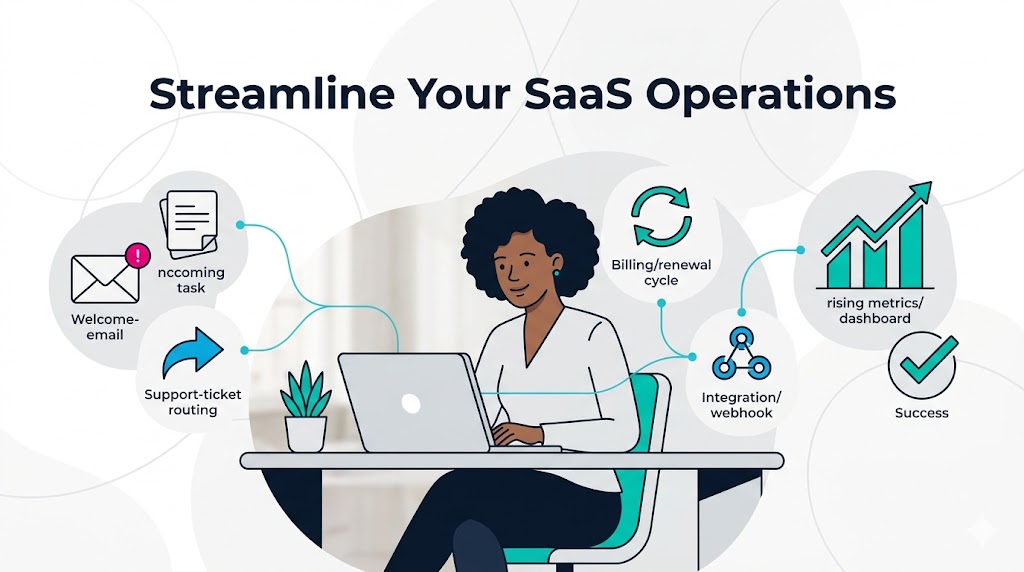
The SaaS Operations Challenge
SaaS companies live and die by operations. Unlike traditional software, where you ship once and move on, SaaS is perpetual: continuous customer onboarding, continuous support, continuous billing, continuous churn management.
That’s operationally intensive. And most SaaS founders aren’t operations people. They’re engineers. Product people. Sales people. Someone has to manage the operational layer. Usually, it’s whoever’s left standing.
A VA removes that burden.
What a SaaS VA Handles
Customer onboarding and activation
What to delegate:
- Welcome emails and first-day communication
- Sending onboarding materials and docs
- Scheduling onboarding calls and demos
- Following up on setup progress
- Sending milestone messages (“Your first 10 users!”)
- Tracking time-to-first-value metrics
Customer support administration
What to delegate:
- Sorting support tickets (routing to engineering, sales, or product)
- Responding to non-technical questions (pricing, features, account questions)
- Escalating bugs and technical issues
- Following up on unresolved tickets
- Managing support metrics and SLAs
Billing and churn management
What to delegate:
- Dunning management (failed payment follow-up)
- Renewal notifications and reminders
- Processing cancellations and understanding churn
- Managing trial-to-paid conversions
- Invoice generation and payment coordination
Metrics and reporting
What to delegate:
- Gathering MRR/ARR and churn metrics
- Compiling customer health metrics
- Preparing monthly reporting dashboards
- Identifying at-risk accounts and flagging them
- Tracking feature requests and usage patterns
Vendor and integration management
What to delegate:
- Managing API integrations and webhooks
- Documentation and support for integrations
- Responding to integration questions
- Maintaining integration status page
The SaaS VA: What It Looks Like in Practice
Pre-VA: The founder or a junior team member is handling customer onboarding, support triage, billing issues, and renewal follow-up. It’s chaotic and inconsistent. Customers wait days for responses. Failed payments aren’t chased. Renewals are ad-hoc.
Post-VA: A systematic process handles all of this. Customers get welcome emails within 2 hours. Onboarding is tracked. Failed payments are followed up within 24 hours. Renewals are triggered automatically.
The net effect: better customer experience, fewer support escalations, higher renewal rates, lower churn.
The Economics
For a SaaS company with £50k MRR and typical SaaS metrics:
Churn rate without VA: 5% MRR
Monthly churn = £2,500
Improved churn with VA (faster response, better onboarding, renewal follow-up): 3% MRR
Monthly churn = £1,500
Monthly improvement = £1,000
Annual improvement: £12,000
VA cost: £34,200/year
Neutral on churn reduction alone. But add:
- Improved onboarding = higher activation rates = higher expansion revenue
- Better customer satisfaction = more referrals
- Founder freed from ops = more time on product and strategy
The ROI is compelling.
Frequently Asked Questions
Can a VA handle technical support?
Not independently. But a VA can triage support (routing technical issues to engineering), respond to non-technical questions, and follow up on resolution and customer satisfaction. That’s 70% of support admin.
What about customer data security?
Use a managed agency VA with data processing agreements. The agency handles data security and compliance. Personal freelancers create compliance risk.
Won’t customers notice they’re talking to a VA, not an engineer?
For onboarding and routine support, customers expect professional support staff, not engineers. For technical issues, they’re routed directly to engineering. Clear communication about who handles what eliminates the problem.
The Bottom Line
SaaS operations don’t scale without systems and people. A VA is the first layer of that infrastructure. They handle the repeatable, high-volume, customer-facing work that defines customer experience.
By the time a SaaS company reaches product-market fit, they need customer ops support. A VA is the best way to add it without hiring a full customer success team.
VAConnect has placed VAs with SaaS companies managing customer onboarding, support, and retention. Most come from SaaS backgrounds and understand the unique needs of the space.
Ready to improve customer experience and reduce churn? Book a call with Karen to discuss the right customer ops structure for your stage.