
The Real Cost of a Bad Virtual Assistant Hire (And How to Avoid It)
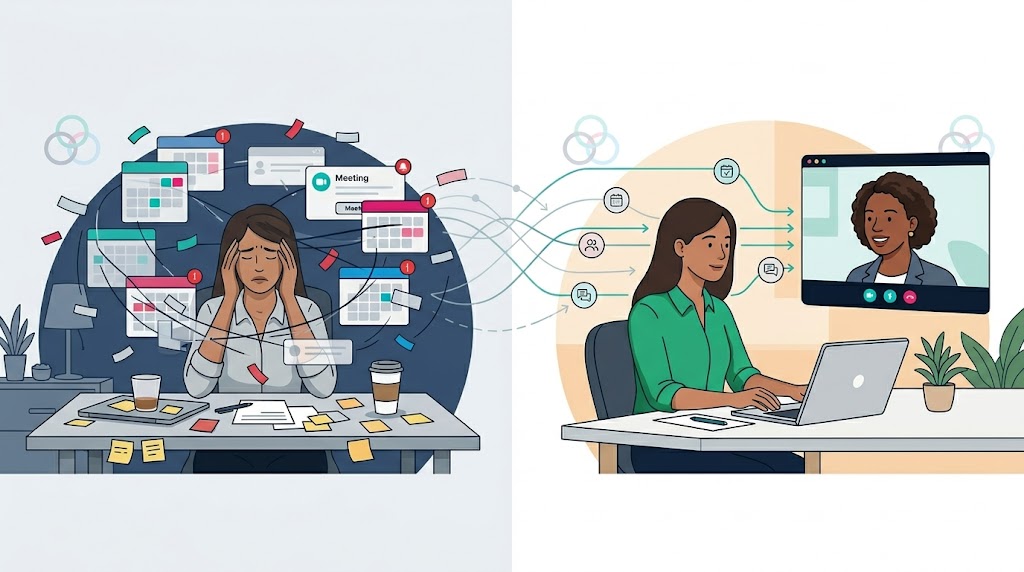
It usually starts on a Tuesday. A founder opens their calendar and finds it sliced into thirty-minute confetti: a “quick sync,” a supplier call that should have been an email, two reschedules from last week, a recruiter chasing a slot, and somewhere in the gaps, the actual work the business depends on. By 4 p.m. nothing on the real to-do list has moved. The day was busy. It was also, in any honest accounting, mostly wasted.
This is the quiet emergency running underneath a lot of small and mid-sized companies right now. Not a lack of talent or ambition, but a lack of anyone whose job is to absorb the coordination chaos — the inbox triage, the scheduling Tetris, the chasing, the follow-ups, the small administrative friction that, compounded across a week, eats the hours that were supposed to go toward growth.
The obvious fix is to hire help. And here’s where it gets expensive in a way most people don’t see coming. Because the wrong help — a cheap freelancer who ghosts, a misaligned offshore hire in an awkward time zone, a generalist who needs everything spelled out twice — doesn’t just fail to solve the problem. It adds a new one. You’re now managing the person you hired to stop you from having to manage everything else.
The gap between businesses that get this right and businesses that don’t has grown wider than most owners realize. This piece is about that gap: what coordination overhead actually costs, why so many virtual assistant hires quietly fail, and what the data says separates a hire that pays for itself from one that bleeds money for months.
The Hidden Tax Nobody Puts on the Balance Sheet
Start with meetings, because they’re the most visible symptom. The average U.S. executive now spends around 23 hours a week in meetings, up from roughly 10 hours in the 1960s, according to figures Axios drew from MIT Sloan Management Review. Since 2020, the time people spend in Microsoft Teams meetings has climbed by 252%, with productivity moving in the opposite direction.
You don’t have to take a consultancy’s word for it. Spend ten minutes reading how working people actually talk about this and the picture sharpens fast. On Blind, a product manager described getting barely two hours of focus time out of an eight-hour day, the rest swallowed by back-to-back calls — to the point it was affecting their mental health. Another manager on the same platform admitted to sitting through 15 to 20 meetings a day. On Hacker News, an engineer’s summary of their week was blunt: there was no time left to actually build anything.
A product manager on Blind put the modern workday plainly: out of eight hours, maybe two are spent on real work. The other six are spent coordinating the work.
Notice what’s actually being described in those threads. It isn’t the meetings themselves — it’s the scaffolding around them. The scheduling. The rescheduling. The “are you free Thursday” Slack messages that hijack a blocked-off lunch. The status updates that exist so someone else doesn’t have to ask. This is coordination overhead, and it’s a tax that never shows up as a line item. You pay it in the most expensive currency a business owner has: their own attention.
For a solo founder or a lean team, the math is brutal. Every hour spent confirming a calendar invite is an hour not spent closing a deal, shipping a product, or thinking. The work doesn’t disappear — it just gets done at 11 p.m., badly, by someone who should have been asleep.
What the Research Actually Says About Remote Productivity
Here’s the part that should reframe the whole conversation. The instinct, when productivity sags, is to blame remote work and drag everyone back to a desk. The evidence doesn’t support that.
Stanford economist Nicholas Bloom has tracked remote and hybrid outcomes since 2012, and his updated 2024 findings showed hybrid schedules producing output equal to or greater than full in-office work across roughly 70% of measured job categories. His widely-cited field experiment at Trip.com found hybrid workers matched the productivity of in-office peers while turnover dropped by 33 to 35%. Remote work, done well, is not the problem.
But — and this is the crucial qualifier — the same research is honest about where distributed work breaks down. A 2024 analysis published in Nature Human Behaviour, tracking 60,000 Microsoft employees, found that fully remote arrangements caused professional networks to silo, with people forming fewer connections outside their immediate team. Microsoft’s 2025 Work Trend Index reported that cross-team collaboration scores drop 17% in fully remote settings, and that new hires take 28% longer to reach full productivity without some structured in-person or coordinated exposure.
Read those two findings together and a pattern emerges. Remote individuals produce focused work brilliantly. What suffers is the connective tissue — coordination, handoffs, the stuff that keeps a distributed operation from fraying. The failure mode of remote work isn’t laziness. It’s coordination breakdown.
Which is exactly the gap a good virtual assistant fills. Not by sitting in more meetings, but by becoming the connective tissue itself — the person who holds the calendar, the inbox, the follow-ups, and the handoffs so the rest of the team can do deep work without the scaffolding collapsing. The research practically describes the job spec.
It’s worth dwelling on why this works at the level of basic cognitive economics. Focused, deep work and reactive coordination work pull against each other; every context switch between them carries a recovery cost, and a day chopped into both produces far less than the sum of its parts. When you hand all the reactive coordination to one dedicated person, you don’t just offload tasks — you stop forcing one brain to do two incompatible jobs at once. The founder gets uninterrupted blocks for the work only they can do. The assistant, meanwhile, isn’t being pulled out of deep work to answer a scheduling ping, because coordination is their work. Both people end up doing what they’re good at, in the mode they’re good at. That’s where the productivity step-change actually comes from. It isn’t magic, and it isn’t more hours. It’s the elimination of the context-switching tax that distributed teams pay without ever measuring it.
Why So Many VA Hires Quietly Fail
If a virtual assistant is the obvious answer, why do so many of these arrangements end in quiet disappointment a few months in?
Because most people hire from the wrong place, for the wrong reason. They go to a giant freelance marketplace, sort by lowest hourly rate, hire the cheapest plausible profile, and hope. The global VA market is enormous and fragmented — independent estimates of the human (non-AI) virtual assistant services market sit somewhere between $3.5 billion and $6.5 billion in 2025–2026 depending on methodology, growing at roughly 23–30% a year. A market that big, growing that fast, is a market full of people who are very good and people who are not, with very little to tell them apart from a profile photo and a star rating.
The result is what I’d call the freelancer roulette. The cheap hire works out maybe a third of the time. The other two-thirds, you get some combination of: missed deadlines, work that needs redoing, a time zone that means every question waits 14 hours for an answer, a sudden disappearance mid-project, or — most insidiously — someone competent who simply needs everything explained in such detail that delegating to them costs more time than doing it yourself.
The true cost of a bad VA hire is rarely the wage. It’s the three months of management, rework, and lost momentum before you admit it isn’t working — and start the search over.
That’s the real number to keep in your head. A bad hire at £8 an hour isn’t an £8-an-hour problem. It’s the recruiting time, the onboarding time, the supervision, the rework, the opportunity cost of the work that didn’t get done, and then the cost of doing the whole search again. Cheap labour that needs constant correction is one of the most expensive things a small business can buy.
This is the gap between an unmanaged freelancer and a managed assistant — someone who has been vetted, trained, and is backed by an organization that’s accountable for the output. The difference isn’t marginal. It’s the difference between delegating a task and acquiring a second job supervising someone.
The Human in the Loop: Why a Person Still Beats Pure Automation
There’s an obvious objection at this point: why hire any human at all in 2026? Can’t AI handle the inbox, draft the emails, book the meetings, write the posts?
Some of it, yes. And anyone telling you to ignore AI tools is giving you bad advice. But the businesses winning right now aren’t choosing between a human and AI. They’re putting a capable human in charge of the AI. The industry data backs this directly: virtual assistants who integrate AI tools into their workflows in 2026 are commanding higher rates and delivering more, precisely because AI is making skilled assistants more valuable, not redundant.
Here’s why the human in the loop matters, and it comes down to judgment. AI is extraordinary at generating the first 80% of a task and confidently wrong about the last 20% — the 20% that involves context, relationships, tone, and the unspoken rules of how your business actually operates. An AI can draft a reply to an angry client in four seconds. Only a person who understands the relationship knows whether that client needs a firm reply, a warm one, a phone call instead of an email, or a quiet heads-up to you before anyone responds at all.
The same is true of the work that’s supposed to sound like you. Marketing copy, client communication, the personal note that goes out under your name — when those read like they came out of a generator, people can tell, and it costs you trust. A human assistant who knows your voice can use AI to move faster while keeping the output recognizably, reassuringly human. Pure automation flattens everything into the same beige register. A person in the loop keeps it sounding like a company run by people who care.
There’s also the simple matter of accountability. When an AI tool makes a mistake, there’s no one to own it, learn from it, and make sure it doesn’t happen twice. A good assistant carries the context forward. They remember that this supplier is always late, that this client hates Monday calls, that you prefer to review anything client-facing before it goes out. That accumulated judgment is something no current tool replicates — and it’s the entire point of delegation. You’re not buying keystrokes. You’re buying someone who thinks.
So the model that actually works is neither “do it all yourself with AI” nor “hire a warm body to copy-paste.” It’s a skilled person, equipped with modern tools, who applies human judgment to the parts that need it. Automation handles the volume. The human handles the meaning.
The South African Advantage
This is where geography stops being a detail and becomes the whole argument. Because once you accept that the answer is a skilled, managed human assistant, the next question is: from where? And for businesses serving the UK and Europe, the answer that keeps surfacing is South Africa — a market that’s smaller and more specialized than the offshore giants, and which has built a reputation on fit rather than just price.
Start with the clock, because it’s the thing that quietly destroys most offshore arrangements. South Africa runs on UTC+2, putting it roughly one to two hours ahead of the UK depending on British daylight saving. That’s not “some overlap.” That’s a near-total working-day overlap. When a London founder messages their assistant at 9 a.m., the assistant is already at their desk and has been for an hour. There’s no waiting until tomorrow for an answer, no async ping-pong stretched across half a day, none of the “scheduling gymnastics” that defines work with assistants twelve time zones away. The assistant is, functionally, in the next room.
South Africa sits one to two hours ahead of the UK. For a British business, that means a virtual assistant who is online when you are — not one you brief at night and hear back from in the morning.
Then there’s language and culture, and this is where the fit becomes obvious. South Africa’s business language is English, spoken with a neutral accent that British clients, partners, and suppliers understand without friction. More than that, there’s a deep cultural familiarity with British and European business norms — the etiquette, the formality, the rhythm of how things get done. A UK marketing manager, in a client review cited by VAConnect, described the contrast bluntly: where previous offshore assistants meant constant scheduling friction and cultural misreads, their South African assistant might as well have been sitting in the next office. That’s the standard worth holding out for — not just someone who can do the task, but someone who can represent your business to your customers without anyone noticing the work was delegated at all.
It’s worth being clear-eyed about the cost side too, because “cheaper” is where these conversations usually start and where they often go wrong. The point isn’t rock-bottom rates. The Philippines and India dominate the global VA workforce on sheer volume — Africa accounts for only about 7% of VA professionals worldwide. South Africa is the smaller, more premium proposition, and deliberately so. The pitch is quality-per-pound, not the lowest possible number. By VAConnect’s own figures, a full-time dedicated South African VA starts around $1,088 a month, roughly £860, against £2,900-plus for a UK-based PA before you add employer National Insurance, pension contributions, and office costs. The saving is real and significant — but the reason it matters is that you’re not trading quality to get it. You’re paying less for work that holds up to British standards, delivered during British working hours, in fluent business English. That combination is rarer than the raw market size suggests.
What “Managed” Actually Means
There’s a meaningful difference between hiring a South African freelancer off a marketplace and engaging a managed agency, and it’s the difference that determines whether your hire succeeds. The whole failure mode described earlier — the roulette, the ghosting, the rework — exists because the individual freelancer is unmanaged. Nobody vetted them. Nobody trained them. Nobody is accountable if it goes wrong except you, after the fact.
A managed model inverts that. Take VAConnect, which has operated in this space since 2008 and built its operation specifically around removing the risk from the equation. The assistants are recruited through a dedicated pipeline, trained through an internal academy the company calls VAVarsity, and held accountable through the agency’s own performance and monitoring systems. Critically, they arrive already fluent in the platforms UK businesses run on — Xero, HubSpot, Slack, Asana, Microsoft 365, Google Workspace — so there’s no weeks-long onboarding lag while someone learns your stack. You also skip the entire employment-admin burden: no PAYE, no employer NI, no pension auto-enrolment paperwork. You contract for output; the agency handles the infrastructure behind it.
That structure maps almost exactly onto what the research said was missing. Remember Microsoft’s finding that new hires in unstructured remote settings take 28% longer to ramp? A managed, pre-trained assistant collapses that ramp. Remember the Nature finding about siloing and coordination breakdown? A managed assistant whose entire role is coordination is the antidote, with an agency standing behind continuity so the function doesn’t vanish if one person is sick or moves on.
This is also the difference that protects the relationship over time. A freelancer is a single point of failure. A managed agency is a system with redundancy, oversight, and a vested interest in keeping the engagement working — because their business depends on retention, not on a one-off transaction. When people describe the dedicated, subscription VA model as the fastest-growing segment of the market, now over half of global VA revenue, this is why. Businesses learned the hard way that continuity and accountability are worth more than the lowest hourly rate.
How to Avoid the Bad Hire: A Practical Checklist
So how do you actually stay out of the trap? After looking at where these arrangements fail, the warning signs are consistent. Use this as a filter before you commit to anyone:
- Time zone overlap. If your working hours and theirs don’t substantially overlap, every question becomes a 12-to-24-hour round trip. Demand real overlap, not “we’re flexible.”
- Vetting you can see. Ask how the person was assessed. “We interviewed them” is not vetting. Look for skills testing, verification, and a track record the provider stands behind.
- A named accountability structure. With a lone freelancer, the accountability is you. With a managed provider, there should be a clear line of recourse and continuity if something goes wrong.
- Tool fluency on day one. If onboarding means teaching someone your entire software stack from scratch, you’ve bought a training project, not an assistant.
- Communication fit. Get on a call before committing. If the language and cultural fit aren’t effortless in a 20-minute conversation, they won’t be effortless across a hundred client emails.
- Continuity guarantees. What happens if your assistant is ill, on leave, or leaves entirely? An individual freelancer has no answer. A managed agency should.
Run a candidate through that list and most of the cheap-marketplace risk evaporates. The hires that fail almost always fail on two or three of those points at once — usually time zone, vetting, and continuity. The hires that succeed tend to clear all six, which is not a coincidence so much as a description of what “managed” is supposed to mean.
The Competitive Gap Is Wider Than It Looks
Step back and the picture is genuinely striking. On one side you have businesses still personally absorbing coordination chaos — founders spending two productive hours in an eight-hour day, the rest lost to scheduling and admin, doing the real work after dark. On the other side you have businesses that handed that entire category of work to a vetted, managed, time-zone-aligned human equipped with modern AI tools, and reclaimed their days.
These two groups are no longer playing the same game. The research is clear that remote work itself isn’t the dividing line — both groups can be remote. The dividing line is coordination. One group has solved it and bought back the most valuable hours of the week. The other is still paying the hidden tax, every Tuesday, in attention they can’t get back.
What’s surprising isn’t that a gap exists. It’s how large it’s become, and how invisible it stays on a balance sheet. There’s no line item for “hours the founder spent rescheduling,” no expense code for “deals not closed because nobody had time to follow up.” The cost is real, it’s enormous, and most of the businesses paying it don’t even know the meter is running.
The companies that figured this out didn’t do it by working harder or by replacing people with software. They did it by putting the right human in the loop — someone whose entire job is to make the coordination disappear — and by sourcing that human from a place where the time zone, the language, the culture, and the quality all line up at once. For UK and European businesses, that increasingly points in one direction. The gap is the warning. Closing it is the opportunity.
DIY vs. Generic Freelancers vs. a Managed VA: The Productivity Difference
| Dimension | DIY Coordination | Generic Freelancer | Managed VA (e.g. VAConnect) |
|---|---|---|---|
| Who absorbs the admin | The founder/team, on top of their real job | An individual you must direct closely | A vetted, trained assistant whose whole role this is |
| Time zone fit (UK) | N/A — it’s your own time | Often 8–13 hrs off; answers wait overnight | ~1–2 hrs ahead of the UK; near-full working-day overlap |
| Vetting & skills | None — you do whatever you can | Profile photo and star ratings | Tested, verified, trained through an internal academy |
| Onboarding time | Zero, but zero relief | Weeks teaching your tools and norms | Arrives fluent in Xero, HubSpot, Slack, Asana, M365 |
| Ramp to full productivity | You never get capacity back | Slow; research shows up to ~28% longer when unstructured | Fast — pre-trained, structured, supported |
| Accountability if it fails | You eat the loss | You, after months of rework | The agency — recourse, oversight, and continuity |
| Continuity (illness/leave/exit) | Single point of failure (you) | Single point of failure (them) | Backed by an agency with cover and redundancy |
| Human judgment + AI | Stretched thin, inconsistent | Variable; often pure manual labour | Skilled human applying judgment, AI-equipped for volume |
| True cost | Lost hours, lost deals, burnout | Wage plus rework, supervision, re-hiring | ~£860/mo full-time vs £2,900+ UK PA, with output you can trust |
| Net effect on your week | The meter keeps running | Sometimes helps, often a second job | Coordination disappears; your hours come back |
Figures attributed to VAConnect reflect the company’s own published pricing and claims; market-size and productivity statistics are drawn from the cited third-party research. Sources: Axios/MIT Sloan; Apollo Technical citing Bloom (2024), Nature Human Behaviour (2024) and Microsoft Work Trend Index (2025); Employee-Monitoring meta-analysis; Future Market Insights; VA Masters; Teamblind; and VAConnect.